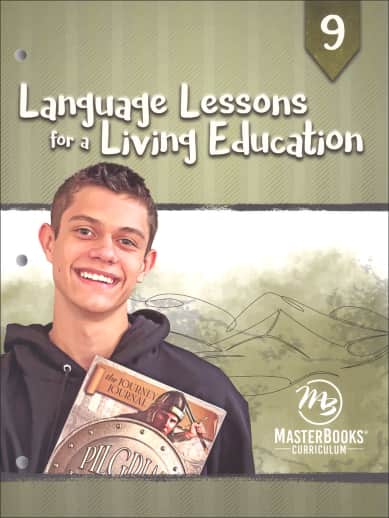

This distinctive course intrigues me. I found myself digging through all the assignments but also impatient to learn what the future high school courses from Master Books would bring. Many aspects of this high school course will ring familiar if you’ve previously used their language arts. Yet, this course adds rigor and additional depth to create a one credit English course. You’ll find a unique combination of Biblical principles with modern application, step-by-step directions, and lots of ways to provide your student with feedback on skills.
Unique from other 9th grade ELA courses, this one adds a focus on worldview analysis; picture, hymn, and scripture (ESV) studies; sketching assignments; and oral presentations. This provides a broader scope of communication than some programs, serving to lay a foundation upon which the rest of high school language arts will be built. This course also emphasizes interpersonal communication from a Biblical perspective: such as active listening, nonverbal skills, interviewing, and converting an essay into an oral presentation. In addition, the overall design significantly puts the student in the driver’s seat. Your student can rise to this challenge if they are reading at grade level, able to write an essay of 3 well-written paragraphs, utilize proper grammar, and is able to recognize abstract ideas.
Weekly, students will read through and respond to questions on a stalwart classic (The Pilgrim’s Progress: the Journey Journal) add readings of their choice, with a weekly patten of 5 daily exercises (vocabulary, grammar, communication, worldview/literary analysis, and review). This course does assume that you’ll be adding independent reading for your student. Two suggested reading lists are provided (one for a grade 7-8 reading level and one for grades 9-12 reading level). Most are nonfiction books developed by the publisher. Personally, I would also select from one of the readily available Charlotte Mason fiction reading lists to round out the genres. Writing assignments include picture studies, sketching, 5 essays and 2 oral presentations. Essay styles include personal narrative, descriptive, expository, critical, and persuasive. For each of these modes, study sheets provide steps and tips.
There are two required materials: Student text (with teacher’s resources in the back) and The Pilgrim’s Progress: The Journey Journal (a unique combination of the complete original written by John Bunyan, with illustrations, worldview notes, space for student notes, character analyses/studies, theological insights, with a forward by Ken Ham). Pilgrim’s Progress is a spine for this course, utilized every week. I think some families may ask, “Isn’t that a lot of focus on just one book?” It certainly is a commitment. Yet this book, originally written in 1678, is the second most famous English book ever printed. As an allegory for successfully traversing the Christian life and incorporating a multitude of genres, this novel is a solid choice for deep analysis and application.
The 110 pages of teaching resources include writing templates and outlines for assignments, spelling words (prefixes, suffix and root words and vocabulary lists), grammar study sheets, and texting guidelines (yes, you read that correctly). Teachers are provided assessments, answers for daily assignments, and detailed rubrics for each of the 6 writing assignments. Assessments happen weekly. Students will also need these items: additional reading of your choice, index cards, colored pencils (for some small drawing and coloring assignments), notebook, dictionary, and a Bible. Includes 180 lessons and 491 pages that are 3-hole punched, perforated. Should qualify for 1 credit. ~ Ruth