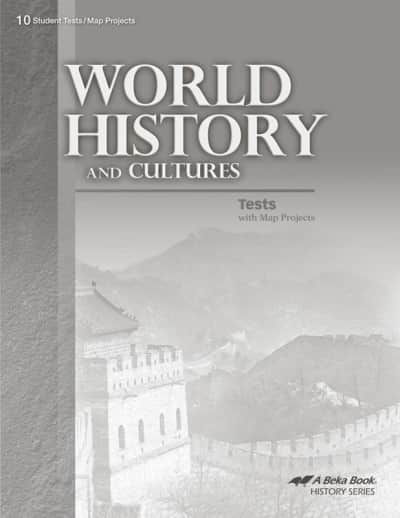
Includes 12 tests consisting of essay questions, multiple choice, true/false, matching, and short answer. There are also 2 nine-week exams, as well as a semester and final exam. Map projects include labeling political and physical features on maps that correspond with the World History and Cultures textbook. Answers are sold separately.
Abeka World History and Cultures in Christian Perspective Student Test and Map Book
SKU
012819
ISBN
9780000115744
Grade 10
These icons are designed to help you quickly understand and learn important information about our products.
Teaching Method
Traditional
Teacher-centered curriculum commonly used in classrooms that may include a text, teacher manual, tests, etc.
Charlotte Mason
A methodology based on the work of a 19th century educator who maintained that children learn best from literature (Living Books), not textbooks.
Classical
A methodology based on the Latin Trivium (three stages of learning), including the grammar stage (memorization and facts), logic stage (critical thinking), and rhetoric stage (developing/defending ideas).
Unit Study
A thematic or topical approach centered around one topic that integrates multiple subject areas.
Montessori (Discovery)
A methodology based on the work of a 20th century educator that emphasizes student and sensory-driven discovery learning and real-life applications.
Other
Other methodologies
Religious Content
Secular
Contains content contrary to common Christian beliefs (i.e. evolution).
Neutral
Avoids religious or theoretical topics or presents multiple viewpoints without preference.
Christian/Religious
Faith-based or including instructional religious content.
Learning Modality
Auditory
Learns through listening, talking out loud or reading out loud.
Visual
Learns through seeing, prefers written instructions and visual materials.
Kinesthetic/Tactile (Hands-On)
Learns through moving, doing and touching.
Multi-Sensory
Curriculum that employ a variety of activities/components.
Presentation
Sequential
Curriculum progresses through well-defined learning objectives. Emphasizes mastery before moving to the next topic.
Spiral
Topics and concepts are repeated from level to level, adding more depth at each pass and connecting with review.
Conceptual/Topical
Focus is on the “why,” often with a unifying concept as well as specific skills; coverage may be broader.
Teacher Involvement
Low Teacher Involvement
Student-led materials; parent acts as a facilitator.
Medium Teacher Involvement
A mix of teacher-led time and independent student work.
High Teacher Involvement
Teacher-led lessons; may utilize discussions, hands-on activities and working together.
Additional Materials Required
No other materials needed
Everything you need is included.
Other Materials Required
There are additional required resources that are a separate purchase.
Other Materials Optional
There are additional resources mentioned or recommended but are not absolutely necessary.
Consumable
Consumable
Designed to be written in; not reusable.
Non-Consumable
Not designed to be written in; reusable.
Our Price
$13.45 Description
Publisher's Description of Abeka World History and Cultures in Christian Perspective Student Test and Map Book
Knowing the world's history and geography will contribute to a more mature understanding of the world and appreciation for God's providence in accomplishing His purposes. These prepared tests help you measure your teen's learning and understanding. In addition, as he labels and studies the physical features and countries and capitals of the world in the map projects, he will learn the places of history and world events.
The tests are correlated with the text World History and Cultures in Christian Perspective, 3rd ed.; World History and Cultures Quizzes; and World History and Cultures in Christian Perspective Teacher Edition, which includes the curriculum/lesson plans and "pop" reading quizzes. Answers and grading guidance for the test and map project book are sold separately in World History and Cultures Test/Map Project Key. Grade 10.
Product Features
* Essay questions develop critical thinking skills as your teen must explain historical details and articulate their significance to the present or identify major influences or consequences. A biblical worldview will be strengthened as he discusses false philosophies and their effects.
* A variety of question formats on the tests such as multiple choice, modified true/false, matching, and short answer holds your teen's interest and verifies whether he understands a concept, no matter how it is presented.
* Testing every three weeks (for a total of 12 tests) provides vital reinforcement of learning and an opportunity for your evaluation of your teen's comprehension.
* Two nine-week exams and semester and final exams further reinforce the concepts learned throughout the year.
* Since each test clearly specifies the sections covered, adjusting a test to your schedule is easy.
* The 8 map projects give your teen valuable hands-on practice in identifying the places of world history. Maps incorporate physical (e.g., rivers, mountain chains, deserts) and political (countries and capitals) features of the Middle East, Asia, Africa, Europe, North America, South America, Australia and New Zealand, and the entire world.
* The gray-scale maps in the map projects correspond to the colored maps in the textbook, preventing confusion and frustration in identifying the locations.
Category Description for World History and Cultures
From a biblical perspective, students gain an overview of world history and cultures from the beginning of civilizations through the twentieth century. Broken down into six units, students study Asia & Africa, Europe, the Middle Ages, the Reformation Era, the Age of Ideas, and the Twentieth Century.
Details
| Product Format: | Paperback |
|---|---|
| Grade: | 10 |
| Brand: | Abeka |
| ISBN: | 9780000115744 |
| Length in Inches: | 11 |
| Width in Inches: | 8.5 |
| Height in Inches: | 0.25 |
| Weight in Pounds: | 0.45 |
Videos
Reviews