These icons are designed to help you quickly understand and learn important information about our products.
Teaching Method
Traditional
Teacher-centered curriculum commonly used in classrooms that may include a text, teacher manual, tests, etc.
Charlotte Mason
A methodology based on the work of a 19th century educator who maintained that children learn best from literature (Living Books), not textbooks.
Classical
A methodology based on the Latin Trivium (three stages of learning), including the grammar stage (memorization and facts), logic stage (critical thinking), and rhetoric stage (developing/defending ideas).
Unit Study
A thematic or topical approach centered around one topic that integrates multiple subject areas.
Montessori (Discovery)
A methodology based on the work of a 20th century educator that emphasizes student and sensory-driven discovery learning and real-life applications.
Other
Other methodologies
Religious Content
Secular
Contains content contrary to common Christian beliefs (i.e. evolution).
Neutral
Avoids religious or theoretical topics or presents multiple viewpoints without preference.
Christian/Religious
Faith-based or including instructional religious content.
Learning Modality
Auditory
Learns through listening, talking out loud or reading out loud.
Visual
Learns through seeing, prefers written instructions and visual materials.
Kinesthetic/Tactile (Hands-On)
Learns through moving, doing and touching.
Multi-Sensory
Curriculum that employ a variety of activities/components.
Presentation
Sequential
Curriculum progresses through well-defined learning objectives. Emphasizes mastery before moving to the next topic.
Spiral
Topics and concepts are repeated from level to level, adding more depth at each pass and connecting with review.
Conceptual/Topical
Focus is on the “why,” often with a unifying concept as well as specific skills; coverage may be broader.
Teacher Involvement
Low Teacher Involvement
Student-led materials; parent acts as a facilitator.
Medium Teacher Involvement
A mix of teacher-led time and independent student work.
High Teacher Involvement
Teacher-led lessons; may utilize discussions, hands-on activities and working together.
Additional Materials Required
No other materials needed
Everything you need is included.
Other Materials Required
There are additional required resources that are a separate purchase.
Other Materials Optional
There are additional resources mentioned or recommended but are not absolutely necessary.
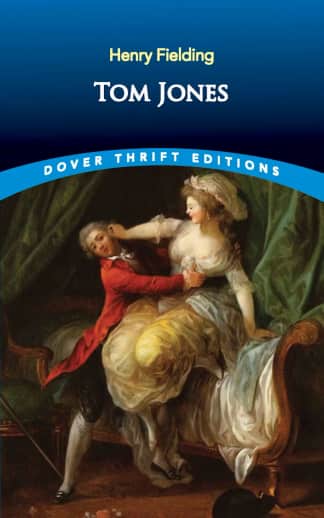
Henry Fielding’s masterpiece from 1749 is an adventure of
epic proportions. Tom was a foundling who became a hero in his own epic tale full
of passion and verve. There is some bawdy humor for parents to be aware of, as
Tom encounters characters from all walks of life, including thieves and
prostitutes.
Henry Fielding (1707–1754) was known for his satirical
writing style. He wrote plays and novels, and as a barrister, he took the side
of the government against the Jacobite Rebellion and wrote pamphlets. As large
as this book is, the font is a tad small in my estimation.
Dover thrift editions are an affordable choice for today’s
readers of unabridged classics. 757pp. ~Sara
Publisher's Description of Tom Jones (Dover Thrift Edition)
When Squire Allworthy returns from London to discover a sleeping baby of unknown parentage in his bed, Tom Jones makes its rollicking start toward a picaresque journey across eighteenth-century England. Its foundling hero, having grown to young manhood and developed a passion for the girl next door, finds himself banished from the squire's country estate by the contrivance of a romantic rival. Lusty, good-hearted Tom is thus compelled to seek his fortune far from home and, ultimately, in the company of soldiers, thieves, whores, and other vividly drawn characters.
One of the first and most influential novels, Tom Jones was an instant sensation upon its publication in 1749. Henry Fielding's masterpiece of wit, written in a mock-epic style that parallels Tom's adventures with episodes from classical mythology, offers an exuberant panorama of eighteenth-century life. Beloved for its bawdy humor and adroit social commentary, the novel has been adapted many times for stage and screen and ranks among English literature's greatest comedies.