
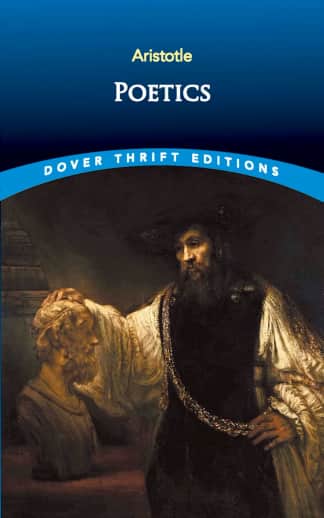
Written by Aristotle circa 330 B.C., Poetics is considered the first attempt at literary analysis. Aristotle looks at epic poetry, tragedy, and comedy and the media through which they are passed on (e.g. various musical instruments). For students who have read the Odyssey and the Iliad, this small book offers an interesting perspective on their production and perpetuation. 60pp. ~Sara
Poetics (Dover Thrift Edition)
SKU
012346
ISBN
9780486295770
Grade 9-AD
These icons are designed to help you quickly understand and learn important information about our products.
Teaching Method
Traditional
Teacher-centered curriculum commonly used in classrooms that may include a text, teacher manual, tests, etc.
Charlotte Mason
A methodology based on the work of a 19th century educator who maintained that children learn best from literature (Living Books), not textbooks.
Classical
A methodology based on the Latin Trivium (three stages of learning), including the grammar stage (memorization and facts), logic stage (critical thinking), and rhetoric stage (developing/defending ideas).
Unit Study
A thematic or topical approach centered around one topic that integrates multiple subject areas.
Montessori (Discovery)
A methodology based on the work of a 20th century educator that emphasizes student and sensory-driven discovery learning and real-life applications.
Other
Other methodologies
Religious Content
Secular
Contains content contrary to common Christian beliefs (i.e. evolution).
Neutral
Avoids religious or theoretical topics or presents multiple viewpoints without preference.
Christian/Religious
Faith-based or including instructional religious content.
Learning Modality
Auditory
Learns through listening, talking out loud or reading out loud.
Visual
Learns through seeing, prefers written instructions and visual materials.
Kinesthetic/Tactile (Hands-On)
Learns through moving, doing and touching.
Multi-Sensory
Curriculum that employ a variety of activities/components.
Presentation
Sequential
Curriculum progresses through well-defined learning objectives. Emphasizes mastery before moving to the next topic.
Spiral
Topics and concepts are repeated from level to level, adding more depth at each pass and connecting with review.
Conceptual/Topical
Focus is on the “why,” often with a unifying concept as well as specific skills; coverage may be broader.
Teacher Involvement
Low Teacher Involvement
Student-led materials; parent acts as a facilitator.
Medium Teacher Involvement
A mix of teacher-led time and independent student work.
High Teacher Involvement
Teacher-led lessons; may utilize discussions, hands-on activities and working together.
Additional Materials Required
No other materials needed
Everything you need is included.
Other Materials Required
There are additional required resources that are a separate purchase.
Other Materials Optional
There are additional resources mentioned or recommended but are not absolutely necessary.
Consumable
Consumable
Designed to be written in; not reusable.
Non-Consumable
Not designed to be written in; reusable.
Our Price
$4.50 $4.50 $3.75
Rainbow Savings: $0.75
Product Overview
- Written by Aristotle circa 330 B.C.
- Discusses Homer’s Odyssey and the Iliad
- Considers literature of his time and how it is passed on
Description
Publisher's Description of Poetics (Dover Thrift Edition)
Among the most influential books in Western civilization, Aristotle's Poetics is really a treatise on fine art. In it are mentioned not only epic and dithyrambic poetry, but tragedy, comedy, and flute and lyre playing. Aristotle's conception of tragedy, i.e. the depiction of a heroic action that arouses pity and fear in the spectators and brings about a catharsis of those emotions, has helped perpetuate the Greek ideal of drama to the present day. Similarly, his dictums concerning unity of time and place, the necessity for a play to have a beginning, middle, and end, the idea of the tragic flaw and other concepts have had enormous influence down through the ages.
Throughout the work, Aristotle reveals not only a great intellect analyzing the nature of poetry, music, and drama, but also a down-to-earth understanding of the practical problems facing the poet and playwright. Now, in this inexpensive edition of the Poetics, readers can enjoy the seminal insights of one of the greatest minds in human history as he sets about laying the foundations of critical thought about the arts.
Throughout the work, Aristotle reveals not only a great intellect analyzing the nature of poetry, music, and drama, but also a down-to-earth understanding of the practical problems facing the poet and playwright. Now, in this inexpensive edition of the Poetics, readers can enjoy the seminal insights of one of the greatest minds in human history as he sets about laying the foundations of critical thought about the arts.
Category Description for Dover Thrift Editions
Complete and unabridged versions of great literature with no "frills" to save you money!
Details
| Product Format: | Paperback Book |
|---|---|
| Grades: | 9-AD |
| Brand: | Dover Publications |
| Author: | Aristotle |
| ISBN: | 9780486295770 |
| Length in Inches: | 8 |
| Width in Inches: | 5 |
| Height in Inches: | 0.125 |
| Weight in Pounds: | 0.1 |
Videos
Reviews