These icons are designed to help you quickly understand and learn important information about our products.
Teaching Method
Traditional
Teacher-centered curriculum commonly used in classrooms that may include a text, teacher manual, tests, etc.
Charlotte Mason
A methodology based on the work of a 19th century educator who maintained that children learn best from literature (Living Books), not textbooks.
Classical
A methodology based on the Latin Trivium (three stages of learning), including the grammar stage (memorization and facts), logic stage (critical thinking), and rhetoric stage (developing/defending ideas).
Unit Study
A thematic or topical approach centered around one topic that integrates multiple subject areas.
Montessori (Discovery)
A methodology based on the work of a 20th century educator that emphasizes student and sensory-driven discovery learning and real-life applications.
Other
Other methodologies
Religious Content
Secular
Contains content contrary to common Christian beliefs (i.e. evolution).
Neutral
Avoids religious or theoretical topics or presents multiple viewpoints without preference.
Christian/Religious
Faith-based or including instructional religious content.
Learning Modality
Auditory
Learns through listening, talking out loud or reading out loud.
Visual
Learns through seeing, prefers written instructions and visual materials.
Kinesthetic/Tactile (Hands-On)
Learns through moving, doing and touching.
Multi-Sensory
Curriculum that employ a variety of activities/components.
Presentation
Sequential
Curriculum progresses through well-defined learning objectives. Emphasizes mastery before moving to the next topic.
Spiral
Topics and concepts are repeated from level to level, adding more depth at each pass and connecting with review.
Conceptual/Topical
Focus is on the “why,” often with a unifying concept as well as specific skills; coverage may be broader.
Teacher Involvement
Low Teacher Involvement
Student-led materials; parent acts as a facilitator.
Medium Teacher Involvement
A mix of teacher-led time and independent student work.
High Teacher Involvement
Teacher-led lessons; may utilize discussions, hands-on activities and working together.
Additional Materials Required
No other materials needed
Everything you need is included.
Other Materials Required
There are additional required resources that are a separate purchase.
Other Materials Optional
There are additional resources mentioned or recommended but are not absolutely necessary.
The goal in Book Three is for students to be able to read original Latin texts with little help. The readings offer students the opportunity to read real Roman literature while they are learning the language, rather than the invented stories most beginners "cut their teeth" on before they are allowed to jump into the classics. To aid in comprehension, a list of characters mentioned in the passage and a glossary of words that have not been introduced yet in the lesson vocabulary are also included. Reading comprehension questions, which often include both Latin questions (to be answered in Latin) and English questions (to be answered in English) follow the readings and reinforce vocabulary. Additional segments which crop up in most lessons include Colloquāmur, Culture Corners and Derivative Detective.
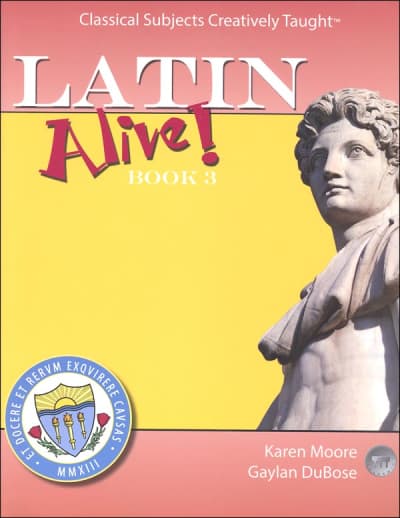
Publisher's Description of Latin Alive! Book 3 Student Edition
Latin Alive! Book 3 (Student Edition) includes lessons on Roman culture, myths, and history, as well as Latin readings and exercises that will prepare students for the National Latin Exam and an Advanced Placement Latin course. It also features original Latin writings.
Features:
16 biweekly chapters, each beginning with the Latin motto of a college or university, divided into 3 units.
Every chapter includes at least one reading, with an explanation of the phrases in the reading, a glossary, and comprehension questions.
Each unit ends with a unit reading (longer than the chapter readings) that includes some history on the piece, information on Latin literature, and a multiple-choice question section to check comprehension.
The last unit includes readings and lessons on original Latin poetry and historical information about Latin poets.
There are several appendices, including a pronunciation guide, reference charts, a guide to abbreviations, a list of noun cases and their common uses, and worksheets on parsing, declining, and conjugating.
Grammar includes more in-depth study of the subjunctive mood, irregular nouns, noun and verb reviews, the gerund and gerundive, impersonal verbs, conditional statements, and a study of different kinds of clauses (purpose, result, doubting, fearing).
The Latin Alive! Book 3 Teacher's Edition includes the entire content of the student edition as well as translations, extensive teacher's notes, and unit test reviews and unit tests.
Still offering the previous editions of Latin Alive! (while supplies last), the Engaging and rigorous course teaches Latin incrementally while demonstrating the relevance of Latin today. It is a user-friendly program, even for those with no prior background in Latin. The course draws upon the successful Wheelock's Latin methodology, a systematic parts-to-whole approach. Latin Alive! prepares students for the National Latin and AP Latin exams.
Product components are as follows:
The Student Text contains complete instruction, exercises, and readings to translate
The Teacher Edition has student pages with answers, teaching suggestions, reproducible unit tests (with answers) and worksheets, and translations
Audio & Video (via Streaming or DVD/CD) gives methodical instruction for each lesson and unit readings, growing a student’s confidence in the ability to speak and translate Latin well
The Latin Alive Reader (for grades 10+) provides readings of various length and complexity from several literary genres. Grammatical notes, comprehension questions and writing prompts are included
The Reader Teacher Book includes the student text with answers, more extensive explanations, and helps
**Please Note: Previous editions are not compatible with revised editions