
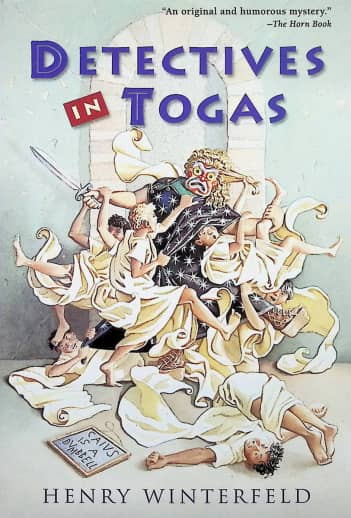
This fictitious tale is set in Ancient Rome. Caius, Rufus, Antonius, Mucius, Flavius, Julius, and Publius are students in the finest grammar school in all of Rome. Only wealthy patricians can afford to send their sons to this school, so these seven are the entire class. One day Cauis begins to irritate Rufus, and Rufus retaliates by writing "Cauis is a dumbbell" on his writing tablet and hanging it up at the front of the classroom. This leads to a scuffle, which their teacher soon dissolves. Rufus is sent home, and the boys are subdued. The next day arrives with a string of mysteries. Neither Rufus nor Cauis come to school, but an even bigger problem is that the teacher isn't there! This has never happened before. The remaining students find him tied up in his closet, his house ransacked. It appears that the burglar took only some mathematic books, unimportant pictures, and Rufus's writing tablet. When the boys go to visit Rufus, they find the words "Cauis is a dumbbell" written in red paint on the temple wall. Rufus claims he is innocent and his handwriting was forged, but his classmates discover that he was out all night long, with no good alibi. Now Rufus has been arrested, and it's up to his six friends to find out who is behind all the mysteries before Rufus is punished for desecrating the temple!
Detectives in Togas
SKU
011762
ISBN
9780152162801
Grade 3-6
These icons are designed to help you quickly understand and learn important information about our products.
Teaching Method
Traditional
Teacher-centered curriculum commonly used in classrooms that may include a text, teacher manual, tests, etc.
Charlotte Mason
A methodology based on the work of a 19th century educator who maintained that children learn best from literature (Living Books), not textbooks.
Classical
A methodology based on the Latin Trivium (three stages of learning), including the grammar stage (memorization and facts), logic stage (critical thinking), and rhetoric stage (developing/defending ideas).
Unit Study
A thematic or topical approach centered around one topic that integrates multiple subject areas.
Montessori (Discovery)
A methodology based on the work of a 20th century educator that emphasizes student and sensory-driven discovery learning and real-life applications.
Other
Other methodologies
Religious Content
Secular
Contains content contrary to common Christian beliefs (i.e. evolution).
Neutral
Avoids religious or theoretical topics or presents multiple viewpoints without preference.
Christian/Religious
Faith-based or including instructional religious content.
Learning Modality
Auditory
Learns through listening, talking out loud or reading out loud.
Visual
Learns through seeing, prefers written instructions and visual materials.
Kinesthetic/Tactile (Hands-On)
Learns through moving, doing and touching.
Multi-Sensory
Curriculum that employ a variety of activities/components.
Presentation
Sequential
Curriculum progresses through well-defined learning objectives. Emphasizes mastery before moving to the next topic.
Spiral
Topics and concepts are repeated from level to level, adding more depth at each pass and connecting with review.
Conceptual/Topical
Focus is on the “why,” often with a unifying concept as well as specific skills; coverage may be broader.
Teacher Involvement
Low Teacher Involvement
Student-led materials; parent acts as a facilitator.
Medium Teacher Involvement
A mix of teacher-led time and independent student work.
High Teacher Involvement
Teacher-led lessons; may utilize discussions, hands-on activities and working together.
Additional Materials Required
No other materials needed
Everything you need is included.
Other Materials Required
There are additional required resources that are a separate purchase.
Other Materials Optional
There are additional resources mentioned or recommended but are not absolutely necessary.
Consumable
Consumable
Designed to be written in; not reusable.
Non-Consumable
Not designed to be written in; reusable.
Our Price
$9.99 $9.99 $7.50
Rainbow Savings: $2.49
Description
Publisher's Description of Detectives in Togas
Yes, Rufus wrote CAIUS IS A DUMBBELL on his tablet at school, but no, he did not break into the schoolroom, did not tie up his teacher, and certainly did not paint his slur about Caius on the Temple of Minerva (even if it is in Rufus's own handwriting). Rufus is doomed unless his six classmates can find out who is really responsible. Every hour seems to bring a new, confusing clue . . . until the boys finally stumble upon someone who is not what he appears to be.
Category Description for Veritas Press Elementary History (Grades 2-6)
Veritas Elementary History offers five different time periods, with each aimed at a different grade level beginning in grade 2 and designed to take one school year. There are a few components to this series that are offered in a kit or sold separately. The Teacher Manual is split into 32 weekly lessons. Each lesson has a worksheet, a project or two, and a test. The color-coded History Cards are an essential element of the program and contain many interesting facts from the various time periods. If the cards also relate to Bible history, they have another color and another number. Songs on the Audio CD are nicely done and designed as a type of auditory timeline.
Details
| Product Format: | Softcover Book |
|---|---|
| Grades: | 3-6 |
| Brand: | Harcourt, Brace and Company |
| Author: | Winterfield |
| ISBN: | 9780152162801 |
| Length in Inches: | 7.5625 |
| Width in Inches: | 5.125 |
| Height in Inches: | 0.625 |
| Weight in Pounds: | 0.38 |
| Ages: | 8+ |
| Edition: | Illustrated |
| Illustrated by: | Charlotte Kleinert |
| Pages: | 272 |
| Publication Date: | 11/2/2013 |
| Translated by: | Richard Winston |
Videos
Reviews