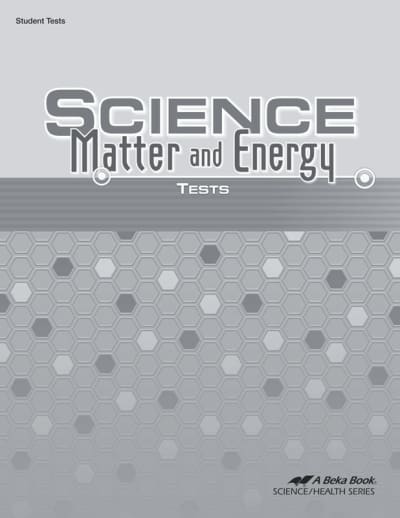
The test book provides a total of 12 exams: 8 tests (one every 3 weeks), 2 nine-week exams, a semester exam, and a final exam. Short answer, multiple choice, matching, and essay questions are included on each test. Answers for the test book are found in the corresponding answer key. Student and teacher resources are not reproducible.
Abeka Science: Matter and Energy Student Test Book
SKU
011634
Grade 9
These icons are designed to help you quickly understand and learn important information about our products.
Teaching Method
Traditional
Teacher-centered curriculum commonly used in classrooms that may include a text, teacher manual, tests, etc.
Charlotte Mason
A methodology based on the work of a 19th century educator who maintained that children learn best from literature (Living Books), not textbooks.
Classical
A methodology based on the Latin Trivium (three stages of learning), including the grammar stage (memorization and facts), logic stage (critical thinking), and rhetoric stage (developing/defending ideas).
Unit Study
A thematic or topical approach centered around one topic that integrates multiple subject areas.
Montessori (Discovery)
A methodology based on the work of a 20th century educator that emphasizes student and sensory-driven discovery learning and real-life applications.
Other
Other methodologies
Religious Content
Secular
Contains content contrary to common Christian beliefs (i.e. evolution).
Neutral
Avoids religious or theoretical topics or presents multiple viewpoints without preference.
Christian/Religious
Faith-based or including instructional religious content.
Learning Modality
Auditory
Learns through listening, talking out loud or reading out loud.
Visual
Learns through seeing, prefers written instructions and visual materials.
Kinesthetic/Tactile (Hands-On)
Learns through moving, doing and touching.
Multi-Sensory
Curriculum that employ a variety of activities/components.
Presentation
Sequential
Curriculum progresses through well-defined learning objectives. Emphasizes mastery before moving to the next topic.
Spiral
Topics and concepts are repeated from level to level, adding more depth at each pass and connecting with review.
Conceptual/Topical
Focus is on the “why,” often with a unifying concept as well as specific skills; coverage may be broader.
Teacher Involvement
Low Teacher Involvement
Student-led materials; parent acts as a facilitator.
Medium Teacher Involvement
A mix of teacher-led time and independent student work.
High Teacher Involvement
Teacher-led lessons; may utilize discussions, hands-on activities and working together.
Additional Materials Required
No other materials needed
Everything you need is included.
Other Materials Required
There are additional required resources that are a separate purchase.
Other Materials Optional
There are additional resources mentioned or recommended but are not absolutely necessary.
Consumable
Consumable
Designed to be written in; not reusable.
Non-Consumable
Not designed to be written in; reusable.
Our Price
$12.90 $12.90 $12.15
Rainbow Savings: $0.75
Description
Publisher's Description of Abeka Science: Matter and Energy Student Test Book
Safety principles, repair basics, innovation tools—all depend on a proper understanding of God's principles of design and His laws governing the universe. From Bernoulli's principle to the second law of thermodynamics, you can know that your teen is understanding how some things work while other things can't through these well-designed tests that reinforce and evaluate his learning. The test book is correlated with the texts Science: Matter and Energy (2012),
Science: Matter and Energy Laboratory Manual, Science: Matter and Energy Quizzes, and Science: Matter and Energy Teacher Edition, which includes the curriculum/lesson plans. Answers and grading guidance are sold separately in Science: Matter and Energy Test Key. Grade 9.
Product Features
* Objective questions in a variety of formats test on multiple levels from recall and understanding to application.
* Since mathematics is the language of science, many tests include an application section of math problems corresponding to the problems demonstrated and practiced in the text. Your teen will see the necessity of both math skills and scientific knowledge as they are applied to practical life situations.
* Essay questions take your teen's thinking skills to a higher level as he must explain the hows and whys of science. They also open his eyes to note God's design in the physical world and to consider how things of man's design work. Noting others' creativity may lead to his own!
* Testing every three weeks (for a total of 12 tests) provides vital reinforcement of learning and an opportunity for your evaluation of your teen's comprehension.
* Two nine-week exams and semester and final exams further reinforce concepts. Exposure to the concepts through reading, discussion, demonstration and practice, independent work, quizzes, tests, and then review examinations cements course content.
* Since every test clearly indicates the sections of the text it covers, you can adjust test taking to your teen's progress through the text.
* As with all Abeka tests, the content and design reflect our half century of educational experience. Directions are easy to understand and the layout is appealing. Test content is clearly covered in the course materials and is appropriate for the grade level.
Category Description for Physical Science (1st Edition)
Building a foundation for upper-level chemistry and physics, Science Matter and Energy, rejects the theory of evolution and presents creation as the only reasonable explanation for the origins of the universe. Beginning with an introduction into the general principles of physical science, students study matter and energy, mathematics in science, chemistry, motion, light and color, electricity and magnetism, and electronics/robotics. Lessons will take about 50 minutes per day, with some students needing longer.
The student textbook provides textual readings, application questions and section and chapter reviews. Space to record answers is not included, so students will need a separate notebook. Feature boxes called A Closer Look highlight God's design in science or provide additional information and application of the lesson. Numerous graphics and colorful illustrations appear throughout the text and aid student understanding.
The teacher guide provides the full student text at the beginning and the teacher resources in the back section. Teacher support includes the scope and sequence with a suggested teaching schedule and grading scale, daily lessons, and answers to the text questions. If you prefer to not use the teacher guide, a separate answer key is available that includes the answers to section and chapter reviews from the student text.
Additional resources include the Lab Manual, Quiz Book, and the Test Book. Answers are not included; each book has a separate teacher guide or answer key.
The lab manual provides 36 experiments. Each experiment begins with an overview, equipment and supply lists, step-by-step instructions and a report sheet. You will need to provide numerous items including a lab coat/apron, safety glasses/goggles, scale balance, graduated cylinder, bathroom scale (kg), measuring cups with ml measurements, beakers, petri dishes, microscope, liquid nitrogen, test tubes, spring scale, copper sulfate, glycerin, sodium hydroxide, filter paper, Bunsen burner, bar magnet, etc. You may be able to modify some of the activities to make them manageable in a homeschool setting.
The Lab Manual Teacher Guide includes the teaching notes for each lab activity, plus the student lab pages with answers for the report sheets and discussion questions.
The test book provides a total of 12 exams: 8 tests (one every 3 weeks), 2 nine-week exams, a semester exam, and a final exam. Short answer, multiple choice, matching, and essay questions are included on each test. The quiz book includes 39 quizzes with matching, true or false, short answer questions and mathematical equations are all represented. Answers for the test book and quiz book are found in the corresponding answer keys. Student and teacher resources are not reproducible.
Also available are the Physical Science Student and Parent Kits. The student kit includes the textbook, test book, quiz book, and lab manual. The parent kit includes the teacher edition, the test key, quiz key, and the lab manual teacher edition.
Details
| Product Format: | Paperback |
|---|---|
| Grade: | 9 |
| Brand: | Abeka |
| Length in Inches: | 11 |
| Width in Inches: | 8.5 |
| Height in Inches: | 0.1875 |
| Weight in Pounds: | 0.45 |
Videos
Reviews