
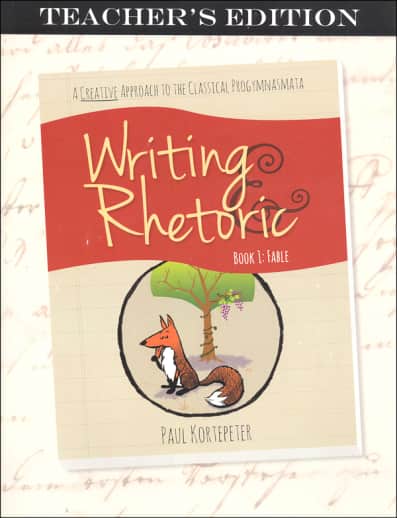

Includes 14 lessons, each utilizing one of Aesop's Fables. Skills covered include summary, amplification, main idea, following an outline, and point of view and include the student's writing his own fable. Both books are about 150 pgs.
Writing & Rhetoric Book 1: Fable Teacher's Edition
SKU
010224
ISBN
9781600512179
Grade 3-4
Classical
Christian/Religious
Low Teacher Involvement
Multi-Sensory
No other materials needed
These icons are designed to help you quickly understand and learn important information about our products.
Teaching Method
Traditional
Teacher-centered curriculum commonly used in classrooms that may include a text, teacher manual, tests, etc.
Charlotte Mason
A methodology based on the work of a 19th century educator who maintained that children learn best from literature (Living Books), not textbooks.
Classical
A methodology based on the Latin Trivium (three stages of learning), including the grammar stage (memorization and facts), logic stage (critical thinking), and rhetoric stage (developing/defending ideas).
Unit Study
A thematic or topical approach centered around one topic that integrates multiple subject areas.
Montessori (Discovery)
A methodology based on the work of a 20th century educator that emphasizes student and sensory-driven discovery learning and real-life applications.
Other
Other methodologies
Religious Content
Secular
Contains content contrary to common Christian beliefs (i.e. evolution).
Neutral
Avoids religious or theoretical topics or presents multiple viewpoints without preference.
Christian/Religious
Faith-based or including instructional religious content.
Learning Modality
Auditory
Learns through listening, talking out loud or reading out loud.
Visual
Learns through seeing, prefers written instructions and visual materials.
Kinesthetic/Tactile (Hands-On)
Learns through moving, doing and touching.
Multi-Sensory
Curriculum that employ a variety of activities/components.
Presentation
Sequential
Curriculum progresses through well-defined learning objectives. Emphasizes mastery before moving to the next topic.
Spiral
Topics and concepts are repeated from level to level, adding more depth at each pass and connecting with review.
Conceptual/Topical
Focus is on the “why,” often with a unifying concept as well as specific skills; coverage may be broader.
Teacher Involvement
Low Teacher Involvement
Student-led materials; parent acts as a facilitator.
Medium Teacher Involvement
A mix of teacher-led time and independent student work.
High Teacher Involvement
Teacher-led lessons; may utilize discussions, hands-on activities and working together.
Additional Materials Required
No other materials needed
Everything you need is included.
Other Materials Required
There are additional required resources that are a separate purchase.
Other Materials Optional
There are additional resources mentioned or recommended but are not absolutely necessary.
Consumable
Consumable
Designed to be written in; not reusable.
Non-Consumable
Not designed to be written in; reusable.
Our Price
$23.95 $23.95 $20.50
Rainbow Savings: $3.45
Description
Publisher's Description of Writing & Rhetoric Book 1: Fable Teacher's Edition
A Creative Approach to the Classical Progymnasmata—Think of the progymnasmata as a step-by-step apprenticeship in the art of writing and rhetoric. What is an apprentice? It is a young person who is learning a skill from a master teacher. Our students will serve as apprentices to the great writers and great stories of history.
Students are often expected to write with no clear model before them. Modern composition scolds traditional writing instruction as rote and unimaginative. It takes imitation to task for a lack of freedom and personal expression. And yet, effective communication from writer to reader always requires some sort of form and structure. Many of history's greatest writers learned by imitation. In other words, writing takes the same kind of determined study as ballet or diving. Creativity uses conventional form as a stage or a springboard from which to launch grand jetés and somersaults. Too often students are expected to tackle complex writing assignments without learning the necessary intermediate steps. The assumption is that because most everyone can speak English well enough to be understood, and form letters with a pencil, that everyone should be able to write well. Yet how many of us would expect a child to sit at a piano, without piano lessons, and play a concerto? Writing is never automatic.
The Writing & Rhetoric series method employs fluent reading, careful listening, models for imitation, and progressive steps. It assumes that students learn best by reading excellent, whole-story examples of literature and by growing their skills through imitation. Each exercise is intended to impart a skill (or tool) that can be employed in all kinds of writing and speaking. The exercises are arranged from simple to more complex. What's more, the exercises are cumulative, meaning that later exercises incorporate the skills acquired in preceding exercises. This series is a step-by-step apprenticeship in the art of writing and rhetoric.
Fable, the first book in the Writing & Rhetoric series, teaches students the practice of close reading and comprehension, summarizing a story aloud and in writing, and amplification of a story through description and dialogue. Students learn how to identify different kinds of stories; determine the beginning, middle, and end of stories; recognize point of view; and see analogous situations, among other essential tools. The Writing & Rhetoric series recovers a proven method of teaching writing, using fables to teach beginning writers the craft of writing well. This is the first in a series of 12 books that will train students over 6 years, starting in grades 3 or 4 and up.
Lessons include:
- Narration/telling it back (creating a natural sense of outline/sequence)
- Analogy—learning how this story is like/different from other stories
- Comprehension
- Sentence play/word play
- Rewriting (gaining a sense of internal structure of a piece of writing)
- Summary
- Amplification
- Rewriting given stories
- Speak It—experiencing the story from your own mouth (orally) with an audience for a different point of contact, often with some sort of change than the first time you heard it.
Writing & Rhetoric Book 1: Fable Teacher's Edition includes the complete student text, as well as answer keys, teacher's notes, and explanations. For every writing assignment, this edition also supplies descriptions and examples of what excellent student writing should look like, providing the teacher with meaningful and concrete guidance.
Category Description for Writing & Rhetoric Book 1: Fable
Includes 14 lessons, each utilizing one of Aesop's Fables. Skills covered include summary, amplification, main idea, followingan outline, and point of view and include the student's writing his own fable. Both books are about 150 pgs.
Details
| Product Format: | Paperback |
|---|---|
| Grades: | 3-4 |
| Brand: | Classical Academic Press |
| ISBN: | 9781600512179 |
| Length in Inches: | 11 |
| Width in Inches: | 8.5 |
| Height in Inches: | 0.4375 |
| Weight in Pounds: | 1.2 |
Videos
Reviews