
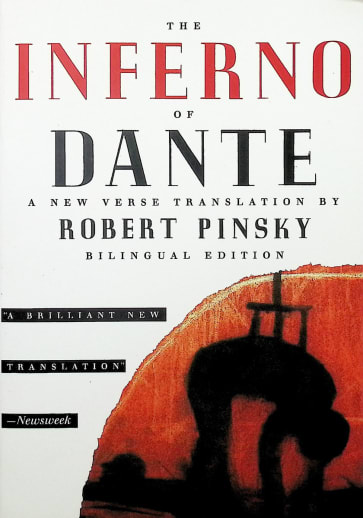
Robert Pinsky translated this edition of Dante's Inferno, and it's an accurate verse translation that captures the poetry and visionary imagery of Dante's original writing. It takes the reader on a journey through nine levels of hell with all the power and wonder that Dante intended. In this edition, the original Italian from Dante is provided on the left-hand page and then Pinsky's English translation is given in stanzas on the right-hand page. With notes by Nicole Pinsky and a forward by John Freccero, this bilingual edition makes the classic story even more enjoyable. 356 pgs, pb.
Inferno of Dante: A New Verse Translation
SKU
010207
ISBN
9780374524524
Grade 9-AD
These icons are designed to help you quickly understand and learn important information about our products.
Teaching Method
Traditional
Teacher-centered curriculum commonly used in classrooms that may include a text, teacher manual, tests, etc.
Charlotte Mason
A methodology based on the work of a 19th century educator who maintained that children learn best from literature (Living Books), not textbooks.
Classical
A methodology based on the Latin Trivium (three stages of learning), including the grammar stage (memorization and facts), logic stage (critical thinking), and rhetoric stage (developing/defending ideas).
Unit Study
A thematic or topical approach centered around one topic that integrates multiple subject areas.
Montessori (Discovery)
A methodology based on the work of a 20th century educator that emphasizes student and sensory-driven discovery learning and real-life applications.
Other
Other methodologies
Religious Content
Secular
Contains content contrary to common Christian beliefs (i.e. evolution).
Neutral
Avoids religious or theoretical topics or presents multiple viewpoints without preference.
Christian/Religious
Faith-based or including instructional religious content.
Learning Modality
Auditory
Learns through listening, talking out loud or reading out loud.
Visual
Learns through seeing, prefers written instructions and visual materials.
Kinesthetic/Tactile (Hands-On)
Learns through moving, doing and touching.
Multi-Sensory
Curriculum that employ a variety of activities/components.
Presentation
Sequential
Curriculum progresses through well-defined learning objectives. Emphasizes mastery before moving to the next topic.
Spiral
Topics and concepts are repeated from level to level, adding more depth at each pass and connecting with review.
Conceptual/Topical
Focus is on the “why,” often with a unifying concept as well as specific skills; coverage may be broader.
Teacher Involvement
Low Teacher Involvement
Student-led materials; parent acts as a facilitator.
Medium Teacher Involvement
A mix of teacher-led time and independent student work.
High Teacher Involvement
Teacher-led lessons; may utilize discussions, hands-on activities and working together.
Additional Materials Required
No other materials needed
Everything you need is included.
Other Materials Required
There are additional required resources that are a separate purchase.
Other Materials Optional
There are additional resources mentioned or recommended but are not absolutely necessary.
Consumable
Consumable
Designed to be written in; not reusable.
Non-Consumable
Not designed to be written in; reusable.
Our Price
$19.00 $19.00 $12.75
Rainbow Savings: $6.25
Description
Publisher's Description of Inferno of Dante: A New Verse Translation
Whether you are approaching Dante Alighieri's Inferno for the first time, for the first time since college, or as a teacher or scholar, you will discover in Robert Pinsky's award-winning translation not merely a fascinating work of medieval Christendom but a psychologically acute vision of sin and suffering with surprising resonance for our times. By conceiving of a fresh, unique way to maintain fidelity to Dante's poetic structure without distorting English usage or idiom, Pinsky conveys not just the literal meaning of Dante's words but their music and spirit, their subtext and emotional import. The result is a timeless, eerily recognizable Hell—and a poem that speaks to our own souls and renews our appreciation of Dante's greatness.
The Inferno is the first part of a three-part epic poem by Dante called the Commedia, or Comedy, and later dubbed Commedia Divina or The Divine Comedy by others. Written in the early fourteenth century, in a world poised between the theological worldview of the Middle Ages and the philosophical expanse of the Renaissance, it presents us with one of the essential human narratives: the journey of the self through the darkest side of existence toward the redemption and affirmation of the soul, from the "dark woods" of human life toward God's light.
On one level, the poem tracks the particular spiritual journey of its author. Set in the year 1300, the Commedia follows Dante the character on a pilgrimage from Hell to Paradise, re-creating metaphorically the course of Dante's life and the development of his ideas. Dante the poet, writing seven years after his fictional pilgrimage, depicts Dante the pilgrim as he is guided through Inferno and Purgatorio by the Latin poet Virgil, and through Paradiso by the Lady Beatrice, or Beatrice Portinari, Dante's true-life beloved who died in 1290 and for whom he was in mourning. Dante had been passionately involved in Florentine politics as a member of the radical Catholic wing of the Guelph party which favored the separation of church and state. When the Guelphs lost power to another faction at the turn of the century, Dante was falsely accused of crimes against the state and exiled from his beloved Florence. In Inferno, he takes the opportunity to name names and assign positions in Hell to the false counselors, errant colleagues, self-interested politicians, misguided clerics, and other morally reprehensible contemporaries whose actions, he believed, led to his exile. At the same time, he revisits his own intellectual and moral life, comes to understand his sins, and in the poem's third part, Paradiso, emerges redeemed. With an irony that animates the poem for the contemporary reader, Inferno traces its author's spiritual growth even as it achieves revenge on his personal enemies—for eternity, in a sense.
The poem's vision of Hell is based on Thomas Aquinas's interpretation of Aristotle's principle of retribution. This is the concept of contrapasso, in which the soul's suffering in Hell extends or reflects or reembodies the sin that predominated it: adulterous lovers are thrown about in a perpetual storm, murderers are boiled in blood, those who succumbed to anger tear at one another's naked bodies, and so forth. This vision of Hell is grounded as well in the medieval belief in a rigorous divine justice.
But what makes the poem an enduring work of literature is not merely its manifestation of Christian doctrine and Aquinas's ideas but its richly detailed, astonishingly imaginative deployment of language, thought, history, belief, and experience. Dante creates a complex tension between his poetic vision of an absolute divine justice and his pilgrim-self's actual experience of human nature and human suffering. Dante's sinners are fully and recognizably human, distinct individuals and members of society; they interest us dramatically. In the Inferno we recognize ourselves as we are in the world above ground and the great challenges we face in struggling to live a good life.
The Inferno is the first part of a three-part epic poem by Dante called the Commedia, or Comedy, and later dubbed Commedia Divina or The Divine Comedy by others. Written in the early fourteenth century, in a world poised between the theological worldview of the Middle Ages and the philosophical expanse of the Renaissance, it presents us with one of the essential human narratives: the journey of the self through the darkest side of existence toward the redemption and affirmation of the soul, from the "dark woods" of human life toward God's light.
On one level, the poem tracks the particular spiritual journey of its author. Set in the year 1300, the Commedia follows Dante the character on a pilgrimage from Hell to Paradise, re-creating metaphorically the course of Dante's life and the development of his ideas. Dante the poet, writing seven years after his fictional pilgrimage, depicts Dante the pilgrim as he is guided through Inferno and Purgatorio by the Latin poet Virgil, and through Paradiso by the Lady Beatrice, or Beatrice Portinari, Dante's true-life beloved who died in 1290 and for whom he was in mourning. Dante had been passionately involved in Florentine politics as a member of the radical Catholic wing of the Guelph party which favored the separation of church and state. When the Guelphs lost power to another faction at the turn of the century, Dante was falsely accused of crimes against the state and exiled from his beloved Florence. In Inferno, he takes the opportunity to name names and assign positions in Hell to the false counselors, errant colleagues, self-interested politicians, misguided clerics, and other morally reprehensible contemporaries whose actions, he believed, led to his exile. At the same time, he revisits his own intellectual and moral life, comes to understand his sins, and in the poem's third part, Paradiso, emerges redeemed. With an irony that animates the poem for the contemporary reader, Inferno traces its author's spiritual growth even as it achieves revenge on his personal enemies—for eternity, in a sense.
The poem's vision of Hell is based on Thomas Aquinas's interpretation of Aristotle's principle of retribution. This is the concept of contrapasso, in which the soul's suffering in Hell extends or reflects or reembodies the sin that predominated it: adulterous lovers are thrown about in a perpetual storm, murderers are boiled in blood, those who succumbed to anger tear at one another's naked bodies, and so forth. This vision of Hell is grounded as well in the medieval belief in a rigorous divine justice.
But what makes the poem an enduring work of literature is not merely its manifestation of Christian doctrine and Aquinas's ideas but its richly detailed, astonishingly imaginative deployment of language, thought, history, belief, and experience. Dante creates a complex tension between his poetic vision of an absolute divine justice and his pilgrim-self's actual experience of human nature and human suffering. Dante's sinners are fully and recognizably human, distinct individuals and members of society; they interest us dramatically. In the Inferno we recognize ourselves as we are in the world above ground and the great challenges we face in struggling to live a good life.
Details
| Product Format: | Softcover Book |
|---|---|
| Grades: | 9-AD |
| Brand: | Farrar, Straus & Giroux |
| Author: | Dante Alighieri |
| ISBN: | 9780374524524 |
| Length in Inches: | 8 |
| Width in Inches: | 5.5 |
| Height in Inches: | 0.5 |
| Weight in Pounds: | 0.85 |
| Foreword by: | John Freccero |
| Pages: | 355 |
| Translated by: | Robert Pinsky |
Videos
Reviews