These icons are designed to help you quickly understand and learn important information about our products.
Teaching Method
Traditional
Teacher-centered curriculum commonly used in classrooms that may include a text, teacher manual, tests, etc.
Charlotte Mason
A methodology based on the work of a 19th century educator who maintained that children learn best from literature (Living Books), not textbooks.
Classical
A methodology based on the Latin Trivium (three stages of learning), including the grammar stage (memorization and facts), logic stage (critical thinking), and rhetoric stage (developing/defending ideas).
Unit Study
A thematic or topical approach centered around one topic that integrates multiple subject areas.
Montessori (Discovery)
A methodology based on the work of a 20th century educator that emphasizes student and sensory-driven discovery learning and real-life applications.
Other
Other methodologies
Religious Content
Secular
Contains content contrary to common Christian beliefs (i.e. evolution).
Neutral
Avoids religious or theoretical topics or presents multiple viewpoints without preference.
Christian/Religious
Faith-based or including instructional religious content.
Learning Modality
Auditory
Learns through listening, talking out loud or reading out loud.
Visual
Learns through seeing, prefers written instructions and visual materials.
Kinesthetic/Tactile (Hands-On)
Learns through moving, doing and touching.
Multi-Sensory
Curriculum that employ a variety of activities/components.
Presentation
Sequential
Curriculum progresses through well-defined learning objectives. Emphasizes mastery before moving to the next topic.
Spiral
Topics and concepts are repeated from level to level, adding more depth at each pass and connecting with review.
Conceptual/Topical
Focus is on the “why,” often with a unifying concept as well as specific skills; coverage may be broader.
Teacher Involvement
Low Teacher Involvement
Student-led materials; parent acts as a facilitator.
Medium Teacher Involvement
A mix of teacher-led time and independent student work.
High Teacher Involvement
Teacher-led lessons; may utilize discussions, hands-on activities and working together.
Additional Materials Required
No other materials needed
Everything you need is included.
Other Materials Required
There are additional required resources that are a separate purchase.
Other Materials Optional
There are additional resources mentioned or recommended but are not absolutely necessary.
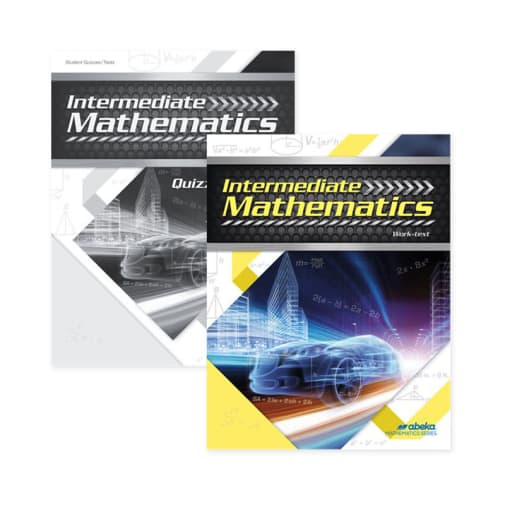
Publisher's Description of Abeka Intermediate Mathematics Student Kit
Give your child a solid foundation in math with the Intermediate Mathematics Homeschool Student Kit. You'll save time by purchasing this kit compared to purchasing each item separately. This complete kit includes the work-text as well as the test and quiz book for assessments. The new Intermediate Mathematics is a more improved seventh-grade math course that successfully bridges the gap between elementary and high school math and effectively prepares students for testing and for more advanced courses. Students will appreciate the step-by-step examples the work-text gives, showing the process for each type of problem within the concept. With daily exercises, examples, review exercises, an index, a glossary of terms, and a reference section, this work-text gives your students the tools to advance their mathematical understanding. Combine with the Intermediate Mathematics Parent Kit (sold separately) for a successful year of mathematical instruction.
Concepts presented include a review of the elementary foundation of math; fraction and decimals; factoring; using and applying of percent; signed number arithmetic; introduction to algebra, plane and solid geometry; use of volume formulas; English and metric systems of measurement; introduction to probability and statistics; constructing and interpreting statistical representations; graphing on the cartesian plane; direct variation; powers and roots; polynomial arithmetic; radicals; solving equations; algebraic word problems; inequalities. 170 lessons