These icons are designed to help you quickly understand and learn important information about our products.
Teaching Method
Traditional
Teacher-centered curriculum commonly used in classrooms that may include a text, teacher manual, tests, etc.
Charlotte Mason
A methodology based on the work of a 19th century educator who maintained that children learn best from literature (Living Books), not textbooks.
Classical
A methodology based on the Latin Trivium (three stages of learning), including the grammar stage (memorization and facts), logic stage (critical thinking), and rhetoric stage (developing/defending ideas).
Unit Study
A thematic or topical approach centered around one topic that integrates multiple subject areas.
Montessori (Discovery)
A methodology based on the work of a 20th century educator that emphasizes student and sensory-driven discovery learning and real-life applications.
Other
Other methodologies
Religious Content
Secular
Contains content contrary to common Christian beliefs (i.e. evolution).
Neutral
Avoids religious or theoretical topics or presents multiple viewpoints without preference.
Christian/Religious
Faith-based or including instructional religious content.
Learning Modality
Auditory
Learns through listening, talking out loud or reading out loud.
Visual
Learns through seeing, prefers written instructions and visual materials.
Kinesthetic/Tactile (Hands-On)
Learns through moving, doing and touching.
Multi-Sensory
Curriculum that employ a variety of activities/components.
Presentation
Sequential
Curriculum progresses through well-defined learning objectives. Emphasizes mastery before moving to the next topic.
Spiral
Topics and concepts are repeated from level to level, adding more depth at each pass and connecting with review.
Conceptual/Topical
Focus is on the “why,” often with a unifying concept as well as specific skills; coverage may be broader.
Teacher Involvement
Low Teacher Involvement
Student-led materials; parent acts as a facilitator.
Medium Teacher Involvement
A mix of teacher-led time and independent student work.
High Teacher Involvement
Teacher-led lessons; may utilize discussions, hands-on activities and working together.
Additional Materials Required
No other materials needed
Everything you need is included.
Other Materials Required
There are additional required resources that are a separate purchase.
Other Materials Optional
There are additional resources mentioned or recommended but are not absolutely necessary.
“Double,
double toil and trouble; Fire burn, and caldron bubble.” Instils the
imagery of witches over their caldron and is one of the many instances that
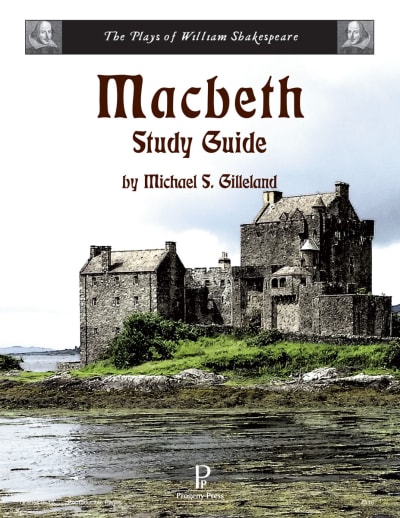
makes Shakespeare fun. The Macbeth Study Guide from Progeny
Press offers a close reading of this dynamic play. There is a Special
Note on Shakespeare’s Plays for the instructor detailing key points of
interest:
read the edition of Macbeth before giving to your student
(you know your student the best)
The use of video or audio BEFORE reading can deepen
understanding of Shakespeare
Sections
cover one Act at a time and starts each section with contemporary vocabulary
development and unscrambling of quotes from the reading. General Questions
focus on comprehension of the text; Analysis questions hit on literary skills
and how they are deployed in the reading; Dig Deeper reflections work at making
scriptural and spiritual connections. Each Act also has Extra Activities and
Discussion options that will add and deepen students’ interaction with the
reading. Literary skills include tone, foreshadowing, hyperbole,
personification, soliloquy, foil, parallelcharacters,
and many others. Prereading Activities provide context to what you will read.
Post reading Essay Prompts help readers make further connections to the text
and showcase what they have learned. A catered list of age-appropriate Further
Resources is provided. Answers are in the back on perforated pages for easy
removal. 65 pages, softcover. ~Rebecca
Publisher's Description of Macbeth Study Guide | Progeny Press
A classic tragedy full of ambition and betrayal, superstition and murder. After meeting three witches who prophesy that he will one day become king, Macbeth sets off a chain of chaos throughout Scotland when impatience drives him to kill his friend, kinsman, and king. Now king himself, Macbeth struggles to prevent the rest of the witches' predictions from coming to pass as his authority begins to crumble and his wife slowly descends into madness.
The fires of rebellion ignite throughout the land, and even the seemingly favorable predictions the witches gave him come to have a double edge.
Large 8.5x11 format is convenient to read and easy for Elementary students
Every question in our novel unit study has plenty of whitespace for primary school level student answers
Encourages neat and clean handwriting practice
Easily transports without the need for a laptop or other expensive equipment
Provides a permanent record of the Elementary school student’s work
Complete, removable answer key included for the teacher to make grading simple!
The High School guides offer many
familiar and popular high school literature options from Progeny Press.
With over 37 titles to choose from, there are numerous books to fill your
students’ reading time! All titles are presented from a Christian worldview, and
each guide is filled with comprehension questions, vocabulary building,
dedicated analysis work, and scriptural connections and application. Pages can
be copied for family and individual classroom use. Many of the classics are
found in this collection and would provide a great opportunity (or incentive)
for your students to read the book and watch the movie! The recommended goal is
for students to read 4-6 guides during the school year. Answers are in the back
and can be easily removed. Each guide includes Notes to the Instructor, mini
author biographies, and background information. These literature selections are
more suited for high school students as they contain difficult topics and
content. Guided reading offers a structured reading experience that develops
analytical skills while enjoying a well-crafted story! ~Rebecca