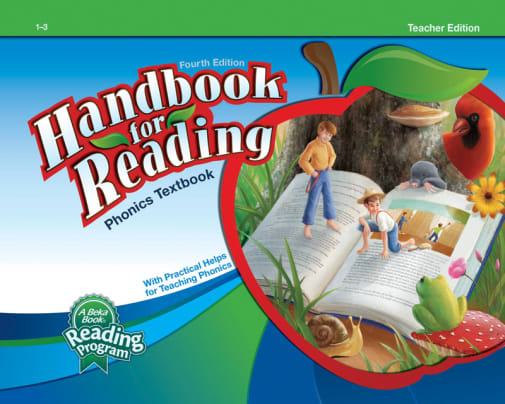
Adding some extra teaching elements to the Handbook for Reading, this spiral-bound manual provides full-sized pages with accompanying teaching information. Instructions for guiding the student as they read through each page are complemented with a before reading section, as well as a section entitled comprehension/discussion that follows. Teaching tips are sprinkled throughout. No longer included with the parent kit, some may still find this a helpful addition to their student's use of the Handbook for Reading.
Abeka Handbook for Reading Teacher's Edition
SKU
009242
ISBN
9780000201119
Grade 1
These icons are designed to help you quickly understand and learn important information about our products.
Teaching Method
Traditional
Teacher-centered curriculum commonly used in classrooms that may include a text, teacher manual, tests, etc.
Charlotte Mason
A methodology based on the work of a 19th century educator who maintained that children learn best from literature (Living Books), not textbooks.
Classical
A methodology based on the Latin Trivium (three stages of learning), including the grammar stage (memorization and facts), logic stage (critical thinking), and rhetoric stage (developing/defending ideas).
Unit Study
A thematic or topical approach centered around one topic that integrates multiple subject areas.
Montessori (Discovery)
A methodology based on the work of a 20th century educator that emphasizes student and sensory-driven discovery learning and real-life applications.
Other
Other methodologies
Religious Content
Secular
Contains content contrary to common Christian beliefs (i.e. evolution).
Neutral
Avoids religious or theoretical topics or presents multiple viewpoints without preference.
Christian/Religious
Faith-based or including instructional religious content.
Learning Modality
Auditory
Learns through listening, talking out loud or reading out loud.
Visual
Learns through seeing, prefers written instructions and visual materials.
Kinesthetic/Tactile (Hands-On)
Learns through moving, doing and touching.
Multi-Sensory
Curriculum that employ a variety of activities/components.
Presentation
Sequential
Curriculum progresses through well-defined learning objectives. Emphasizes mastery before moving to the next topic.
Spiral
Topics and concepts are repeated from level to level, adding more depth at each pass and connecting with review.
Conceptual/Topical
Focus is on the “why,” often with a unifying concept as well as specific skills; coverage may be broader.
Teacher Involvement
Low Teacher Involvement
Student-led materials; parent acts as a facilitator.
Medium Teacher Involvement
A mix of teacher-led time and independent student work.
High Teacher Involvement
Teacher-led lessons; may utilize discussions, hands-on activities and working together.
Additional Materials Required
No other materials needed
Everything you need is included.
Other Materials Required
There are additional required resources that are a separate purchase.
Other Materials Optional
There are additional resources mentioned or recommended but are not absolutely necessary.
Consumable
Consumable
Designed to be written in; not reusable.
Non-Consumable
Not designed to be written in; reusable.
Our Price
$36.15 Description
Publisher's Description of Abeka Handbook for Reading Teacher's Edition
This invaluable teaching tool includes the student text as well as thorough teaching plans designed to give you all the help needed to complete each page of Handbook for Reading. Not sure how to pronounce the phonics sounds? See our Basic Phonics Sounds CD (sold separately). 167 pages.
Category Description for Abeka Phonics
Abeka Phonics is a systematic, intensive, multi-sensory phonics program known for producing strong, confident early readers. Used from Preschool through 2nd grade, it forms the foundation of Abeka’s Language Arts curriculum and is a major focus in their K4 and K5 programs.
Abeka teaches phonics explicitly rather than relying on sight words or whole language methods. The program uses a combination of teacher instruction, flashcards, chants with hand motions, blend ladders, phonetic marking, and daily reading practice to create a truly multi-sensory experience.
Six Basic Steps of Phonics Instruction:
- Learn short vowel sounds
- Learn consonant sounds
- Blend consonants and vowels using front-end blending
- Sound out one-vowel words
- Learn long vowel sounds and two-vowel words
- Master special sounds (blends, digraphs, r-controlled vowels, and more)
How Abeka Phonics Progresses by Grade:
- PK/K4: Focuses on letter recognition, short vowels, consonants, and early blending. Lessons are very teacher-directed with lots of repetition.
- K5: Reviews previous skills and introduces long vowels mid-year, followed by special sounds. Students get daily phonics lessons with strong emphasis on mastery.
- Grades 1-2: Phonics instruction continues but is fully integrated with reading, spelling, handwriting, and grammar as part of a complete Language Arts program.
Key Features of Abeka Phonics:
- Unique front-end blending approach
- One simple rule for long vowels that covers both silent-e words and vowel pairs
- Heavy review and repetition built into every lesson
- Strong focus on reading fluency and comprehension
Important Note: Abeka Phonics works best when used with the full Abeka Curriculum/Lesson Plans, which reference readers, workbooks, flashcards, and other materials. While the phonics portion can be used somewhat independently in the early years, it becomes increasingly integrated with other language arts subjects in 1st and 2nd grade.
Abeka Phonics is an excellent choice for families who want a traditional, structured, and proven phonics program that emphasizes mastery and produces early, strong readers.
Details
| Product Format: | Paperback |
|---|---|
| Grade: | 1 |
| Brand: | Abeka |
| ISBN: | 9780000201119 |
| Length in Inches: | 8 |
| Width in Inches: | 10.375 |
| Height in Inches: | 0.75 |
| Weight in Pounds: | 0.9 |
Videos
Reviews