
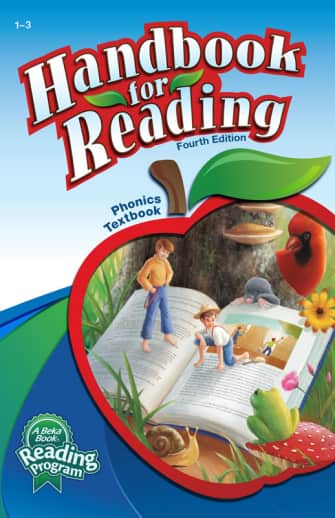
Reminiscent of the old Webster's Blue-Backed Speller, this little handbook provides practice and review of Abeka's complete phonics presentation. Following their Six Easy Steps, the book first provides practice pages for short vowel sounds, then consonant sounds, then long vowel sounds, and finally the special sounds. The 155 pages provide a one-page-a-day warm-up activity before getting into daily lessons. Letters and letter combinations, shown in both cursive and manuscript writing, are paired with illustrations at the top of each page. Sounds, blends, and ultimately words are presented in a multi-column; multi-row grid that allows for reading down as well as across. Occasionally, sight words are introduced and pages conclude with reading segments that start with only words at the beginning of the book but progress to sentences and short stories. All in all, a handy tool for practice, review, and identifying when extra help is needed. Included with the Grade 1 and Grade 2 Student Kits, this could also be used for review in 3rd grade or remedial work in upper elementary grades. 155 pgs, pb.
Abeka Handbook for Reading
Description
Learning to read is easy with the right materials! The Abeka Reading Program is supported by a wide range of phonics-based language arts materials that increase reading comprehension and refine thinking skills. At the heart of our phonics materials is the Handbook for Reading. This invaluable teaching tool for the application of phonics rules may be used at any level from child to adult for initial teaching of phonics and reading, for reinforcement of skills, or for remedial work. It clearly presents the six easy steps to reading. The consonant-vowel blends and words in this reader are arranged to correlate with the sequence in which the special phonics sounds are taught. Ample practice and thorough review are provided. By mastering the simple phonics in this book, any person will be well on his way to becoming a skillful reader. 155 pages.
Abeka Phonics is a systematic, intensive, multi-sensory phonics program known for producing strong, confident early readers. Used from Preschool through 2nd grade, it forms the foundation of Abeka’s Language Arts curriculum and is a major focus in their K4 and K5 programs.
Abeka teaches phonics explicitly rather than relying on sight words or whole language methods. The program uses a combination of teacher instruction, flashcards, chants with hand motions, blend ladders, phonetic marking, and daily reading practice to create a truly multi-sensory experience.
Six Basic Steps of Phonics Instruction:
- Learn short vowel sounds
- Learn consonant sounds
- Blend consonants and vowels using front-end blending
- Sound out one-vowel words
- Learn long vowel sounds and two-vowel words
- Master special sounds (blends, digraphs, r-controlled vowels, and more)
How Abeka Phonics Progresses by Grade:
- PK/K4: Focuses on letter recognition, short vowels, consonants, and early blending. Lessons are very teacher-directed with lots of repetition.
- K5: Reviews previous skills and introduces long vowels mid-year, followed by special sounds. Students get daily phonics lessons with strong emphasis on mastery.
- Grades 1-2: Phonics instruction continues but is fully integrated with reading, spelling, handwriting, and grammar as part of a complete Language Arts program.
Key Features of Abeka Phonics:
- Unique front-end blending approach
- One simple rule for long vowels that covers both silent-e words and vowel pairs
- Heavy review and repetition built into every lesson
- Strong focus on reading fluency and comprehension
Important Note: Abeka Phonics works best when used with the full Abeka Curriculum/Lesson Plans, which reference readers, workbooks, flashcards, and other materials. While the phonics portion can be used somewhat independently in the early years, it becomes increasingly integrated with other language arts subjects in 1st and 2nd grade.
Abeka Phonics is an excellent choice for families who want a traditional, structured, and proven phonics program that emphasizes mastery and produces early, strong readers.
| Product Format: | Paperback |
|---|---|
| Grade: | 1 |
| Brand: | Abeka |
| ISBN: | 9780000201102 |
| Length in Inches: | 8.5625 |
| Width in Inches: | 5.5 |
| Height in Inches: | 0.25 |
| Weight in Pounds: | 0.45 |