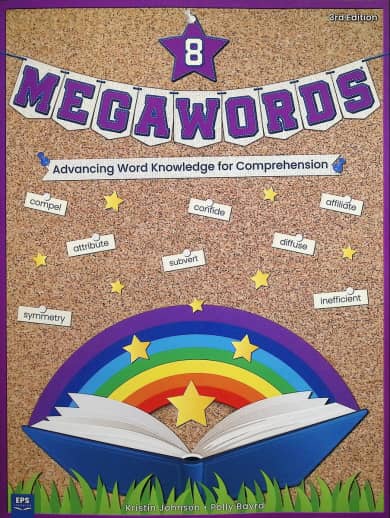
Level 8 of Megawords is structured like a review to the Megawords program. Many of the words have been covered in previous levels, but are now organized by prefixes instead of by their endings. Through a variety of activities like proofreading, word searches, matching, dictation, fill-in-the-blanks, crosswords, reading comprehension practice, and more, students will be exposed to ~651 words across word lists 39–44. Megawords 8 covers assimilated prefixes of com/as/sub/ob/dis/ex/syn and in. Megawords emphasizes equipping students to sound out words with the goal to read and write multisyllabic words proficiently and fluently. The Teacher’s Edition walks parents through the instruction aspects of this program. 124 pgs, paperback. ~Rebecca
Megawords 8 Student Book (3rd Edition)
SKU
007745
ISBN
9781429328661
Grade 11
These icons are designed to help you quickly understand and learn important information about our products.
Teaching Method
Traditional
Teacher-centered curriculum commonly used in classrooms that may include a text, teacher manual, tests, etc.
Charlotte Mason
A methodology based on the work of a 19th century educator who maintained that children learn best from literature (Living Books), not textbooks.
Classical
A methodology based on the Latin Trivium (three stages of learning), including the grammar stage (memorization and facts), logic stage (critical thinking), and rhetoric stage (developing/defending ideas).
Unit Study
A thematic or topical approach centered around one topic that integrates multiple subject areas.
Montessori (Discovery)
A methodology based on the work of a 20th century educator that emphasizes student and sensory-driven discovery learning and real-life applications.
Other
Other methodologies
Religious Content
Secular
Contains content contrary to common Christian beliefs (i.e. evolution).
Neutral
Avoids religious or theoretical topics or presents multiple viewpoints without preference.
Christian/Religious
Faith-based or including instructional religious content.
Learning Modality
Auditory
Learns through listening, talking out loud or reading out loud.
Visual
Learns through seeing, prefers written instructions and visual materials.
Kinesthetic/Tactile (Hands-On)
Learns through moving, doing and touching.
Multi-Sensory
Curriculum that employ a variety of activities/components.
Presentation
Sequential
Curriculum progresses through well-defined learning objectives. Emphasizes mastery before moving to the next topic.
Spiral
Topics and concepts are repeated from level to level, adding more depth at each pass and connecting with review.
Conceptual/Topical
Focus is on the “why,” often with a unifying concept as well as specific skills; coverage may be broader.
Teacher Involvement
Low Teacher Involvement
Student-led materials; parent acts as a facilitator.
Medium Teacher Involvement
A mix of teacher-led time and independent student work.
High Teacher Involvement
Teacher-led lessons; may utilize discussions, hands-on activities and working together.
Additional Materials Required
No other materials needed
Everything you need is included.
Other Materials Required
There are additional required resources that are a separate purchase.
Other Materials Optional
There are additional resources mentioned or recommended but are not absolutely necessary.
Consumable
Consumable
Designed to be written in; not reusable.
Non-Consumable
Not designed to be written in; reusable.
Our Price
$22.65 $22.65 $17.09
Rainbow Savings: $5.56
Product Overview
- A sequential spelling program that starts students at the syllable level and builds their confidence and proficiency with multisyllabic words
- This level focuses on assimilated prefixes
- A great spelling program for beginning spellers and struggling spellers
- Consumable student workbook; teacher guide sold separately
Description
Publisher's Description of Megawords 8 Student Book (3rd Edition)
Megawords is a Tier 2 intervention program for students in grades 4-12 who have moved beyond foundational decoding skills but are not yet performing at grade level. It leverages advanced word-study techniques to build vocabulary and improve reading comprehension. Each level focuses on a distinct group of word study skills. The instructional routines found within Megawords include practices aligned with Science of Reading research and Structured Literacy.
Megawords strengthens students’ literacy skills through:
- Explicit decoding, encoding (spelling), and morphology instruction
- Vocabulary expansion and comprehension development
- Diagnostic and flexible instruction
- Each lesson begins with an extensive list of words related to target pattern(s).
- Six-step lessons build skills from one syllable words in context, monitoring accuracy, proficiency, fluency, and comprehension.
- Students are encouraged to incorporate words from the list into their writing to reinforce learning and retention.
Category Description for Megawords 8 (3rd Edition)
Megawords Level 8 is the culmination of this spelling program. It is a review of previous levels, providing additional practice for mastery of skills. Words are not presented by their endings, but instead by their prefixes—generating a new order in your word lists. Each student will need their own consumable workbook, and guidance is found in the Teacher’s Edition.
Details
| Product Format: | Paperback |
|---|---|
| Grades: | 11-2 |
| Brand: | Educators Publishing Service |
| ISBN: | 9781429328661 |
| Length in Inches: | 10.875 |
| Width in Inches: | 8.25 |
| Height in Inches: | 0.25 |
| Weight in Pounds: | 0.6 |
Videos
Reviews