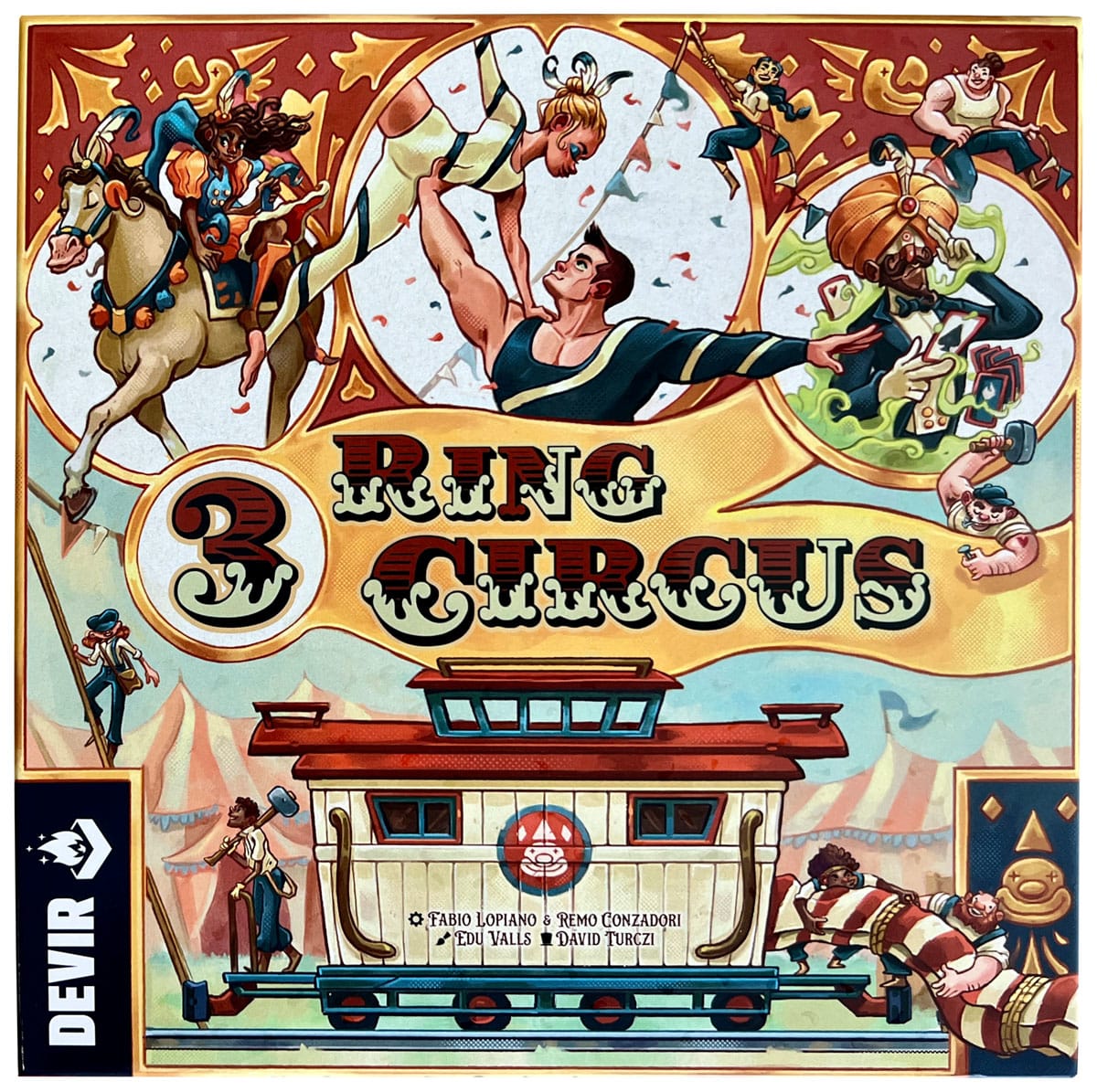
3 Ring Circus Game

SKU
007442
Grade 7-AD
Teaching Method
Traditional
Teacher-centered curriculum commonly used in classrooms that may include a text, teacher manual, tests, etc.
Charlotte Mason
A methodology based on the work of a 19th century educator who maintained that children learn best from literature (Living Books), not textbooks.
Classical
A methodology based on the Latin Trivium (three stages of learning), including the grammar stage (memorization and facts), logic stage (critical thinking), and rhetoric stage (developing/defending ideas).
Unit Study
A thematic or topical approach centered around one topic that integrates multiple subject areas.
Montessori (Discovery)
A methodology based on the work of a 20th century educator that emphasizes student and sensory-driven discovery learning and real-life applications.
Other
Other methodologies
Religious Content
Secular
Contains content contrary to common Christian beliefs (i.e. evolution).
Neutral
Avoids religious or theoretical topics or presents multiple viewpoints without preference.
Christian/Religious
Faith-based or including instructional religious content.
Learning Modality
Auditory
Learns through listening, talking out loud or reading out loud.
Visual
Learns through seeing, prefers written instructions and visual materials.
Kinesthetic/Tactile (Hands-On)
Learns through moving, doing and touching.
Multi-Sensory
Curriculum that employ a variety of activities/components.
Presentation
Sequential
Curriculum progresses through well-defined learning objectives. Emphasizes mastery before moving to the next topic.
Spiral
Topics and concepts are repeated from level to level, adding more depth at each pass and connecting with review.
Conceptual/Topical
Focus is on the “why,” often with a unifying concept as well as specific skills; coverage may be broader.
Teacher Involvement
Low Teacher Involvement
Student-led materials; parent acts as a facilitator.
Medium Teacher Involvement
A mix of teacher-led time and independent student work.
High Teacher Involvement
Teacher-led lessons; may utilize discussions, hands-on activities and working together.
Additional Materials Required
No other materials needed
Everything you need is included.
Other Materials Required
There are additional required resources that are a separate purchase.
Other Materials Optional
There are additional resources mentioned or recommended but are not absolutely necessary.
Consumable
Consumable
Designed to be written in; not reusable.
Non-Consumable
Not designed to be written in; reusable.
Our Price
$39.99 $39.99 $31.99
Rainbow Savings: $8.00
Bargain Version Available
Discover

Description

In the 3 Ring Circus Game, you can experience the challenge of planning circus tours through the northeast United States. The way to success is to become famous by being the best 3 Ring Circus to arrive in town.  

There are two main actions to take in this game. One is hiring performers for your circus and the other is traveling to towns, medium cities, and large cities to perform.  

Working with a personal gameboard, each player has card spaces for 15 potential circus performers arranged in 3 five-card rows, plus 3 end-game goal cards. Deciding which performers to play and in which locations is the key part of strategy. Some cards have end-game point values based on placement of other performers relative to their location. Other cards provide additional resources to help with circus performances and end-game points. There are 3 spaces for end-game goal cards, each of which can be placed when a 3-space column of performance cards is populated.

Taking the show on the road means moving your circus wagon to another location first. Whether performing in a small, medium, or large city, there are resources and rewards, including collecting money cards, performance cards, or game points. Each time a player’s circus performs, the Barnum Caravan, which is owned by the game’s supreme round-tracker entity, moves counterclockwise around the main board’s outer ring of towns/cities. When this caravan stops in any large city, round-end scoring takes place. Once the caravan reaches the large city it started in, the game is immediately over. A final end-game scoring is completed, where personal board card points are calculated, and the player with the most points wins!

3 Ring Circus is unique in its mix of mechanics. There are tableau-building elements, movement, and area majorities, along with some money management. The circus theme is well done with cards and components reflecting old-style circus trappings. Identifying and implementing the best strategy is challenging and rewarding. Choosing the right cards to play and playing them in positions on the board with the best resources, rewards, and end game points is the best way to balance the game, but you will need to have access to these cards and be able to pay to place them. Besides card play, there is effective planning required to decide when and where to perform. Performing provides money cards to play entertainers on personal boards and there are significant points gained by being the first to perform in large cities and medium towns—but before you do, you will need resources and the right card placements on your personal board. Because there are different ways to earn points in this game, there are a generous number of paths to victory, and I really like that!

Besides multiplayer play, 3 Ring Circus has a solo mode, as well as some game variation changes based on player count. For 1-4 players with an 80-minute game time. ~Marsha

Publisher's Description of 3 Ring Circus Game

The circus has come to town! Under the tent, jugglers, clowns, magicians, strongmen and wild beasts capture the curiosity of a dedicated audience that applauds non-stop. After each performance, your little troupe accumulates fame and may one day pique the interest of P.T. Barnum, the greatest circus mogul of all time.

In 3 Ring Circus, players take on the role of a circus director who tours the United States at the end of the 19th century. Your objective is to hire artists and offer performances in various towns and cities with the intention of gaining fame. In towns, features are easy to set up and give you starting resources to upgrade your cast; small cities are somewhat more demanding, but they allow you to come into contact with better artists; audiences in big cities are even more demanding and want to see very specific numbers, but performing there brings you much more fame!

On their turn, players can hire an artist or host a performance. At the beginning of the game, each player's circuses are empty, so it will be necessary to contract to form the company. The artist cards grant more or fewer benefits depending on the order in which they act, so one of the keys to the game is planning the shows that will be offered.

If they decide to act, the players must move to a free space on the map. If it is a town, they receive the most basic currency cards as a prize. If you perform in a small city, depending on the number of pedestals you have in your company you can claim more or fewer entry cards (the second most valuable) or fame points. In the big cities, you get a lot of fame points, but the public always demands a specific type of artist.

While your little circus tries to survive, the great and splendid Barnum Circus travels across the country, and when it arrives in a big city, a score is held in that region, and the circuses that have given the most performances there will gain even more fame.

Details
More Information
Product Format:Other
Grades:7-AD
Brand:Devir Games
EAN/UPC:8436607940616
Length in Inches:9
Width in Inches:9
Height in Inches:2.6875
Weight in Pounds:3.85
Videos
This product doesn't have a video
Reviews
Product Q&A