
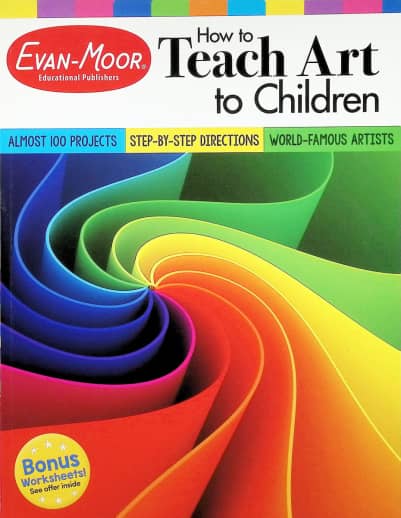
How to Teach Art to Children contains 96 projects that teach the 7 elements of art: line, shape, color, value, texture, form, and space. A nice variety of projects accommodates a range of ages and lets each artist respond at their own level. For example, when teaching color, students will learn about warm vs. cool tones, contrast, primary and secondary colors, and get their hands into mixing paints! When learning about texture, they will make crayon rubbings, create an abstract still life with colored pencils, and construct a textured landscape mural with crayons and textured surfaces. No fancy art supplies are required as most of the art projects are done on or with paper using paints, crayons, colored pencils, and various around-the-house, collage-type materials. You will also learn about several famous artists in the context of the elements!
How to Teach Art to Children
Product Overview
- Multi-age, introductory content
- Uses home-friendly art supplies
- Contains reproducible student pages
Description
How to Teach Art to Children has it all: background information, literature resources, and easy step-by-step directions for 96 art projects. Children learn about the seven elements of art and then use the elements in the styles of famous artists.
This beautifully illustrated book is designed to increase children's awareness of different kinds of art and offer a wide range of activities to experience it. Included are downloadable PDFs of famous works of art that you can print and display in your classroom or home or use to create an art journal for children.
How to Teach Art to Children is divided into two sections:
- Learning About the Elements of Art: The first section introduces the seven basic elements of art: line, shape, color, value, texture, form, and space. A series of art activities allow young artists to experiment with each element.
- Using the Elements of Art: The second section focuses on famous artists and art experiences. Literature resources and examples of the artists' work help children learn and appreciate the famous artists' techniques. Simple step-by-step directions help children apply similar techniques in their own art projects.
This instructional art book includes:
- 96 art projects with step-by-step directions
- Full-color fine art examples
- Downloadable PDFs of the fine art examples to display in your classroom or home
- Literature references and background information on famous artists to enhance children's art education
- A list of materials needed for easy reference
- Reproducible templates to help students understand the elements of art
Art activities include:
- Using clay to learn about form
- Creating a collage to learn about warm and cool colors
- Using construction paper and tissue paper to create sunflowers in a vase to learn about Vincent van Gogh'sSunflowers
- Creating a paper "story quilt" in the art experience of Faith Ringgold's quilt paintings
- And many more!
This edition also includes:
- Additional support for teachers and parents--Pictures of cultural works of art and famous artists' works make it easy to talk about art forms and artists.
- Additional support for students--A downloadable PDF features full-page pictures of cultural works of art and famous artists' works of art. You simply print and display the art examples.
Give children an art education that they will remember with the meaningful activities in How to Teach Art to Children. The art lessons and activities have simple directions for children learning at home or in the classroom. The art projects are easily adaptable to different ages.
This resource contains teacher support pages and reproducible student pages. This is a reproducible resource (photocopying of lessons is permitted) for single classroom or individual home use only.
| Product Format: | Softcover Book |
|---|---|
| Grades: | 1-6 |
| Brand: | Evan-Moor |
| Author: | Joy Evans |
| ISBN: | 9781629388755 |
| EAN/UPC: | 023472010162 |
| Length in Inches: | 10.875 |
| Width in Inches: | 8.5 |
| Height in Inches: | 0.3125 |
| Weight in Pounds: | 1.15 |