These icons are designed to help you quickly understand and learn important information about our products.
Teaching Method
Traditional
Teacher-centered curriculum commonly used in classrooms that may include a text, teacher manual, tests, etc.
Charlotte Mason
A methodology based on the work of a 19th century educator who maintained that children learn best from literature (Living Books), not textbooks.
Classical
A methodology based on the Latin Trivium (three stages of learning), including the grammar stage (memorization and facts), logic stage (critical thinking), and rhetoric stage (developing/defending ideas).
Unit Study
A thematic or topical approach centered around one topic that integrates multiple subject areas.
Montessori (Discovery)
A methodology based on the work of a 20th century educator that emphasizes student and sensory-driven discovery learning and real-life applications.
Other
Other methodologies
Religious Content
Secular
Contains content contrary to common Christian beliefs (i.e. evolution).
Neutral
Avoids religious or theoretical topics or presents multiple viewpoints without preference.
Christian/Religious
Faith-based or including instructional religious content.
Learning Modality
Auditory
Learns through listening, talking out loud or reading out loud.
Visual
Learns through seeing, prefers written instructions and visual materials.
Kinesthetic/Tactile (Hands-On)
Learns through moving, doing and touching.
Multi-Sensory
Curriculum that employ a variety of activities/components.
Presentation
Sequential
Curriculum progresses through well-defined learning objectives. Emphasizes mastery before moving to the next topic.
Spiral
Topics and concepts are repeated from level to level, adding more depth at each pass and connecting with review.
Conceptual/Topical
Focus is on the “why,” often with a unifying concept as well as specific skills; coverage may be broader.
Teacher Involvement
Low Teacher Involvement
Student-led materials; parent acts as a facilitator.
Medium Teacher Involvement
A mix of teacher-led time and independent student work.
High Teacher Involvement
Teacher-led lessons; may utilize discussions, hands-on activities and working together.
Additional Materials Required
No other materials needed
Everything you need is included.
Other Materials Required
There are additional required resources that are a separate purchase.
Other Materials Optional
There are additional resources mentioned or recommended but are not absolutely necessary.
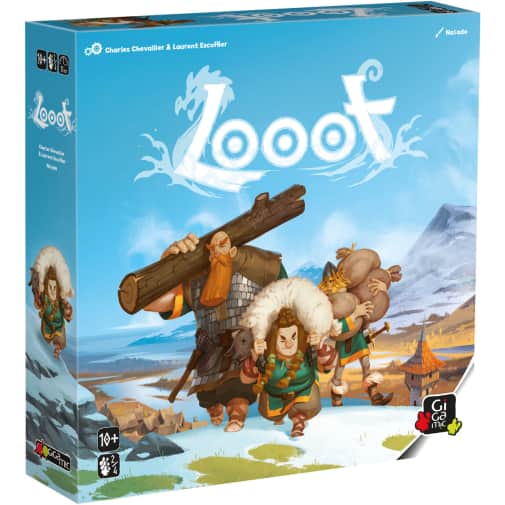
Viking clans have landed and are staking claims to Fjords
where they hope to develop and build a new community. In this tile
management/placement game, each player’s clan of 12 Vikings compete to gain the
most points by visiting the main board to gain the resources and buildings
needed to finish construction sites and fill Longships on their Fjords. On a
turn, players send one member of their Viking clan to the main board and
strategically place their gained resources, buildings, and Longships on their
Fjords. When all clans are placed on the main board, the game ends and the player
with the most points wins!
Here are all the ways to earn points:
Longships: Each time a Viking
visits the mainland, they may choose a Longship tile to place on their Fjord.These
tiles have three resource requirements in all different combinations of axes,
wood, sheep, and gold, which must be placed directly next to the Longship to
complete it.Once completed, the player flips the Longship to its
reverse side, which displays a number and any one of the following symbols (Castle,
Watchtower, House, Gold, Wood, Sheep). These numbers are added to the base
value as a multiplier for each of that type of tile on a player’s Fjord at
game-end.
Individual Buildings: Castles
are worth 4 points, Watchtowers are worth 2 points, and houses are worth 1
point. Add any Longship multipliers to those values and multiply by the number
of that tile type on a player’s Fjord to total a score for that building type.
Individual Resources: Gold is
worth 2 points, sheep and trees are worth 1 point. See trophy scoring for axe
resource values below.
Trophy Scoring: At the end of
any turn, players may claim any one of five trophies that represent point
values for different numbers of axes on their board at the end of the game. These range from 3 points for 2 axes up to 21
points for 6 axes. Only one trophy per player may be claimed.
Construction Site Completion:
Each player has three construction sites. If completed, they are worth 9, 7,
and 5 points for a possible total of 21 points.
Subtract five points each for
any uncompleted Longships.
This game has quickly become one of my newly discovered
favorites this year (2025). I love that it has a low/medium difficulty level
with about a 10-minute time to teach but has interesting decision-making
spaces, strategy/reasoning challenges, and a little bit of tension with other
players claiming spots on the main board that have resources needed by others.
Looot is a beautifully produced game and plays in about a half hour or so. For
2-4 players. - Marsha
Publisher's Description of Looot Game
Lead your Viking clan to victory by gathering resources,
capturing buildings, and expanding your empire. Outmaneuver your rivals
with cunning strategy and bold moves as you race to claim the legendary
title Jarl of the North in this epic conquest!
Every move is strategic as you gather resources, and chaining
Vikings together to capture castles and watchtowers. Load your longships
with plunder but beware unfilled ships. From resource management to
tactical placement, every decision counts as you strive to forge your
legacy as the ultimate Jarl in the exhilarating game of Looot!