These icons are designed to help you quickly understand and learn important information about our products.
Teaching Method
Traditional
Teacher-centered curriculum commonly used in classrooms that may include a text, teacher manual, tests, etc.
Charlotte Mason
A methodology based on the work of a 19th century educator who maintained that children learn best from literature (Living Books), not textbooks.
Classical
A methodology based on the Latin Trivium (three stages of learning), including the grammar stage (memorization and facts), logic stage (critical thinking), and rhetoric stage (developing/defending ideas).
Unit Study
A thematic or topical approach centered around one topic that integrates multiple subject areas.
Montessori (Discovery)
A methodology based on the work of a 20th century educator that emphasizes student and sensory-driven discovery learning and real-life applications.
Other
Other methodologies
Religious Content
Secular
Contains content contrary to common Christian beliefs (i.e. evolution).
Neutral
Avoids religious or theoretical topics or presents multiple viewpoints without preference.
Christian/Religious
Faith-based or including instructional religious content.
Learning Modality
Auditory
Learns through listening, talking out loud or reading out loud.
Visual
Learns through seeing, prefers written instructions and visual materials.
Kinesthetic/Tactile (Hands-On)
Learns through moving, doing and touching.
Multi-Sensory
Curriculum that employ a variety of activities/components.
Presentation
Sequential
Curriculum progresses through well-defined learning objectives. Emphasizes mastery before moving to the next topic.
Spiral
Topics and concepts are repeated from level to level, adding more depth at each pass and connecting with review.
Conceptual/Topical
Focus is on the “why,” often with a unifying concept as well as specific skills; coverage may be broader.
Teacher Involvement
Low Teacher Involvement
Student-led materials; parent acts as a facilitator.
Medium Teacher Involvement
A mix of teacher-led time and independent student work.
High Teacher Involvement
Teacher-led lessons; may utilize discussions, hands-on activities and working together.
Additional Materials Required
No other materials needed
Everything you need is included.
Other Materials Required
There are additional required resources that are a separate purchase.
Other Materials Optional
There are additional resources mentioned or recommended but are not absolutely necessary.
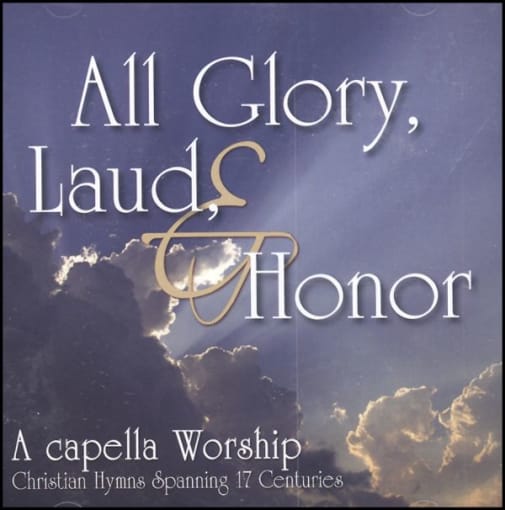
Publisher's Description of All Glory, Laud, and Honor Christian Hymns CD
Album of music produced by Diana Waring and Mary Beth Cecil This is a worshipful, glorious album of church hymns from the Early Church to the Great Awakening! Designed to be used by families in home worship, by families in the study of Romans, Reformers, Revolutionaries, or by those who simply desire to listen to Christian meditative music. Exalt our God together with the music of the ages, in 14 all new arrangements by Mary Beth Cecil. Produced by Roger Treece. Professional vocal music. A Cappella.
Track Titles
Track 1: Lord Jesus, Think on Me (Synesius of Cyrene)
Track 2: Of the Father’s Love Begotten (Aurelius Clemens Prudentius)
Track 3: Father, We Praise Thee, Now the Night is Over (Gregory the Great)
Track 4: O God, Thou Art the Father (St. Columba)
Track 5: Come, Ye Faithful, Raise the Strain (John of Damascus)
Track 6: All Glory, Laud, and Honor (Theodulph of Orleans)
Track 7: Jesus, the Very Thought of Thee (Latin, 12th century)
Track 8: To Avert From Men God’s Wrath (John Huss)
Track 9: All People That On Earth Do Dwell (Psalm 100)
The second study in this series covers AD30 to AD1799, also known as Resurrection to Revolution. This edition covers from the Roman Empire to the French Revolution, when God is turning the tides of human destiny in miraculous ways. The church of Jesus Christ explodes throughout the world; uncharted regions are explored, distant cultures are united, religious wars burst into flame; technology, medicine, philosophy and art sweep nations into bitter turmoil and proud independence. Through it all, God is moving behind the scenes to accomplish His purposes, inviting kings and peasants alike into His kingdom.