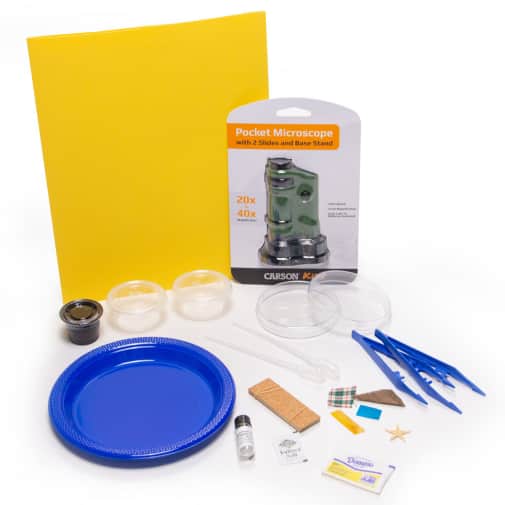
Explore a world that cannot be seen with the naked eye. Microscopic Explorations from Home Science Adventures guides students into the unseen world around them. Through guided activities, children will discover how a microscope works as they investigate plants, animals, fungi, protozoa, and crystals. They will also get a close-up of an insect, explore moldy bread, discover hidden states on the $5 bill, and much more! The Kit includes everything for 1-2 students to complete the activities. Student materials are reproducible for family use. Families using Microscopic Explorations with more than one student may wish to purchase an additional MicroBrite Pocket Microscope for simultaneous exploration. Microscopic Explorations is also included in the Home Science Adventures Complete Kit II along with Wonders of Light and Discovering Insects.
Home Science Adventures Microscope Explorations Set
SKU
004427
Grade 1-8
Montessori (Discovery)
Neutral
High Teacher Involvement
Kinesthetic/Tactile (Hands-On)
No other materials needed
Conceptual/Topical
These icons are designed to help you quickly understand and learn important information about our products.
Teaching Method
Traditional
Teacher-centered curriculum commonly used in classrooms that may include a text, teacher manual, tests, etc.
Charlotte Mason
A methodology based on the work of a 19th century educator who maintained that children learn best from literature (Living Books), not textbooks.
Classical
A methodology based on the Latin Trivium (three stages of learning), including the grammar stage (memorization and facts), logic stage (critical thinking), and rhetoric stage (developing/defending ideas).
Unit Study
A thematic or topical approach centered around one topic that integrates multiple subject areas.
Montessori (Discovery)
A methodology based on the work of a 20th century educator that emphasizes student and sensory-driven discovery learning and real-life applications.
Other
Other methodologies
Religious Content
Secular
Contains content contrary to common Christian beliefs (i.e. evolution).
Neutral
Avoids religious or theoretical topics or presents multiple viewpoints without preference.
Christian/Religious
Faith-based or including instructional religious content.
Learning Modality
Auditory
Learns through listening, talking out loud or reading out loud.
Visual
Learns through seeing, prefers written instructions and visual materials.
Kinesthetic/Tactile (Hands-On)
Learns through moving, doing and touching.
Multi-Sensory
Curriculum that employ a variety of activities/components.
Presentation
Sequential
Curriculum progresses through well-defined learning objectives. Emphasizes mastery before moving to the next topic.
Spiral
Topics and concepts are repeated from level to level, adding more depth at each pass and connecting with review.
Conceptual/Topical
Focus is on the “why,” often with a unifying concept as well as specific skills; coverage may be broader.
Teacher Involvement
Low Teacher Involvement
Student-led materials; parent acts as a facilitator.
Medium Teacher Involvement
A mix of teacher-led time and independent student work.
High Teacher Involvement
Teacher-led lessons; may utilize discussions, hands-on activities and working together.
Additional Materials Required
No other materials needed
Everything you need is included.
Other Materials Required
There are additional required resources that are a separate purchase.
Other Materials Optional
There are additional resources mentioned or recommended but are not absolutely necessary.
Consumable
Consumable
Designed to be written in; not reusable.
Non-Consumable
Not designed to be written in; reusable.
Our Price
$38.00 Product Overview
- Engaging hands-on activities with no parent prep!
- Thirteen lessons and supplies to complete twenty activities are included. All you need to add is an onion and a piece of bread
- Pocket microscope included
Description
Publisher's Description of Home Science Adventures Microscope Explorations Set
EXPLORE A WORLD TOO SMALL FOR THE NAKED EYE
- Learn how a microscope works while investigating plants, animals, fungi and protozoa, as well as crystals and crystal formation.
COOL ACTIVITIES
- DISCOVER the HIDDEN STATES on a five dollar bill.
- See micro-crystals FORM RIGHT BEFORE YOUR EYES!
- Get a close up, magnified view of a LIVE INSECT!
- EXPLORE a MICROSCOPIC FOREST of bread mold!
- View ACTUAL CELLS in an onion membrane!
- and many more!
20 ACTIVITIES IN 13 LESSONS
- includes a parent guide
- an easy-to-use pocket microscope
- everything you need to do the lessons except an onion and a slice of bread.
WHAT IS INCLUDED?
Everything you need is included in the kit except an onion and a slice of bread . . . and your curiosity!
- 1 Pocket Microscope
- 2 petri dishes
- 2 observation plates
- 2 pipettes
- 2 sample collection cups
- 2 forceps
- 1 vial of quick forming crystal solution (salicylic acid in alcohol)
- 1 set of sea samples (starfish and micro-auger shells)
- 1 set of fabric samples (cotton, wool, silk, acetate)
- 1 set of crystal samples (salt & sugar)
- 1 kit for constructing an insect slide trap (microscope slides, cork sheets & rubber bands)
Category Description for Home Science Adventures Kits
Experience science through a hands-on discovery approach with the Home Science Adventure Kits! Cleverly disguised as fun, hands-on activities, these kits introduce science lessons through observation and exploration. After you finish “oohing and aaahing” over the supplies, you’ll be happy to discover that the written material is every bit as impressive. Along with the necessary supplies, there are over a hundred pages of student worksheets, a parent guide, keys, and more advanced questions. The lessons are written for grades 3-6, although the activities appeal to all ages, making these a great option for family learning. The Parent Guide includes teacher notes, safety concerns (if applicable), answer key, and further explorations for each of the lessons in the study. Each lesson centers around an exploratory activity. The directions are clear and easy to follow. Materials in the kit can be shared by two students. Student worksheets require short written responses or the recording of data from experiments. These are hole-punched and reproducible for family use. Busy families will appreciate the well laid out and self-contained lessons, making this truly a pick-up-and-go science option! Kits include nearly everything necessary for success, with minimal teaching prep. Kits are available separately, or choose one of the Complete (3 in 1) Kits, which provide enough material for one semester!
Details
| Product Format: | Kit |
|---|---|
| Grades: | 1-8 |
| Brand: | Stratton House |
| Length in Inches: | 13.25 |
| Width in Inches: | 10 |
| Height in Inches: | 2.25 |
| Weight in Pounds: | 1.125 |
Videos
Reviews