
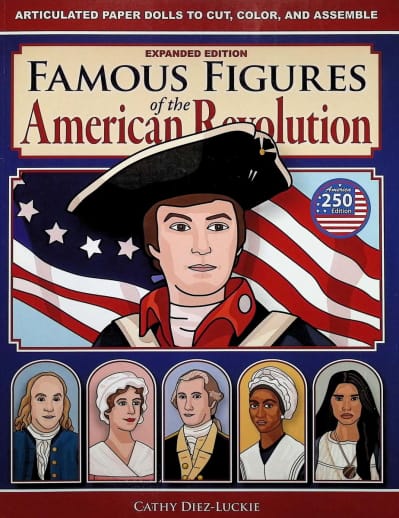
Famous Figures of the American Revolution Expanded Edition

SKU
004136
ISBN
9781944481988
Grade 1-7
Neutral
Consumable
Teaching Method
Traditional
Teacher-centered curriculum commonly used in classrooms that may include a text, teacher manual, tests, etc.
Charlotte Mason
A methodology based on the work of a 19th century educator who maintained that children learn best from literature (Living Books), not textbooks.
Classical
A methodology based on the Latin Trivium (three stages of learning), including the grammar stage (memorization and facts), logic stage (critical thinking), and rhetoric stage (developing/defending ideas).
Unit Study
A thematic or topical approach centered around one topic that integrates multiple subject areas.
Montessori (Discovery)
A methodology based on the work of a 20th century educator that emphasizes student and sensory-driven discovery learning and real-life applications.
Other
Other methodologies
Religious Content
Secular
Contains content contrary to common Christian beliefs (i.e. evolution).
Neutral
Avoids religious or theoretical topics or presents multiple viewpoints without preference.
Christian/Religious
Faith-based or including instructional religious content.
Learning Modality
Auditory
Learns through listening, talking out loud or reading out loud.
Visual
Learns through seeing, prefers written instructions and visual materials.
Kinesthetic/Tactile (Hands-On)
Learns through moving, doing and touching.
Multi-Sensory
Curriculum that employ a variety of activities/components.
Presentation
Sequential
Curriculum progresses through well-defined learning objectives. Emphasizes mastery before moving to the next topic.
Spiral
Topics and concepts are repeated from level to level, adding more depth at each pass and connecting with review.
Conceptual/Topical
Focus is on the “why,” often with a unifying concept as well as specific skills; coverage may be broader.
Teacher Involvement
Low Teacher Involvement
Student-led materials; parent acts as a facilitator.
Medium Teacher Involvement
A mix of teacher-led time and independent student work.
High Teacher Involvement
Teacher-led lessons; may utilize discussions, hands-on activities and working together.
Additional Materials Required
No other materials needed
Everything you need is included.
Other Materials Required
There are additional required resources that are a separate purchase.
Other Materials Optional
There are additional resources mentioned or recommended but are not absolutely necessary.
Consumable
Consumable
Designed to be written in; not reusable.
Non-Consumable
Not designed to be written in; reusable.
Our Price
$21.95 $21.95 $14.50
Rainbow Savings: $7.45

Product Overview

  • Newly updated for America’s 250th anniversary!
  • Moveable figures bring history to life
  • Biography cards to learn more about each famous person

Description

This 250th Edition of Famous Figures of the American Revolution includes even more figures (5 more!) from the American Revolution! Kids will love getting to cut, color, and assemble these characters (British loyalists and patriots!) to act out history and bring the past to life. Each of the 15 figures comes in a pair, one brightly colored in historically accurate dress, and the other – ready for your own touch of color with colored pencils, markers, or paint. Although made from sturdy cardstock, these paper dolls have moveable parts, connected at the joints by mini metal brads – making them extra fun to interact with! You can even use string, pipe cleaners, or popsicle sticks to make your own puppets. The back of each paper doll is labeled for quick recognition.

Front pages include colorful, detailed biography cards (postcard-size) of each famous figure that can be cut out and displayed if you like. Also includes a long list of suggested books to use for read-alouds and independent reading. A great way to spark an interest in history and encourage creative play.

Includes these Famous Figures: Benjamin Franklin, Betsy Ross, Daniel Boone, George Washington, John Adams, Molly Pitcher, Patrick Henry, Paul Revere, Soldier of the continental Army, Patrick Henry, Phillis Wheatley, British Soldier, Two Kettles Together (Tyonajanegen), Joseph Brant, and Thomas Jefferson. ~Nancie

Publisher's Description of Famous Figures of the American Revolution Expanded Edition
Updated with 5 new figures for America’s 250th birthday!

Fight for liberty with Lafayette, Speak out for freedom with John Adams, explore the wilderness with Daniel Boone, protect your people with Joseph Brant, and more!  These movable paper figures to cut, color, and assemble let your children create new stories using memorable people from the era of the American Revolution. 
Category Description for Famous Figures of _______ Times

If you are not a big arts-and-crafts type of teacher, no worries! You can easily add a craft project to your history studies with these consumable workbooks. The artwork is wonderfully done, and the craft is interactive, from designing to assembly to historical play. The books (designed to be disassembled and the figures cut out) are made with heavyweight cardstock. There are two sets of each figure: one in full color, and one with black-and-white line art to be colored in (definitely a colored pencil project). At the front of the book is a pictorial guide to each figure that includes a detailed biographical sketch and a companion reading list (read-aloud as well as independent reading options). There are complete instructions for assembling using small brads or eyelets, with a letter key printed on the back of each piece for easy assembly. A hole punch and fasteners are required for assembly and are NOT included. These time-era paper doll books would make a wonderful addition to a classical history program like Mystery of History, Story of the World, or BiblioPlan.

Details
More Information
Product Format:Softcover Book
Grades:1-7
Brand:Figures in Motion
Author:Cathy Diez-Luckie
ISBN:9781944481988
Length in Inches:11
Width in Inches:8.5
Height in Inches:0.5
Weight in Pounds:0.65
Videos
This product doesn't have a video
Reviews
Product Q&A