
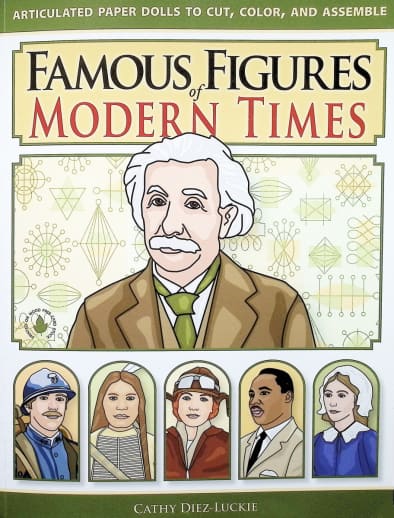
Looking to add a fun, interactive element to your modern history studies? Introduce students to 21 historical men and women with these articulated paper dolls. You are provided with a full color and a blank doll waiting to be decorated, instructions for assembly, a fact card for each individual, and a suggested book list for further study on each person. 96 pgs, pb. ~Rebecca
Famous Figures of Modern Times
SKU
003597
ISBN
9781944481339
Grade K-8
These icons are designed to help you quickly understand and learn important information about our products.
Teaching Method
Traditional
Teacher-centered curriculum commonly used in classrooms that may include a text, teacher manual, tests, etc.
Charlotte Mason
A methodology based on the work of a 19th century educator who maintained that children learn best from literature (Living Books), not textbooks.
Classical
A methodology based on the Latin Trivium (three stages of learning), including the grammar stage (memorization and facts), logic stage (critical thinking), and rhetoric stage (developing/defending ideas).
Unit Study
A thematic or topical approach centered around one topic that integrates multiple subject areas.
Montessori (Discovery)
A methodology based on the work of a 20th century educator that emphasizes student and sensory-driven discovery learning and real-life applications.
Other
Other methodologies
Religious Content
Secular
Contains content contrary to common Christian beliefs (i.e. evolution).
Neutral
Avoids religious or theoretical topics or presents multiple viewpoints without preference.
Christian/Religious
Faith-based or including instructional religious content.
Learning Modality
Auditory
Learns through listening, talking out loud or reading out loud.
Visual
Learns through seeing, prefers written instructions and visual materials.
Kinesthetic/Tactile (Hands-On)
Learns through moving, doing and touching.
Multi-Sensory
Curriculum that employ a variety of activities/components.
Presentation
Sequential
Curriculum progresses through well-defined learning objectives. Emphasizes mastery before moving to the next topic.
Spiral
Topics and concepts are repeated from level to level, adding more depth at each pass and connecting with review.
Conceptual/Topical
Focus is on the “why,” often with a unifying concept as well as specific skills; coverage may be broader.
Teacher Involvement
Low Teacher Involvement
Student-led materials; parent acts as a facilitator.
Medium Teacher Involvement
A mix of teacher-led time and independent student work.
High Teacher Involvement
Teacher-led lessons; may utilize discussions, hands-on activities and working together.
Additional Materials Required
No other materials needed
Everything you need is included.
Other Materials Required
There are additional required resources that are a separate purchase.
Other Materials Optional
There are additional resources mentioned or recommended but are not absolutely necessary.
Consumable
Consumable
Designed to be written in; not reusable.
Non-Consumable
Not designed to be written in; reusable.
Our Price
$21.95 $21.95 $14.50
Rainbow Savings: $7.45
Description
Publisher's Description of Famous Figures of Modern Times
Crazy Horse fights to defend his people on the wide plains of Montana.
Rosa Parks, Gandhi, Nelson Mandela, and Martin Luther King take brave
stands to make a better world. Rosie the Riveter builds ships, tanks,
and airplanes that soldiers and pilots will use to defend democracy.
Amelia Earhart explores the endless skies, while Neil Armstrong dares to
go further than any human has ever been. This is the modern era.
Category Description for Famous Figures of _______ Times
If you are not a big arts-and-crafts type of teacher, no worries! You can easily add a craft project to your history studies with these consumable workbooks. The artwork is wonderfully done, and the craft is interactive, from designing to assembly to historical play. The books (designed to be disassembled and the figures cut out) are made with heavyweight cardstock. There are two sets of each figure: one in full color, and one with black-and-white line art to be colored in (definitely a colored pencil project). At the front of the book is a pictorial guide to each figure that includes a detailed biographical sketch and a companion reading list (read-aloud as well as independent reading options). There are complete instructions for assembling using small brads or eyelets, with a letter key printed on the back of each piece for easy assembly. A hole punch and fasteners are required for assembly and are NOT included. These time-era paper doll books would make a wonderful addition to a classical history program like Mystery of History, Story of the World, or BiblioPlan.
Details
| Product Format: | Paperback |
|---|---|
| Grades: | K-8 |
| Brand: | Well-Trained Mind Press |
| ISBN: | 9781944481339 |
| Length in Inches: | 11.125 |
| Width in Inches: | 8.5 |
| Height in Inches: | 0.4375 |
| Weight in Pounds: | 1.2 |
Videos
Reviews