
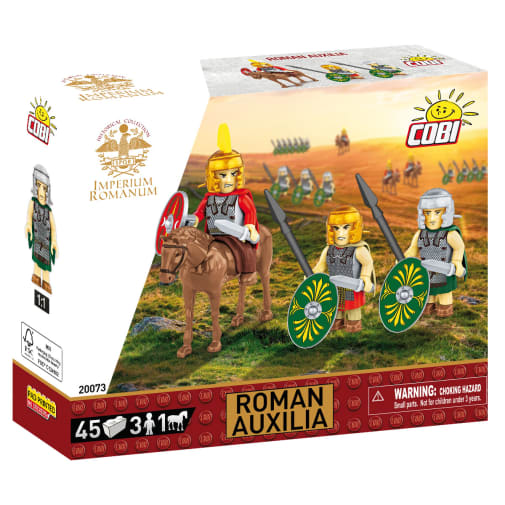
Build the Roman Auxilia set and prepare for a tale of ambition and combat! This set of three figures complements the models from the ROMAN IMPERIUM collection!
Are you ready to explore the world of power, glory, and great battles? These are the warriors who sowed fear only to become Roman citizens. Add them to your collection and expand your empire!
Deploy units of fearless auxiliaries. Recreate realistic formations, plan tactics, learn strategy, and discover the military richness of the ROMAN IMPERIUM world. With ROMAN AUXILIA, your empire takes shape – brick by brick!
The ROMAN AUXILIA set includes:
• Two infantrymen (cohortes) – armed with shields with a completely new, oval shape. In addition, the soldiers have new capes that beautifully complement their outfits.
• Cavalry Soldier - The cavalryman is armed with a sword (gladius) and a round shield (parma), wearing a helmet with a yellow plume (crista), Lorica hamata chain mail, and a red cape.
• Horse with Saddle - The cavalryman is complemented by a horse with a saddle, on which our warrior can be mounted.
Advantages of the ROMAN AUXILIA set:
High-quality workmanship - The set is characterized by high precision and attention to detail. Importantly, the set does not include traditional stickers, only high-quality prints, ensuring durability and a perfect appearance of the model for years to come.
Completely new elements - The auxilia soldiers are armed with shields of a completely new shape with new prints. An additional new element in the IMPERIUM ROMANUM series is the prints on the chain mail. Lorica hamata, very popular in the Roman army.
Intuitive Instructions – Thanks to the simple and intuitive instructions, building the set is easy even for less experienced builders. It's an excellent option for people of all ages who want to explore the secrets of building war machines.
Perfect for both adults and children – This set is ideal for younger modelers aged 8 and over, but also looks great on the shelf of a mature collector who wants to add dioramas from the IMPERIUM ROMANUM series to their collection.
Wide Selection – Check out other sets from the IMPERIUM ROMANUM series, combine them, and create your own scenarios and dioramas! Don't let your forces be surprised by your enemies. Send your auxiliaries to the attack! Prepare ambushes and decide how the battle unfolds. In the world of building blocks, you build your empire.
Specialized Auxiliary Forces
Auxiliaries ("support") were auxiliary forces in the Roman army. During the Republic, auxiliary units were recruited from among the inhabitants of Latin cities and Rome's allies. They were made up of non-Roman citizens recruited from the farthest reaches of the Empire.
Unlike legionaries, auxiliaries were recruited for their local skills – for example, excellent cavalry was obtained from Numidia, archers from Crete, and slingers from the Balkans.
Auxiliaries were divided into cavalry units called alae and infantry units called cohortes. The cohortes were led by the cohort prefect (prefectus cohortis), while the alae were led by the praefectus equitum.
Increasingly dangerous, increasingly important!
Auxiliaries provided specialized units that could operate where the heavy infantry of the legendary Roman army was insufficient. Initially, their equipment was simpler than that of the legionaries, but over time, these differences began to blur – both in terms of weaponry and their importance on the battlefield.
Service in the auxiliary units typically lasted 25 years. Upon completion, soldiers often received Roman citizenship, a privilege that extended to their families. For many provincials, this was one of the few available avenues for full participation in the life of the Empire.