
Exploring Creation with Botany Textbook (2nd Edition)

SKU
000850
ISBN
9781946506399
Grade K-6
Charlotte Mason
Christian/Religious
High Teacher Involvement
Multi-Sensory
Other Materials Required
Teaching Method
Traditional
Teacher-centered curriculum commonly used in classrooms that may include a text, teacher manual, tests, etc.
Charlotte Mason
A methodology based on the work of a 19th century educator who maintained that children learn best from literature (Living Books), not textbooks.
Classical
A methodology based on the Latin Trivium (three stages of learning), including the grammar stage (memorization and facts), logic stage (critical thinking), and rhetoric stage (developing/defending ideas).
Unit Study
A thematic or topical approach centered around one topic that integrates multiple subject areas.
Montessori (Discovery)
A methodology based on the work of a 20th century educator that emphasizes student and sensory-driven discovery learning and real-life applications.
Other
Other methodologies
Religious Content
Secular
Contains content contrary to common Christian beliefs (i.e. evolution).
Neutral
Avoids religious or theoretical topics or presents multiple viewpoints without preference.
Christian/Religious
Faith-based or including instructional religious content.
Learning Modality
Auditory
Learns through listening, talking out loud or reading out loud.
Visual
Learns through seeing, prefers written instructions and visual materials.
Kinesthetic/Tactile (Hands-On)
Learns through moving, doing and touching.
Multi-Sensory
Curriculum that employ a variety of activities/components.
Presentation
Sequential
Curriculum progresses through well-defined learning objectives. Emphasizes mastery before moving to the next topic.
Spiral
Topics and concepts are repeated from level to level, adding more depth at each pass and connecting with review.
Conceptual/Topical
Focus is on the “why,” often with a unifying concept as well as specific skills; coverage may be broader.
Teacher Involvement
Low Teacher Involvement
Student-led materials; parent acts as a facilitator.
Medium Teacher Involvement
A mix of teacher-led time and independent student work.
High Teacher Involvement
Teacher-led lessons; may utilize discussions, hands-on activities and working together.
Additional Materials Required
No other materials needed
Everything you need is included.
Other Materials Required
There are additional required resources that are a separate purchase.
Other Materials Optional
There are additional resources mentioned or recommended but are not absolutely necessary.
Consumable
Consumable
Designed to be written in; not reusable.
Non-Consumable
Not designed to be written in; reusable.
Our Price
$55.00 $55.00 $44.00
Rainbow Savings: $11.00

Description

Newly revised, this updated edition of Botany offers expanded content and activities. If you are familiar with the 1st edition, the first thing you will notice about the updated edition is the improved layout and graphics. Opening the textbook, the vibrant illustrations and updated hands-on activities formatting are eye catching. Most of the lesson content has been rewritten, giving the text a less casual or chatty feel, while remaining clear and understandable for children. The new edition offers 14 chapters covering an introduction to botany, seeds, flowers, pollination, fruits, leaves, as well as the roots and stems of plants. Children also learn about food production, with one lesson dedicated to teaching children about gardening, including how to build a raised garden. Additionally, the new edition introduces mycology (the study of fungi). Hands-on activities remain essential to the course. There is also a greater focus in this new edition on creating a Charlotte Mason inspired nature journal. Textbook contains 14 lessons, the activity supply list, and an answer key. 237 pgs, hc.
Publisher's Description of Exploring Creation with Botany Textbook (2nd Edition)
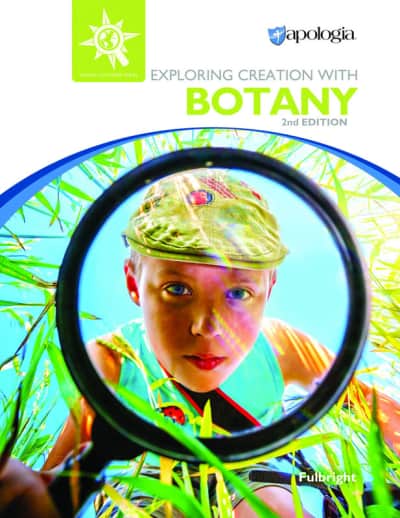
The beauty of creation has never been more evident than in this 2nd edition of Exploring Creation with Botany. Now with 14 lessons and a newly designed course schedule, students will have even more hands-on experience as they cultivate their love of learning all about the plants God created.

With new and redesigned activities, students will read about and explore why botany matters. They will learn about seeds, pollination, and fruits. They will understand the importance of leaves, roots, and stems. And all along, they will be preparing for growing their own garden andmuch more! By building and using their own light hut in the opening chapter, students will be continually studying the life cycle of different types of plants throughout their year of studying botany.

Young botanists will also be taught how to think like a scientist. In addition to their hands-on written notes, mini-book (lap-style) activities, and vocabulary building exercises in their Notebooking Journals, students will also create their own Nature Journal to take with them as they go outside to explore, study, and document the wonderful world of plants and fungi.

This course title is one in Apologia's Young Explorers series and is designed to be used in any grade from 1st grade through 6th grade. Created in a Charlotte Mason learning style, students are not tested, but rather they are encouraged to use their Notebooking Journal to documentall that they learn. Throughout the text, and included in the Notebooking Journal, are "What Do You Remember" questions where students are encouraged to stop and explain in their own words to someone else the materials they are studying. By allowing students the freedom toincorporate their new knowledge into their own words, students are better equipped to remember what they are learning.


Category Description for Exploring Creation with Botany

Exploring Creation with Botany from Apologia is an engaging elementary science course that explores the world of plants from a biblical worldview. Now in its 2nd edition, it helps students discover God’s design in seeds, flowers, pollination, fruits, leaves, roots, stems, and more, while introducing mycology (the study of fungi) and practical gardening skills.

The course combines clear explanations, vibrant illustrations, and hands-on activities to make botany memorable and meaningful.

Key Curriculum Features:

  • 14 chapters covering botany basics, plant structures, pollination, food production, and fungi
  • Updated text with improved layout, graphics, and a less casual tone
  • Hands-on activities and outdoor adventures (e.g., building a raised garden)
  • Greater emphasis on Charlotte Mason–style nature journaling
  • Flexible pacing: 2 days per week, approximately one hour per day

Program Components:

  • Student Textbook: Full-color hardcover text with lessons, explanations, and activities
  • Notebooking Journal (regular or Junior): Consumable journal for recording observations, drawings, and reflections. The Junior version has less handwriting and more coloring
  • Lab Kit (optional): Convenient package from Nature’s Workshop with most supplies needed for experiments

Important Note: 1st and 2nd editions are not compatible.

Exploring Creation with Botany stands out for its beautiful presentation, hands-on approach, and clear biblical worldview that nurtures curiosity about God’s creation. It is an excellent choice for homeschool families seeking an engaging elementary botany course that combines science and faith.

Browse all Exploring Creation with Botany resources and sets below!

Details
More Information
Product Format:Hardcover
Grades:K-6
Brand:Apologia
ISBN:9781946506399
Length in Inches:11.1875
Width in Inches:8.625
Height in Inches:0.625
Weight in Pounds:1.9438
Videos
This product doesn't have a video
Reviews
Product Q&A