
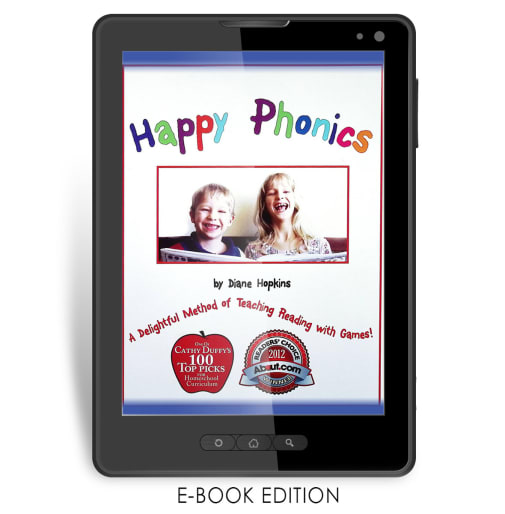
Do you have a child that would rather be playing games than completing workbook pages? This hands-on phonics program was written by a homeschool mom who had a very active little boy. She found a way to teach him to read and developed this entertaining program with lots of fun activities! This digital packet includes the Teacher Guidebook, a 76-page beginning reader, flashcards, game components, little readers, and spelling lists. The Teacher Guidebook is easy to follow and includes straightforward instruction on how to use the games and other components. The digital version does not come with any print material. After purchasing, the publisher will send you an email and you will have access to all the material in a PDF format. ~ Gina
Happy Phonics Digital Version
SKU
000818
Grade PK-3
These icons are designed to help you quickly understand and learn important information about our products.
Teaching Method
Traditional
Teacher-centered curriculum commonly used in classrooms that may include a text, teacher manual, tests, etc.
Charlotte Mason
A methodology based on the work of a 19th century educator who maintained that children learn best from literature (Living Books), not textbooks.
Classical
A methodology based on the Latin Trivium (three stages of learning), including the grammar stage (memorization and facts), logic stage (critical thinking), and rhetoric stage (developing/defending ideas).
Unit Study
A thematic or topical approach centered around one topic that integrates multiple subject areas.
Montessori (Discovery)
A methodology based on the work of a 20th century educator that emphasizes student and sensory-driven discovery learning and real-life applications.
Other
Other methodologies
Religious Content
Secular
Contains content contrary to common Christian beliefs (i.e. evolution).
Neutral
Avoids religious or theoretical topics or presents multiple viewpoints without preference.
Christian/Religious
Faith-based or including instructional religious content.
Learning Modality
Auditory
Learns through listening, talking out loud or reading out loud.
Visual
Learns through seeing, prefers written instructions and visual materials.
Kinesthetic/Tactile (Hands-On)
Learns through moving, doing and touching.
Multi-Sensory
Curriculum that employ a variety of activities/components.
Presentation
Sequential
Curriculum progresses through well-defined learning objectives. Emphasizes mastery before moving to the next topic.
Spiral
Topics and concepts are repeated from level to level, adding more depth at each pass and connecting with review.
Conceptual/Topical
Focus is on the “why,” often with a unifying concept as well as specific skills; coverage may be broader.
Teacher Involvement
Low Teacher Involvement
Student-led materials; parent acts as a facilitator.
Medium Teacher Involvement
A mix of teacher-led time and independent student work.
High Teacher Involvement
Teacher-led lessons; may utilize discussions, hands-on activities and working together.
Additional Materials Required
No other materials needed
Everything you need is included.
Other Materials Required
There are additional required resources that are a separate purchase.
Other Materials Optional
There are additional resources mentioned or recommended but are not absolutely necessary.
Consumable
Consumable
Designed to be written in; not reusable.
Non-Consumable
Not designed to be written in; reusable.
Our Price
$34.95 Product Overview
- A complete hands-on phonics program with straightforward instruction, games, flashcards, and readers
- All components are digital and come to you in a PDF format after purchasing
- Teacher guide shows you how to use Explode the Code books with the program
Important
Non-returnable. Is, or contains, a digital item.Description
Publisher's Description of Happy Phonics Digital Version
When my son Ammon was a very bright, wiggly and energetic 5-year-old, he couldn't seem to get interested in workbooks or sit still for lessons. The only way I could get his attention long enough to teach him to read was to play games with him. Over the years, these games have evolved into an easy, happy way to teach children to read, from the very first step (learning the ABC song) through advanced phonics and spelling.
Simple, yet entertaining and educational, these phonics games are printed on colorful, sturdy cardstock ready to cut out. Included is a mother-friendly guidebook which contains the details on how I teach phonics and reading, how to pronounce and teach the phonics sounds, how to make your own simple beginning readers, and step-by-step teaching info for each phonics sound.
Happy Phonics covers beginning to advanced phonics and is the sum total of my experience. My children enjoy the games and never really realize that they are drilling phonics sounds! Enjoy learning games, little books, and activities as well as a 76-page beginning reader, My Big Book. Use with the Explode the Code Primers A, B, C for a complete manuscript handwriting and phonics course.
I think you will be very pleased with the pain-free, rapid reading results! I guarantee you will love it and your child will learn to read, or I'll send your money right back--happily!
Simple, yet entertaining and educational, these phonics games are printed on colorful, sturdy cardstock ready to cut out. Included is a mother-friendly guidebook which contains the details on how I teach phonics and reading, how to pronounce and teach the phonics sounds, how to make your own simple beginning readers, and step-by-step teaching info for each phonics sound.
Happy Phonics covers beginning to advanced phonics and is the sum total of my experience. My children enjoy the games and never really realize that they are drilling phonics sounds! Enjoy learning games, little books, and activities as well as a 76-page beginning reader, My Big Book. Use with the Explode the Code Primers A, B, C for a complete manuscript handwriting and phonics course.
I think you will be very pleased with the pain-free, rapid reading results! I guarantee you will love it and your child will learn to read, or I'll send your money right back--happily!
Category Description for Happy Phonics
The essence of Happy Phonics is to introduce phonics concepts a few at a time and then play games for retention. Written by a homeschool mom, Mrs. Hopkins has boiled the entire process down into eight steps: alphabet song; capital letters match lowercase letters; the main sound for each letter; blend letter sounds to form a word; teach common non-phonetic (sight) words; teach vowels that can make a second sound; teach through the phonic units; READ.
The games and other reinforcement activities are a central component of this program, and some preparation is required. Cutting out and possibly laminating the games is the most time-consuming part of the program. The author suggests that lesson time be about 10 minutes a day. The package contains the Happy Phonics Guidebook, “My Big Book,” and plenty of printed, brightly colored paper and cardstock - flashcards, game components, first little readers and spelling lists. The Guidebook contains the Eight Steps along with specific how-to instructions for each step. Suggestions for written practice and supplemental readers are found in the program.
Details
| Product Format: | Other |
|---|---|
| Grades: | PK-3 |
| Brand: | Love to Learn |
Videos
Reviews