
- Bargain Items are brand-new products that have been dinged, dented, or scuffed, but are otherwise in usable condition.
- Bargain Items have limited inventory, and they are only reserved for you when checkout is completed.
- Bargain Items are non-returnable and non-refundable.
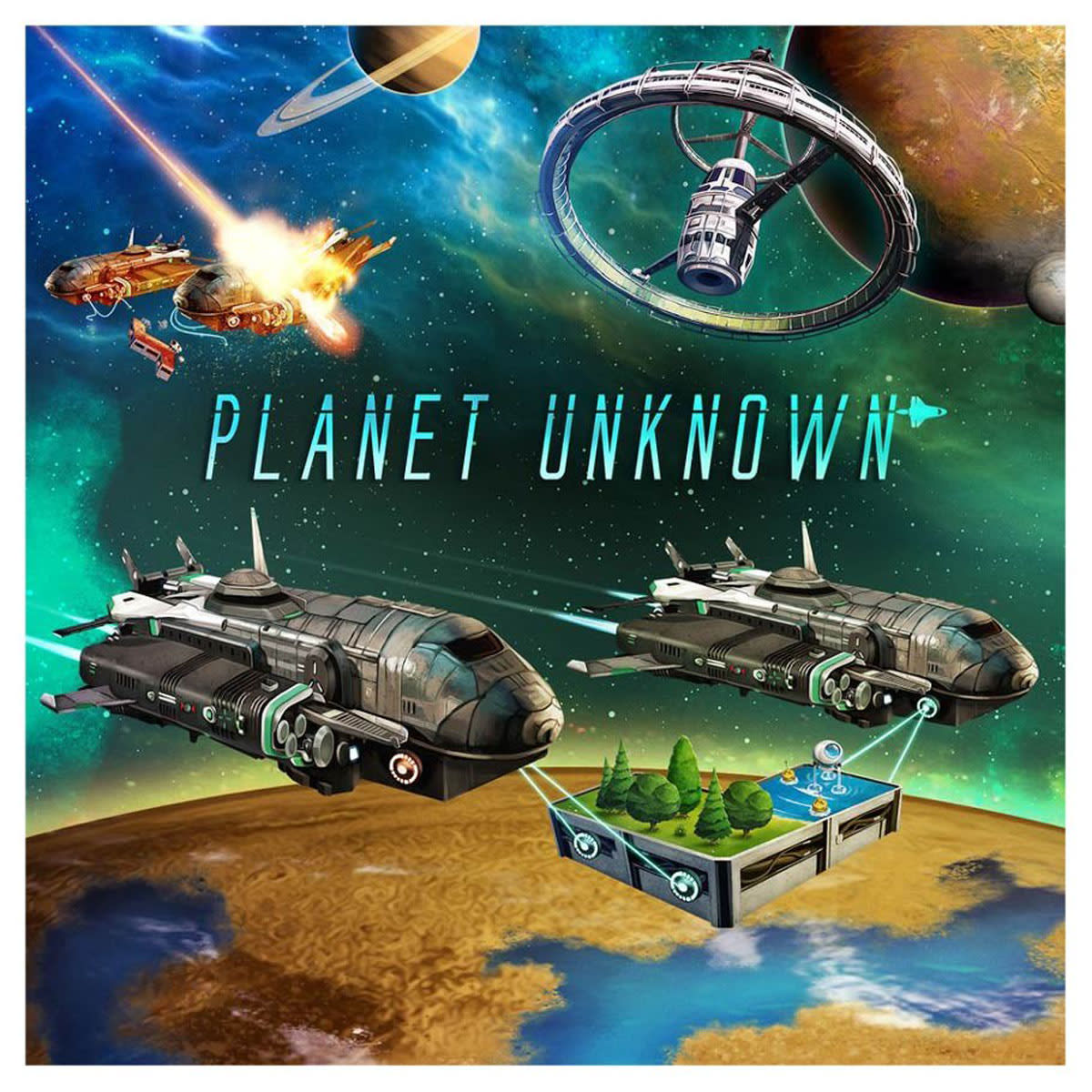
Planet Unknown by Adam’s Apple games transports each player to an unknown, newly discovered, and undeveloped planet for a strategic challenge. Choosing from 12 different shaped polyomino tiles, which contain two different resources each, players compete to provide their planets with a solid infrastructure to make the planet habitable.
The tiles are all contained in a space station, which functions like a Lazy Susan and is divided into six depots, each of which has two different tile types. Players start by placing a “depot indicator” matching their player color in front of one of the depots. Each round, they will take turns being the Commander, which gives them the opportunity to move the space station around to a tile set which they can choose from. After they take one of the two tiles in the depot they choose, other players select one of the two tile types positioned in front of their depot indicator and immediately place them on their planet map boards.
Individual items players start with are a planet map board and a resource (corporation) tracker board. Both board types are two-sided with identical (symmetric) maps and tracker boards on one side of each and asymmetric sides on the other side. Beginning players usually start with the symmetric sides of the maps and resource boards, as they are not as challenging in difficulty or complexity to play as the asymmetric boards. To complete setup, five different colored resource tracker tokens are placed on the 0 space of each resource track. The planet map is populated with “Lifepod” tokens where they are indicated on the player map and furnished with the number of rovers that are determined by the resource board each player uses. Additional community resources placed in easy reach are biomass patches and meteorites. The other item to set up before the game starts is objective cards. There is a deck of 28 two-sided objective cards that are either shared by “neighbors” or used privately. (Solo games use the private side.) In a two-player game, three cards are shared by both players and in a 3-6 player game, one card is positioned between each player so that everyone has two objectives to work on.
As mentioned previously, each tile used to transform the planet maps contains two of six different resources. When a tile is placed on a planet map board, players move up on the corresponding resource tracks that match those provided on the tile. Each resource track provides escalating medal values that add to end-game scoring and additional moves up on any resource track.
Following is a description of unique resource track resources and benefits. One of these resources (Energy) does not have a resource track of its own.
- Civ Resource—Before the game starts, the 36 Civ Cards (8 each of 4 different levels) are separated by level facedown and made available to all players. Moving up this track will provide a chance to look through each level’s card stack as that level is reached. These cards provide choices of benefits during the game or end-game points.
- Water—There are no unique benefits on this track, but tiles containing water resources must be placed over a space on the planet map that contains water to move up this track.
- Rovers—Reaching a rover space on the track allows the player to put one of their rovers on their planet map. After that, moving up the track onto one of the many numbered areas gives rovers that number of moves on the player’s planet map. The role of rovers is to remove meteorites and Lifepods from player maps and onto collection areas, which scores points at the end of the game. Another reason to remove meteorites is that they impede scoring goals when left on the map. (See overall game goals below for a better understanding.)
- Tech—The unique resources on this track are beneficial rule modifications or actions. One example would be to add one step to each rover movement that you gain for the rest of the game.
- Biomass—There is a supply of Biomass tiles (1x1 square pieces). They are useful to fill an empty square on a map board. There are five spaces on this resource track that provide one, but they must be placed immediately unless you have a special action that allows you to hold it for a later placement.
- Energy—Because there is no energy track, you are allowed to advance on another resource track, either on the placed tile containing the energy or any adjacent tile.
Overall game goals: While working on objective cards and moving up resource tracks, players should try to complete as many rows and columns on their player maps as possible that contain no asteroids or blank squares. Longer rows and columns provide up to three points each, while medium and shorter completed rows and columns provide 2 and 1 points each, respectively. The game ends when both tiles in any space station segment are used or when any player cannot place either available tile in their segment on a turn. The round is played through and the person with the most points wins! Points are awarded for completed rows and columns on planet maps, positions on resource tracks, lifepods and meteorites collected, any civ cards that award end-game points, private objectives (if playing solo), and the winner of the neighbor objective cards. For 1-6 players with a 60–80-minute play time. ~ Marsha