
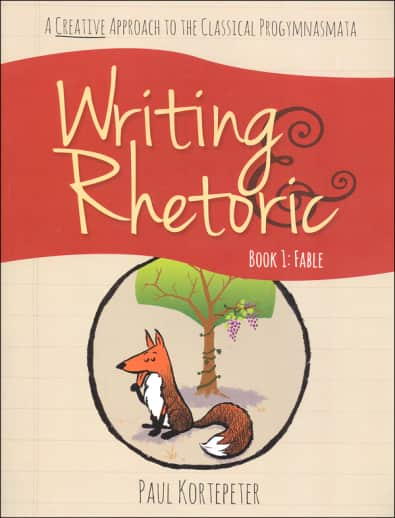

Book 1 Fable of Writing and Rhetoric
provides the starting point for 3rd or 4th grade students
and a point of reference or form to follow in their own writing. Ancient fables
and proverbs from all over the world are introduced to study and learn
from—Aesop’s fables are extensively used, with others from China, India, and
the Hebrew Scriptures sprinkled throughout. Everything needed for the student
is provided in this workbook, printed copies of the fables, lines for writing
assignments, artwork for picture studies, and basic directions. This creative
approach to writing in the classical methodology uses multiple learning styles
from book work, recitation, drama, dictations, and writing their own
fables—every kind of learner will be supported and challenged to learn more!
The publisher does offer additional rubrics for the writing samples and an Errata
Sheet for Book 1. 168 pages, softcover. ~Rebecca
***Please Note: The Hebrew Scriptures are utilized
throughout this book as an example of Ancient Literature.
Writing & Rhetoric Book 1: Fable Student Edition
Product Overview
- A one-semester (14 lessons), classical approach to teaching writing for elementary students—first semester!
- Plenty of room to write in the workbook
- Optional audio files are available that read the fables aloud
Description
A Creative Approach to the Classical Progymnasmata—Think of the progymnasmata as a step-by-step apprenticeship in the art of writing and rhetoric. What is an apprentice? It is a young person who is learning a skill from a master teacher. Our students will serve as apprentices to the great writers and great stories of history.
Students are often expected to write with no clear model before them. Modern composition scolds traditional writing instruction as rote and unimaginative. It takes imitation to task for a lack of freedom and personal expression. And yet, effective communication from writer to reader always requires some sort of form and structure. Many of history's greatest writers learned by imitation. In other words, writing takes the same kind of determined study as ballet or diving. Creativity uses conventional form as a stage or a springboard from which to launch grand jetés and somersaults. Too often students are expected to tackle complex writing assignments without learning the necessary intermediate steps. The assumption is that because most everyone can speak English well enough to be understood, and form letters with a pencil, that everyone should be able to write well. Yet how many of us would expect a child to sit at a piano, without piano lessons, and play a concerto? Writing is never automatic.
The Writing & Rhetoric series method employs fluent reading, careful listening, models for imitation, and progressive steps. It assumes that students learn best by reading excellent, whole-story examples of literature and by growing their skills through imitation. Each exercise is intended to impart a skill (or tool) that can be employed in all kinds of writing and speaking. The exercises are arranged from simple to more complex. What's more, the exercises are cumulative, meaning that later exercises incorporate the skills acquired in preceding exercises. This series is a step-by-step apprenticeship in the art of writing and rhetoric.
Fable, the first book in the Writing & Rhetoric series, teaches students the practice of close reading and comprehension, summarizing a story aloud and in writing, and amplification of a story through description and dialogue. Students learn how to identify different kinds of stories; determine the beginning, middle, and end of stories; recognize point of view; and see analogous situations, among other essential tools. The Writing & Rhetoric series recovers a proven method of teaching writing, using fables to teach beginning writers the craft of writing well. This is the first in a series of 12 books that will train students over 6 years, starting in grades 3 or 4 and up.
Lessons include:
- Narration/telling it back (creating a natural sense of outline/sequence)
- Analogy—learning how this story is like/different from other stories
- Comprehension
- Sentence play/word play
- Rewriting (gaining a sense of internal structure of a piece of writing)
- Summary
- Amplification
- Rewriting given stories
- Speak It—experiencing the story from your own mouth (orally) with an audience for a different point of contact, often with some sort of change than the first time you heard it.
See the Support tab above for suggested schedule and rubrics.
This is a consumable item.
Classical Academic Press’ Writing and Rhetoric Book 1:
Fable is the first semester course for 3rd or 4th
grade students. Introducing writers to the classical progymnasmata (progym)
model of writing. This method uses a heavy reliance on modeling good literature
and writing styles. This first book uses Fables as the writing
example—providing readings from Aesop’s fables as well as fables from China,
India, the Hebrew scriptures, Italy, and others. Targeted writing skills
include
- Anthropomorphism
- Amplification
- Summarizing
- Narration and Dictation
- Following an outline
- Creating one’s own Fable
| Product Format: | Paperback |
|---|---|
| Grades: | 3-4 |
| Brand: | Classical Academic Press |
| ISBN: | 9781600512162 |
| Length in Inches: | 11 |
| Width in Inches: | 8.5 |
| Height in Inches: | 0.625 |
| Weight in Pounds: | 1.1 |