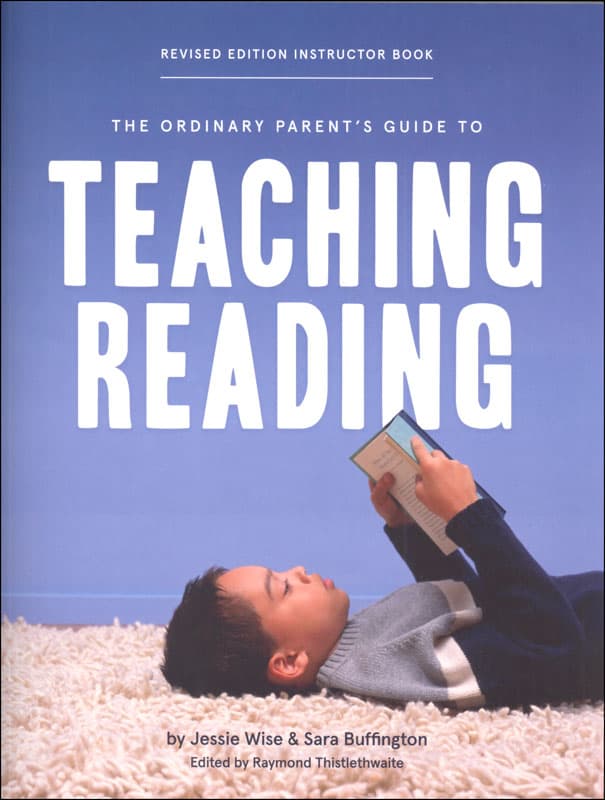
The Ordinary Parent's Guide to Teaching Reading Revised Edition (Paperback)

SKU
008253
ISBN
9781952469251
Grade PK-3
Classical
Neutral
High Teacher Involvement
Multi-Sensory
Other Materials Optional
Teaching Method
Traditional
Teacher-centered curriculum commonly used in classrooms that may include a text, teacher manual, tests, etc.
Charlotte Mason
A methodology based on the work of a 19th century educator who maintained that children learn best from literature (Living Books), not textbooks.
Classical
A methodology based on the Latin Trivium (three stages of learning), including the grammar stage (memorization and facts), logic stage (critical thinking), and rhetoric stage (developing/defending ideas).
Unit Study
A thematic or topical approach centered around one topic that integrates multiple subject areas.
Montessori (Discovery)
A methodology based on the work of a 20th century educator that emphasizes student and sensory-driven discovery learning and real-life applications.
Other
Other methodologies
Religious Content
Secular
Contains content contrary to common Christian beliefs (i.e. evolution).
Neutral
Avoids religious or theoretical topics or presents multiple viewpoints without preference.
Christian/Religious
Faith-based or including instructional religious content.
Learning Modality
Auditory
Learns through listening, talking out loud or reading out loud.
Visual
Learns through seeing, prefers written instructions and visual materials.
Kinesthetic/Tactile (Hands-On)
Learns through moving, doing and touching.
Multi-Sensory
Curriculum that employ a variety of activities/components.
Presentation
Sequential
Curriculum progresses through well-defined learning objectives. Emphasizes mastery before moving to the next topic.
Spiral
Topics and concepts are repeated from level to level, adding more depth at each pass and connecting with review.
Conceptual/Topical
Focus is on the “why,” often with a unifying concept as well as specific skills; coverage may be broader.
Teacher Involvement
Low Teacher Involvement
Student-led materials; parent acts as a facilitator.
Medium Teacher Involvement
A mix of teacher-led time and independent student work.
High Teacher Involvement
Teacher-led lessons; may utilize discussions, hands-on activities and working together.
Additional Materials Required
No other materials needed
Everything you need is included.
Other Materials Required
There are additional required resources that are a separate purchase.
Other Materials Optional
There are additional resources mentioned or recommended but are not absolutely necessary.
Consumable
Consumable
Designed to be written in; not reusable.
Non-Consumable
Not designed to be written in; reusable.
Our Price
$37.95 $37.95 $23.75
Rainbow Savings: $14.20

Description

The Instructor Guide begins with a How to Use section, followed by the phonics lessons. If you are new to teaching phonics or unfamiliar with phonics as a reading method (like this writer who learned to read through Dick and Jane and the look-say method), you may want to read Part 2 first. Here, the "ordinary" parent finds sections on preparing a young child to be a reader, managing the reading session, encouraging a child to be a reader, working with remedial readers, a key to phonetic symbols as well as a collection of questions and answers. The phonics instruction starts with short-vowel sounds; then it progresses through consonant sounds; short-vowel words; two-consonant blends; consonant digraphs; three-consonant beginning blends; long-vowel sounds; silent-e words; long-vowel sound spellings; other vowel sound spellings; other spellings for short-vowel sounds; silent letters; r-changed vowels; two-syllable words; other letter patterns and silent letters; possessive words and contractions; other spellings for the long-e sound; plural and hyphenated words; three-syllable words; endings, suffixes, and prefixes; more letter patterns; and a final section on homonyms, homophones, and homographs. Following a typical pattern, lessons are scripted with necessary supplies clearly noted. Intermingled with the instructor's words are explanations of phonics specifics [i.e. ng looks like a consonant blend (two distinct sounds blended together), but it is actually a consonant digraph (two letters representing a single speech sound)]. These explanations are extremely helpful for the "ordinary" parent who wishes to understand phonics terminology. Many lessons include optional follow-up activities to review the lesson or previously learned material. All of the Student materials previously found in the Ordinary Parents Guide to Teaching Reading Manual are now found in the separate Student Book.

Publisher's Description of The Ordinary Parent's Guide to Teaching Reading Revised Edition (Paperback)
The Ordinary Parent's Guide to Teaching Reading, Revised Edition, Instructor Book is part of an updated, easier-to-use edition of the phonics program that helped a million parents teach their children to read. Scripted, open-and-go lessons enable you to give your student a strong foundation in reading. Student Book also required. You can add it easily by creating a bundle, below.

The Ordinary Parent's Guide to Teaching Reading is a popular and trusted phonics-based reading program for homeschool families. Newly revised with updated content, clearer formatting, and a two-book format, it gives ordinary parents the confidence and tools needed to successfully teach their children to read. No special training required!

This straightforward, scripted program teaches reading through systematic phonics instruction, starting with short vowels and progressing step-by-step through blends, digraphs, long vowels, silent letters, multi-syllable words, and more. Lessons are clear, easy to follow, and include helpful explanations of phonics rules so parents truly understand what they are teaching.

Key Features:

  • Fully scripted lessons that require no prior teaching experience
  • Two-book format: separate Instructor Guide and Student Book
  • Logical progression from basic sounds to advanced reading skills
  • Built-in review and optional enrichment activities
  • Flexible pacing ideal for ages 4-7

Program Components:

  • Instructor Guide (559 pages): Complete lesson plans, teaching tips, phonics explanations, answer keys, and guidance for beginners and remedial readers
  • Student Book (335 pages): All reading practice pages, words, sentences, rhymes, and short stories

Optional Resources:

  • 320 pre-printed flashcards
  • Audio Companion CD for correct pronunciation of sounds through rhymes and songs

The Ordinary Parent's Guide to Teaching Reading is an excellent choice for homeschool families who want a thorough, no-nonsense, phonics-first program that produces strong, confident readers. Its clear structure and parent-friendly approach have made it a longtime favorite among homeschoolers.

Details
More Information
Product Format:Softcover Book
Grades:PK-3
Brand:Well-Trained Mind Press
ISBN:9781952469251
Length in Inches:11
Width in Inches:8.625
Height in Inches:1.25
Weight in Pounds:3.1
Videos
This product doesn't have a video
Reviews
Product Q&A