
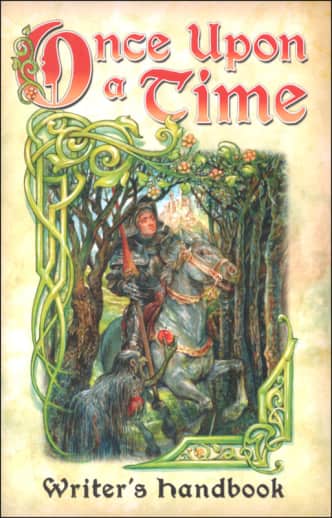
A wonderful handbook for the developing storyteller! While the handbook primarily teaches storytelling by use of the companion Once Upon a Time card game, the tips, tricks, and suggestions can still be used on their own. The book also employs Vladimir Propp’s Functions of a Fairytale (included in appendix) to teach storytelling—31 main events, or parts, of a fairytale. Five chapters cover brainstorming, character development, setting, beginnings, and endings, with tips, prompts, and examples scattered throughout. Students will study structure, plot, themes, and style, with ample discussion on outlining, showing vs telling, pace, grammar, vocabulary, tense, and point of view. After all these elements are studied, students turn the page to encounter the editing section, which includes a sample first draft of a short story along with model edits paragraph-by-paragraph. (A finalized version of this same sample, with the edits incorporated, is included in the appendix.) The handbook wraps up with writing and revising tips, a section on writer’s block, and a brief discussion on publishing. In addition to the Vladimir Propp list and the edited short story, the appendix also includes a recommended reading list of books about writing. 127 pgs, pb.
Once Upon a Time: Writer's Handbook
Product Overview
- Designed to be paired with the Once Upon a Time card game but can be used by itself
- Covers all the main elements of a story, plus discussions on outlining, structure, theme, pace, tense, point of view, and more
- Brainstorming prompts, writing tips, and a helpful appendix included
- Editing section includes an example first draft of a short story with model edits on each paragraph to help students visualize what is being taught
Description
In Once Upon a Time, players work together to tell a tale based on the information on the cards in their hand. Use this game to jumpstart your fiction writing with the Writer's Handbook.
Learn how to put story elements together to create flow, and examine why some stories work and others don't. Easily generate ideas to practice the material in the book using your Once Upon a Time game. Bust through writer's block and improve your craft with this easy-to-use tool!
Weave a fairy tale as you play story element cards to work your story towards your desired ending. The first player puts down story element cards for character, thing, place, aspect, and event. The storyteller keeps playing cards while telling the story until they get stuck. The next player continues the story. Another player can sometimes play an interrupt card to take over. Contains 114 beautifully illustrated story cards and 51 ending cards. Expansion Card Sets include 55 new cards (38 story and 17 ending cards). Inspires creative thinking and listening skills! The Writer’s Handbook (optional) helps turn game cards into awesome fiction stories! Use it to break through writer’s block, get ideas flowing, and provide the needed framework for a great story.
| Product Format: | Paperback |
|---|---|
| Grades: | 3-AD |
| Brand: | Atlas Games |
| ISBN: | 9781589781122 |
| Length in Inches: | 8.5 |
| Width in Inches: | 5.5 |
| Height in Inches: | 0.375 |
| Weight in Pounds: | 0.4 |