
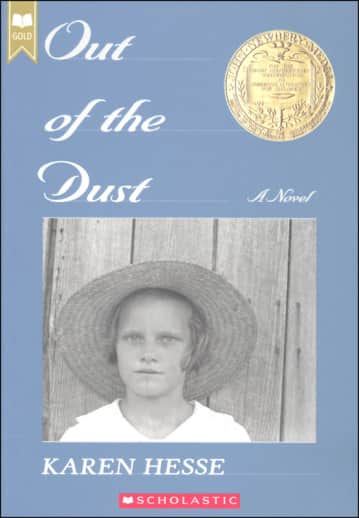
Set in the dust bowl era, a tragic accident takes the life of Billie Jo's mother. Filled with guilt and anger, Billie slowly regains hope as rains finally come to their farm and her father meets a special person.
Out of the Dust by Karen Hesse
SKU
009483
ISBN
9780590371254
Grade 4-10
These icons are designed to help you quickly understand and learn important information about our products.
Teaching Method
Traditional
Teacher-centered curriculum commonly used in classrooms that may include a text, teacher manual, tests, etc.
Charlotte Mason
A methodology based on the work of a 19th century educator who maintained that children learn best from literature (Living Books), not textbooks.
Classical
A methodology based on the Latin Trivium (three stages of learning), including the grammar stage (memorization and facts), logic stage (critical thinking), and rhetoric stage (developing/defending ideas).
Unit Study
A thematic or topical approach centered around one topic that integrates multiple subject areas.
Montessori (Discovery)
A methodology based on the work of a 20th century educator that emphasizes student and sensory-driven discovery learning and real-life applications.
Other
Other methodologies
Religious Content
Secular
Contains content contrary to common Christian beliefs (i.e. evolution).
Neutral
Avoids religious or theoretical topics or presents multiple viewpoints without preference.
Christian/Religious
Faith-based or including instructional religious content.
Learning Modality
Auditory
Learns through listening, talking out loud or reading out loud.
Visual
Learns through seeing, prefers written instructions and visual materials.
Kinesthetic/Tactile (Hands-On)
Learns through moving, doing and touching.
Multi-Sensory
Curriculum that employ a variety of activities/components.
Presentation
Sequential
Curriculum progresses through well-defined learning objectives. Emphasizes mastery before moving to the next topic.
Spiral
Topics and concepts are repeated from level to level, adding more depth at each pass and connecting with review.
Conceptual/Topical
Focus is on the “why,” often with a unifying concept as well as specific skills; coverage may be broader.
Teacher Involvement
Low Teacher Involvement
Student-led materials; parent acts as a facilitator.
Medium Teacher Involvement
A mix of teacher-led time and independent student work.
High Teacher Involvement
Teacher-led lessons; may utilize discussions, hands-on activities and working together.
Additional Materials Required
No other materials needed
Everything you need is included.
Other Materials Required
There are additional required resources that are a separate purchase.
Other Materials Optional
There are additional resources mentioned or recommended but are not absolutely necessary.
Consumable
Consumable
Designed to be written in; not reusable.
Non-Consumable
Not designed to be written in; reusable.
Our Price
$8.99 $8.99 $5.95
Rainbow Savings: $3.04
Description
Publisher's Description of Out of the Dust by Karen Hesse
A poem cycle that reads as a novel, Out of the Dust tells the story of a girl named Billie Jo, who struggles to help her family survive the dust-bowl years of the Depression. Fighting against the elements on her Oklahoma farm, Billie Jo takes on even more responsibilities when her mother dies in a tragic accident. A testament to the American spirit, this novel is an instant classic.
This gripping story, written in sparse first-person, free-verse poems, tells of Billie Jo's stoic courage, as she learns to cope with the loss of her mother and her grieving father's slow deterioration. There is hope at the end when Billie Jo's badly burned hands are healed, and she is able to play her beloved piano again.
Category Description for Middle School Grades 6-8
The Middle School guides is our largest offering of titles with Progeny Press. With over 40 titles to choose from, there are numerous books that will likely be suitable for your student. All presented from a Christian worldview, each guide is filled with comprehension questions, vocabulary building, and scriptural connections and application. Pages can be copied for family and individual classroom use. Many of the classics are found in this collection and would provide a great opportunity (or incentive) for your students to read the book and watch the movie! The recommended target goal is for students to read 4-6 guides during the school year. Answers are in the back and can be easily removed. Each guide includes Notes to the Instructor, mini author biographies, and background information. You may be working with a range of students all from one guide, and that’s okay! Each student will do what they are developmentally capable of accomplishing. It is easy to read just for fun, yet adding a literature guide helps to provide a guided reading experience promoting deeper thought and critical thinking. ~Rebecca
Details
| Product Format: | Softcover Book |
|---|---|
| Grades: | 4-10 |
| Brand: | Scholastic |
| Author: | Karen Hesse |
| ISBN: | 9780590371254 |
| Length in Inches: | 7.568 |
| Width in Inches: | 5.261 |
| Height in Inches: | 0.646 |
| Weight in Pounds: | 0.36 |
| Ages: | 9 - 12 |
| Awards: | Newbery Medal 1998 |
| Pages: | 240 |
| Publication Date: | 1/1/1999 |
Videos
Reviews