
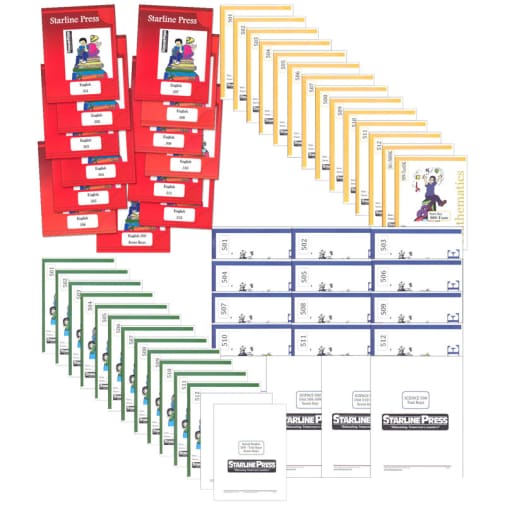
English: Dictionary and Thesaurus skills are further developed. Instruction progresses on proper usage of singular, plural and subject noun; verbs including action, compound, helping and state of being, verb phrases and verb endings. Spelling lists with spelling rules are incorporated at this age. Students also study figures of speech, metaphors, imagery and narratives, including writing and giving a narrative presentation. To enrich the reading experience, students complete several literature compositions, including: The Lion, The Witch and The Wardrobe, Alice's Adventures in Wonderland, The Mayflower Conflict, Paul Revere's Ride and Aunt Polly Shedd's Brigade. Fifth grade students also use the encyclopedia to conduct research and obtain information. They learn to write an outline, revise and rewrite, take notes and complete a finished report.
Math: Updated in 2020, the core content remains the same as the previous edition, but has been rearranged, with a couple additional mental math lessons added. Students engage in standards-based activities, including place value, decimals, exponents and prime factors. Students also review and build on the four math operations (addition, subtraction, multiplication and division) and apply them to fractions, decimals, as well as positive and negative numbers. Integers are introduced, including how to identify; translate and write expressions; along with adding/subtracting integers. Students will also learn variable and use tables, and organize and display data with graphs. Students study shapes, lines, points and angles, and learn to solve perimeter, surface and volume of an area. Students will develop strong problem-solving skills, conceptual understanding and procedural skills. Set includes 12 student worktexts, score keys and test keys. Keys are answers only, no solutions are included.
Science: Students build on investigation and research skills. They study atoms, elements, and the periodic table, as well as solids, liquids and gases. Students also learn about energy, electricity and light, and how cameras and telescopes work. Through experiments and research, students study the human body, including cells, the heart, breathing and circulatory system, as well as the digestive system. Learners also study animal and plant cells, and the life cycles of plants, animals and insects. They will learn about ecosystems, habitats and weather effects on our planet, along with constellations and the planets' effects on one another. Activities use primarily common household items.
Social Studies: The people of the Americas are studied including Cliff Dwellers, Nomads, American Indians and Woodland People. Students study explorations and explorers, such as Christopher Columbus and Francisco Vasquez de Coronado, as well as early land and sea explorers. Early settlements and colonies in North America are also studied. The French and Indian war, Declaration of Independence, Bill of Rights, westward expansion, California Gold Rush, and the Oregon Trail are all taught. Students do reports, create dioramas, and view artifacts to enrich understanding. Students are expected to work in groups and alone to prepare charts, graphs and develop critical thinking skills. ~Sara