
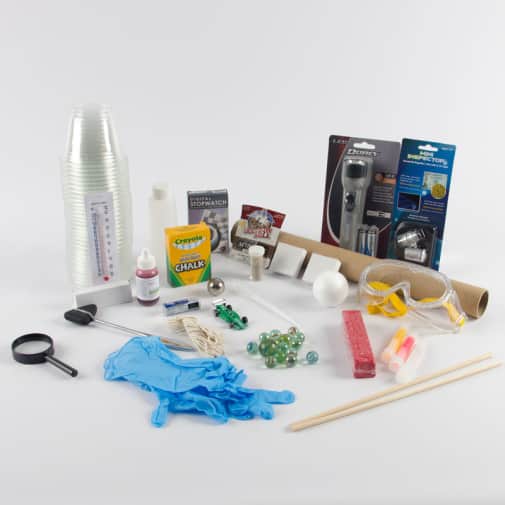

Kit includes a magnifying glass, 20x mini-inspector, modeling clay, antacid tablets, clear plastic cups, disposable pipets, protozoa culture kit, blank glass slides, Eosin Y, yeast, Ziplock bags, nitrile gloves, digital stop watch, marbles, HDPE plastic bottle, chalk, dowels, percussion (reflex) hammer, child’s safety goggles, toy car, plastic student thermometer, heavy cord, white card stock, cardboard tube, manila folder, 2 double convex lens, Styrofoam ball, glow sticks, LED flashlight and steel ball. You will need to provide colored pencils, sodium chloride (table salt), sodium bicarbonate (baking soda), red cabbage indicator (or make your own!), measuring spoons and cups, black permanent marker, milk chocolate bar, economy rock pick (or hammer), and acetic acid (vinegar).
Exploring the Building Blocks of Science Book 2 Kit
- Small parts. Not for children under 3 years.
Description
This handy kit contains over 30 items for experiments in the Building Blocks of Science Book 2. This kit makes gathering materials easy so you can focus on hands-on learning for your student instead! Included in this kit you will find glow sticks, gloves, marbles, protozoa, a reflex hammer, mini-inspector, assorted slides, pipet, clay, marbles and more! Students will learn about chemistry, biology, physics, astronomy, and geology through these interactive experiments.
Contents List: Bottle, 125 ml (4 oz), natural HDPE; Pipet, disposable, 1 ml; Antacid Tablets, 12 pack; Chalk (calcium carbonate); Eosin Y, 1%, 30 ml; Clay, modeling, 1/4 lb.; Glow Sticks, 3 pack, assorted colors; Gloves, Nitrile, Small, 2 pairs; Marbles, pack of 15; Protozoa, dry live culture with instructions;Yeast, packet; Ball, steel, 1"", each; Percussion or Reflex Hammer;String, heavy cord, 25'; Toy Car; Digital Stop Watch; Plastic Student Thermometer; Mini Inspector 20X; Slides, plain glass, 12 pack; Lens, double convex, 150mm f/l; Lens, double convex, 500mm f/l; LED Flashlight, 25 Lumens; Magnifying Glass, 2"", 3X Lens; 5x7 Ziplock Bags, 6 pack (not pictured); Card Stock, 110#, 8-1/2"" x 11"", 2 sheets; Cup, clear plastic, 9 oz, 30 pack; Dowel, 1/4"", 12"" long, 2 pack; Folder, manila letter size; Styrofoam Ball, 2"" diameter; Cardboard Tube, 1-1/2"" X 15"; Chemical Splash Safety Goggles, Child
In this level, students will look at the most common tools used in science, as well as acids and bases, chemical reactions, constellations, solar systems, stars, protists, fungi, motion, friction, geosphere and atmosphere. A typical week includes reading the chapter, performing the experiment, and review.
| Product Format: | Other |
|---|---|
| Grade: | 2 |
| Brand: | Home Science Tools |
| Length in Inches: | 19.1875 |
| Width in Inches: | 14.5 |
| Height in Inches: | 5.25 |
| Weight in Pounds: | 4.15 |