
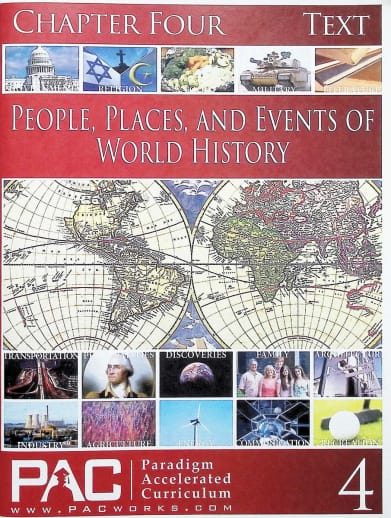
This course, designed for high school students, studies the 15 basic components of cultures from 5000 BC through 2011 AD: Agriculture, Architecture, Communication, Discoveries, Dominant Personalities, Education, Families, Food, Government, Industry, Energy, Military, Religion, Sports, and Transportation. Chapter one begins with evidence of civilization in the Fertile Crescent, and expands to the major continents of the world. A conversational narrative style is designed to engages students. Selected vocabulary words are highlighted and defined to help enrich the students' understanding of the English language. Illustrations and maps are sprinkled through each chapter to create mental images that solidify comprehension of the People, Places, & Events of World History. Character principles are added to each lesson to prompt students to consider how their world view of life is being shaped. This course consists of six chapters. This course is designed for one transcript credit.
CHAPTER 4 TEXT
Time span: 632 AD-1675 AD: The Middle Ages; Charlemagne; Gauls and Franks; the Crusades, Islam, and the Dome of the Rock; Genghis Khan; Marco Polo; American Pyramids; Cathedrals; Settlements in North America; The Magna Carta; King Arthur, Dante, and Thomas Aquinas; John Knox, Queen Mary, Martin Luther, and Protestantism; John Wycliffe's Bible; Indian life; Conquistadors; Columbus; Cortes; Montezuma; Guttenberg's press; The Invincible Armada; Galileo; Gunpowder; Magellan; William Tyndale; John Calvin's model city; Catholics and Protestants.