
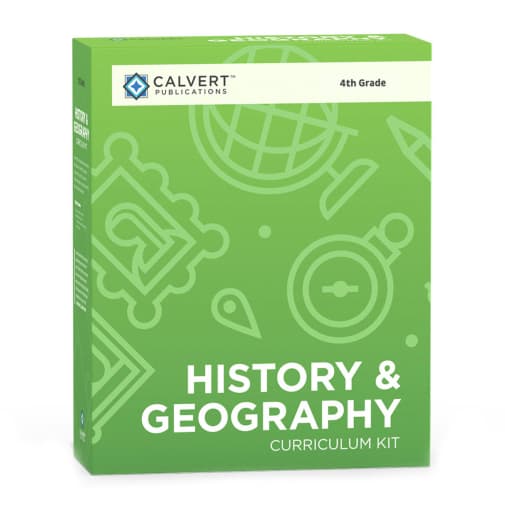
With an easy-to-follow, student-directed learning format, this course lets students set their own pace while studying mountains, rivers, fields, plants, animals, and people in each U.S. region. This course also features lessons on map reading skills. Each of the 10 units contains 3-5 sections to complete. Each section ends with a self-test, which is great for review and each unit ends with a cumulative unit test. The Teacher’s Guide has the answers to all the sections, self-tests, unit tests, additional learning activities and worksheets, and includes an Alternate Test for each unit. Daily instructional material is written directly into the workbooks. This course will take an average of 45 minutes daily to complete. ~Amber
Calvert History & Geography Grade 3 Complete Set
SKU
043709
ISBN
9780740341663
Grade 3
These icons are designed to help you quickly understand and learn important information about our products.
Teaching Method
Traditional
Teacher-centered curriculum commonly used in classrooms that may include a text, teacher manual, tests, etc.
Charlotte Mason
A methodology based on the work of a 19th century educator who maintained that children learn best from literature (Living Books), not textbooks.
Classical
A methodology based on the Latin Trivium (three stages of learning), including the grammar stage (memorization and facts), logic stage (critical thinking), and rhetoric stage (developing/defending ideas).
Unit Study
A thematic or topical approach centered around one topic that integrates multiple subject areas.
Montessori (Discovery)
A methodology based on the work of a 20th century educator that emphasizes student and sensory-driven discovery learning and real-life applications.
Other
Other methodologies
Religious Content
Secular
Contains content contrary to common Christian beliefs (i.e. evolution).
Neutral
Avoids religious or theoretical topics or presents multiple viewpoints without preference.
Christian/Religious
Faith-based or including instructional religious content.
Learning Modality
Auditory
Learns through listening, talking out loud or reading out loud.
Visual
Learns through seeing, prefers written instructions and visual materials.
Kinesthetic/Tactile (Hands-On)
Learns through moving, doing and touching.
Multi-Sensory
Curriculum that employ a variety of activities/components.
Presentation
Sequential
Curriculum progresses through well-defined learning objectives. Emphasizes mastery before moving to the next topic.
Spiral
Topics and concepts are repeated from level to level, adding more depth at each pass and connecting with review.
Conceptual/Topical
Focus is on the “why,” often with a unifying concept as well as specific skills; coverage may be broader.
Teacher Involvement
Low Teacher Involvement
Student-led materials; parent acts as a facilitator.
Medium Teacher Involvement
A mix of teacher-led time and independent student work.
High Teacher Involvement
Teacher-led lessons; may utilize discussions, hands-on activities and working together.
Additional Materials Required
No other materials needed
Everything you need is included.
Other Materials Required
There are additional required resources that are a separate purchase.
Other Materials Optional
There are additional resources mentioned or recommended but are not absolutely necessary.
Consumable
Consumable
Designed to be written in; not reusable.
Non-Consumable
Not designed to be written in; reusable.
Our Price
$144.00 Description
Publisher's Description of Calvert History & Geography Grade 3 Complete Set
Calvert 3rd Grade History & Geography provides a comprehensive study of United States Geography. Each unit explores a collection of states through in-depth lessons on their geography, resources, and community.
Since each self-paced unit can be completed in as little as three to four weeks, students experience a sense of accomplishment at the completion of each one! In addition, regular self tests and an end-of-unit test provide assessment of student progress. An essential teacher's guide is included to provide important teaching supplements, such as instructional notes and answer keys, as well as additional resources and activities.
Category Description for Calvert History & Geography
Calvert History & Geography is a well-organized, mastery-based social studies curriculum that builds analytical and critical thinking skills through cognitive reasoning questions, moving beyond rote memorization. It progresses from teacher-student interaction in early grades to greater student independence, with all instruction written directly into the colorful worktexts.
The program ensures solid understanding of history, geography, government, and culture while preparing students for future studies.
Key Curriculum Features:
- Mastery approach with teacher checkpoints to confirm comprehension before moving forward
- Cognitive reasoning questions that build analytical and critical thinking skills
- Full-color Student Worktexts with textual material, activities, and response space
- 10 worktexts per grade for approximately 150–180 lessons per year
- Teacher Guides with scope & sequence, teaching tips, planning/grading sheets, optional activities, and answer keys
- Removable tests packaged at the back of each worktext
Program Components:
- Student Worktexts: 10 full-color, consumable booklets per grade with instruction, activities, and tests
- Teacher Guides: Detailed support including lesson planning, answers, and teaching resources
- Complete Sets: Convenient boxes with all student and teacher materials for one grade
Calvert History & Geography stands out for its structured, mastery-oriented approach and ease of use. It is an excellent choice for homeschool families seeking a comprehensive, low-prep social studies curriculum that builds strong reasoning skills and historical understanding.
Browse all Calvert History & Geography levels and sets below!
Details
| Product Format: | Other |
|---|---|
| Grade: | 3 |
| Brand: | Alpha Omega Publications |
| ISBN: | 9780740341663 |
| Length in Inches: | 11.375 |
| Width in Inches: | 9.25 |
| Height in Inches: | 3.375 |
| Weight in Pounds: | 3.75 |
Videos
Reviews