These icons are designed to help you quickly understand and learn important information about our products.
Teaching Method
Traditional
Teacher-centered curriculum commonly used in classrooms that may include a text, teacher manual, tests, etc.
Charlotte Mason
A methodology based on the work of a 19th century educator who maintained that children learn best from literature (Living Books), not textbooks.
Classical
A methodology based on the Latin Trivium (three stages of learning), including the grammar stage (memorization and facts), logic stage (critical thinking), and rhetoric stage (developing/defending ideas).
Unit Study
A thematic or topical approach centered around one topic that integrates multiple subject areas.
Montessori (Discovery)
A methodology based on the work of a 20th century educator that emphasizes student and sensory-driven discovery learning and real-life applications.
Other
Other methodologies
Religious Content
Secular
Contains content contrary to common Christian beliefs (i.e. evolution).
Neutral
Avoids religious or theoretical topics or presents multiple viewpoints without preference.
Christian/Religious
Faith-based or including instructional religious content.
Learning Modality
Auditory
Learns through listening, talking out loud or reading out loud.
Visual
Learns through seeing, prefers written instructions and visual materials.
Kinesthetic/Tactile (Hands-On)
Learns through moving, doing and touching.
Multi-Sensory
Curriculum that employ a variety of activities/components.
Presentation
Sequential
Curriculum progresses through well-defined learning objectives. Emphasizes mastery before moving to the next topic.
Spiral
Topics and concepts are repeated from level to level, adding more depth at each pass and connecting with review.
Conceptual/Topical
Focus is on the “why,” often with a unifying concept as well as specific skills; coverage may be broader.
Teacher Involvement
Low Teacher Involvement
Student-led materials; parent acts as a facilitator.
Medium Teacher Involvement
A mix of teacher-led time and independent student work.
High Teacher Involvement
Teacher-led lessons; may utilize discussions, hands-on activities and working together.
Additional Materials Required
No other materials needed
Everything you need is included.
Other Materials Required
There are additional required resources that are a separate purchase.
Other Materials Optional
There are additional resources mentioned or recommended but are not absolutely necessary.
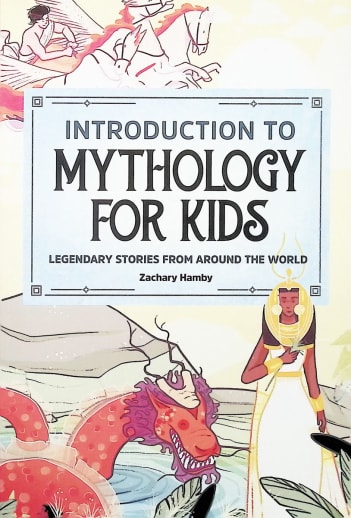
These short, mythological stories from
cultures all around the world are written for elementary readers and each one
is accompanied by beautiful illustrations. Back pages include a glossary of important
terms to aid in understanding the context and culture better.
Note: These stories do include myths of gods and
goddesses that have been passed down over hundreds of years. Parents may want
to read along with their children to help them discern myth from reality.
Publisher's Description of Introduction to Mythology for Kids
Myths are stories that have been told over hundreds of years to
help explain why the world works the way it does. They're filled with
powerful magic, mysterious monsters, and fantastical beasts, but also
brave heroes on exciting adventures that teach us about right and wrong.
From
the Japanese myth of Momotarō The Peach Boy and his loyal animal
friends to the Slavic myth of Vasilisa the Wise and her enchanted doll,
this beautifully illustrated collection of mythology for kids takes you
on a journey through the sands of time. You'll explore diverse cultures
across the globe through the incredible tales of gods and goddesses,
earth-shattering giants, mighty dragons, magical lakes, and more.