
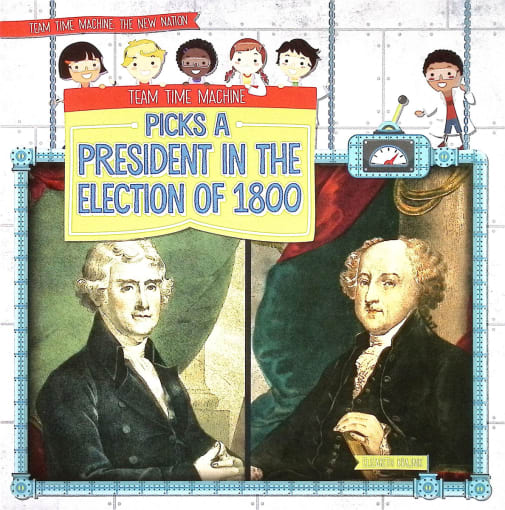
Travel back in time with Gaby, Zoe, and Will to the Presidential Election of 1800, when Thomas Jefferson and Aaron Burr got the same number of votes! Full-color photographs, fact boxes, and more help readers understand more context about the election process and how it has changed over time. The adventure is broken up into short chapters (2 to 4 pages), making information easily digestible. For the reader that wants to go deeper, there is a further information section, a glossary, index, and link to websites. Note that the main body text is very light and several speech bubbles and fact boxes are even smaller, so this might not be an ideal option for a newer reader.
Team Time Machine Picks a President in the Election of 1800 (Team Time Machine)
SKU
019817
ISBN
9781538257036
Grade 3-5
These icons are designed to help you quickly understand and learn important information about our products.
Teaching Method
Traditional
Teacher-centered curriculum commonly used in classrooms that may include a text, teacher manual, tests, etc.
Charlotte Mason
A methodology based on the work of a 19th century educator who maintained that children learn best from literature (Living Books), not textbooks.
Classical
A methodology based on the Latin Trivium (three stages of learning), including the grammar stage (memorization and facts), logic stage (critical thinking), and rhetoric stage (developing/defending ideas).
Unit Study
A thematic or topical approach centered around one topic that integrates multiple subject areas.
Montessori (Discovery)
A methodology based on the work of a 20th century educator that emphasizes student and sensory-driven discovery learning and real-life applications.
Other
Other methodologies
Religious Content
Secular
Contains content contrary to common Christian beliefs (i.e. evolution).
Neutral
Avoids religious or theoretical topics or presents multiple viewpoints without preference.
Christian/Religious
Faith-based or including instructional religious content.
Learning Modality
Auditory
Learns through listening, talking out loud or reading out loud.
Visual
Learns through seeing, prefers written instructions and visual materials.
Kinesthetic/Tactile (Hands-On)
Learns through moving, doing and touching.
Multi-Sensory
Curriculum that employ a variety of activities/components.
Presentation
Sequential
Curriculum progresses through well-defined learning objectives. Emphasizes mastery before moving to the next topic.
Spiral
Topics and concepts are repeated from level to level, adding more depth at each pass and connecting with review.
Conceptual/Topical
Focus is on the “why,” often with a unifying concept as well as specific skills; coverage may be broader.
Teacher Involvement
Low Teacher Involvement
Student-led materials; parent acts as a facilitator.
Medium Teacher Involvement
A mix of teacher-led time and independent student work.
High Teacher Involvement
Teacher-led lessons; may utilize discussions, hands-on activities and working together.
Additional Materials Required
No other materials needed
Everything you need is included.
Other Materials Required
There are additional required resources that are a separate purchase.
Other Materials Optional
There are additional resources mentioned or recommended but are not absolutely necessary.
Consumable
Consumable
Designed to be written in; not reusable.
Non-Consumable
Not designed to be written in; reusable.
Our Price
$11.50 $11.50 $8.75
Rainbow Savings: $2.75
Product Overview
- Travel back in time to the Presidential Election of 1800 and learn about the election process and how it has changed over time
- Fact boxes, photographs, and illustrations fill the pages; also includes a further information section, glossary, and index
- Short chapters make information easily digestible
- The main text is small and light, so this would be ideal for a stronger reader
Description
Publisher's Description of Team Time Machine Picks a President in the Election of 1800 (Team Time Machine)
In the early days of the United States, people voted for the president
and vice president on the same ballot. In the presidential election of
1800, Thomas Jefferson and Aaron Burr received the same number of
electoral votes. In this fictional blast to the past, Gaby, Zoe, and
Will witness the tie-breaking decision that led to the election of the
nation's third president. Readers learn more about America's early
political beginnings with humor and intrigue, while historical images
and fact boxes provide them with the information they need to understand
how the election process in the United States has changed since 1800.
Category Description for Team Time Machine
Join six school-aged friends as they discover a time machine in their school’s library and sneak away on historical adventures. Glimpses of history are presented in narrative form, encouraging student engagement with the text. Topics include the Siege at Yorktown, Paul Revere, Lexington and Concord, the Boston Tea Party, drafting the Declaration of Independence, Washington’s crossing of the Delaware, and the Bill of Rights. Throughout, there are classical works of art, charts, and maps. These are quick reads with factoids and explanations of events scattered in. Vocab words are bolded and then defined in the glossary. The end pages also include additional information for further research into the topic. ~Rebecca
Details
| Product Format: | Paperback Book |
|---|---|
| Grades: | 3-5 |
| Brand: | Gareth Stevens |
| ISBN: | 9781538257036 |
| Length in Inches: | 8.5 |
| Width in Inches: | 8.375 |
| Height in Inches: | 0.125 |
| Weight in Pounds: | 0.25 |
Videos
Reviews