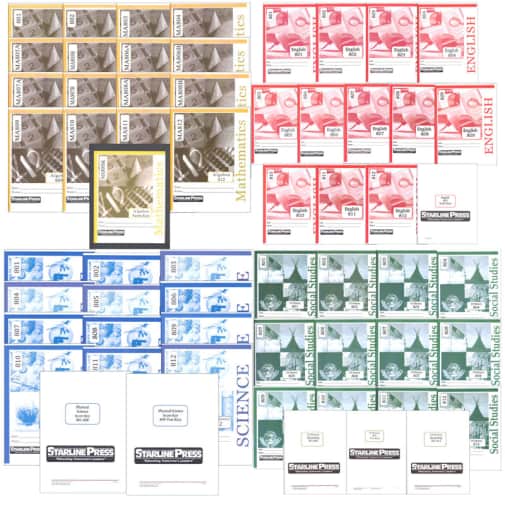
English: Grammar, spelling and work presentation skills continue to be mastered. Students will read and write responses to literature, as well as learn how to prepare friendly and business letters. Eighth grade students learn the meaning of consumer documents (warranties, contracts, and product information) and problem-solving consumer materials. They are introduced to technical directions (operating instructions). Students also learn to prepare, practice, and present speeches using visual aids. They learn beginning persuasive writing, arguments and counter arguments, and will write a research paper and two speeches.
Math: ALGEBRA I: Eighth grade students continue the study of algebraic concepts. A high school level graphing calculator is recommended. Students will study the properties and operations of real numbers, adding positive and negative numbers, and adding decimals and percent. They will also study mathematical operations of fractions, linear equations, exponents, absolute value and scientific notation. They solve addition, subtraction, multiplication and division equations as well as solving two-step equations and equations involving parenthesis. Students learn to solve equations and rate problems with variables on both sides. Inequalities, compound inequalities, and inequalities with absolute values are learned. Students will also study the Cartesian coordinate system, verifying solutions, slope, graphing lines, and writing equations of lines in slope intercept form and transforming to standard form. Exponents, square roots, polynomials and quadratic equations are taught. Students will learn simplifying rational expressions and solving rational equations as well as adding, subtracting, multiplying and dividing radicals. Note: this course may be used to meet requirements for High School Algebra.
Science: Physical Science: Students study living organisms and their responses to the environment. They also study population growth, food chains, and ecological succession. Students learn to read a weather map and study weather instruments, fronts and masses, hurricanes, tornadoes, lightning and clouds. The curriculum includes hands-on laboratory experiences, research projects, textbook information acquisition and note taking techniques. Students also study speed, velocity, acceleration and gravity. Through experiments they evaluate chemical reactions. They study air, water, and chemical pollution as well as fossil fuels, solar energy, and energy conservation. Also studied are: electric currents, fields and circuits along with magnetic fields and electromagnetism. Special lab items are necessary at this level and include beakers, safety goggles, gram scale, copper sulfate, 0.5 M acetic acid, crucible tongs, and zinc (mossy).
Social Studies: US history is the focus of this year. Students will study the Constitution, Bill of Rights, requirements for citizenship, how to use the ballot and political parties. They learn about city, state and federal government powers and procedures. Early presidents are studied including George Washington, Thomas Jefferson, and James Madison. The War of 1812, Mexican American War 1845, and the last Indian wars are studied. Students will also learn about the origins of slavery, the lives of black Americans who gained freedom, the characteristics of white southern society and the women's suffrage movement. Students will do presentations, research topics online and write a research paper on a famous person in American history. ~Sara