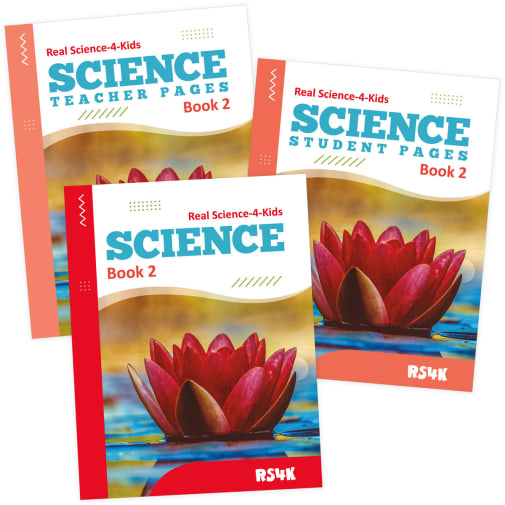
Builds on the solid foundation established in Book 1, guiding students deeper into scientific thinking with a fresh focus on tools, processes, and patterns across all five core disciplines: chemistry, biology, physics, geology, and astronomy.
This year-long curriculum spans 22 richly illustrated chapters that bring real science into sharper focus. Students are introduced to the tools scientists use—from microscopes and telescopes to models, robotics, and geology hammers—while exploring how these tools help us understand and measure the world. The atoms-first spiral model continues, reinforcing earlier concepts while adding complexity and relevance.
Students will:
- Investigate acids, bases, and chemical reactions through hands-on explorations.
- Study protists, fungi, and food molecules in biology, using observation as a central scientific practice.
- Analyze motion and forces in physics, including linear and nonlinear motion.
- Explore Earth’s systems—the atmosphere, geosphere, and biosphere—as interconnected parts of our planet.
- Use telescopes and sky charts to navigate the solar system and constellations, expanding their view of the universe.
Throughout the book, students revisit key scientific ideas in more detail, connecting topics across fields to see how science operates as a system. By learning how scientists observe, measure, and model, students sharpen their ability to think critically and ask deeper questions.