
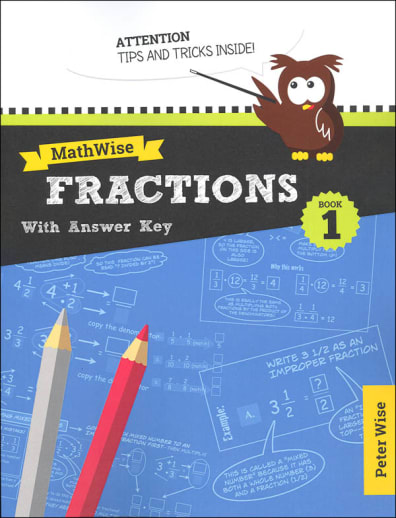
Book 1 offers students an introduction to fractions with foundational concepts that build as students grow in their understanding.
Numerators and Denominators Relating to Two Separate Operations
An essential key to understanding fractions is to view them as two-step problems: the bottom (denominator) of a fraction has the idea of division, while the top of a fraction (numerator) has the idea of multiplication. It is much easier for students to comprehend what is going on if they see fractions having two easy components, rather than a more complex single entity.
This can be initially taught with fraction circles or rectangles. When a shape is cut up into parts, this represents the division of the denominator (it may help students to remember both "d" words: denominator and division). When some of the equal-sized parts are shaded, this represents the multiplication of the numerator.
This two-part aspect of fractions is easily reinforced by having students do basic problems like 2/3 of 12 (12 divided by 3 and then the quotient multiplied by 2). Practice with these kinds of problems helps students with understanding the workings of fractions. The closer the numerators and denominators are, the more the fraction approximates one whole. The larger the denominator, in relation to the numerator, the more the fraction reduces the size of any number multiplying it - and visa versa.
It usually takes students a while to fully comprehend that the denominator of a fraction has the idea of division. Sometimes when they see other expressions in denominators they forget that fractions are just another way to write division problems.
The MathWise fraction books emphasize the mathematical reasoning behind fraction operations. This foundation will serve students well when they move up into higher math classes requiring the use of fractions.
Note:
A key skill for students to master is being able to convert numbers from fractions to decimals to percents. I tell students that numbers wear three costumes: the fraction costume, the decimal costume, and the percent costume. Even if the costumes change, the actor or actress is the same - he or she is just wearing a different outfit!