
Writing Detective - Level One

SKU
060819
ISBN
9781601446497
Grade 3-6
Teaching Method
Traditional
Teacher-centered curriculum commonly used in classrooms that may include a text, teacher manual, tests, etc.
Charlotte Mason
A methodology based on the work of a 19th century educator who maintained that children learn best from literature (Living Books), not textbooks.
Classical
A methodology based on the Latin Trivium (three stages of learning), including the grammar stage (memorization and facts), logic stage (critical thinking), and rhetoric stage (developing/defending ideas).
Unit Study
A thematic or topical approach centered around one topic that integrates multiple subject areas.
Montessori (Discovery)
A methodology based on the work of a 20th century educator that emphasizes student and sensory-driven discovery learning and real-life applications.
Other
Other methodologies
Religious Content
Secular
Contains content contrary to common Christian beliefs (i.e. evolution).
Neutral
Avoids religious or theoretical topics or presents multiple viewpoints without preference.
Christian/Religious
Faith-based or including instructional religious content.
Learning Modality
Auditory
Learns through listening, talking out loud or reading out loud.
Visual
Learns through seeing, prefers written instructions and visual materials.
Kinesthetic/Tactile (Hands-On)
Learns through moving, doing and touching.
Multi-Sensory
Curriculum that employ a variety of activities/components.
Presentation
Sequential
Curriculum progresses through well-defined learning objectives. Emphasizes mastery before moving to the next topic.
Spiral
Topics and concepts are repeated from level to level, adding more depth at each pass and connecting with review.
Conceptual/Topical
Focus is on the “why,” often with a unifying concept as well as specific skills; coverage may be broader.
Teacher Involvement
Low Teacher Involvement
Student-led materials; parent acts as a facilitator.
Medium Teacher Involvement
A mix of teacher-led time and independent student work.
High Teacher Involvement
Teacher-led lessons; may utilize discussions, hands-on activities and working together.
Additional Materials Required
No other materials needed
Everything you need is included.
Other Materials Required
There are additional required resources that are a separate purchase.
Other Materials Optional
There are additional resources mentioned or recommended but are not absolutely necessary.
Consumable
Consumable
Designed to be written in; not reusable.
Non-Consumable
Not designed to be written in; reusable.
Our Price
$12.99

Description

Writing Detective Level One is a collection of 18 activities focused on investigative reporting. Students are given a short mystery story to analyze, with prompts to help them identify key points from the story: who, what, when, where, how, why. As they consider the elements of the story that help them answer these questions, they will be able to deduce or infer what actually happened. Their task from that point is to write a newspaper-style article that explains to other readers what occurred - keeping in mind that people reading their articles have not read the original story but still need all the details! Great practice for journalism and critical thinking. This workbook is consumable and reproducible for family use. Answers, including examples of finished articles, are included. Zach (

Publisher's Description of Writing Detective - Level One
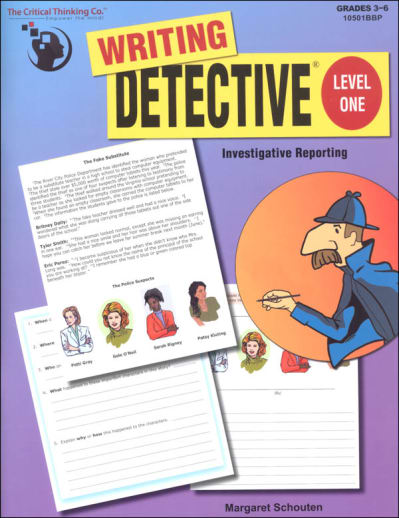
If you believe you need to think clearly to write so readers can understand what you have written, you'll find that Writing Detective® is a very helpful set of supplemental writing activities.

In Writing Detective®, students in Grades 3-6 act as investigative reporters writing articles for a local newspaper. To write the article, students must use higher-order thinking skills to synthesize clues they identify in the story to solve the mystery. Every activity requires students to put clues together and then evaluate the evidence to infer or deduce what happened in the story. The stories are high interest to make it easy to motivate students to do the analytical work needed to piece together the evidence and write the article.

Before writing, students complete an outline detailing When, Who, What, Where, and How or Why. These fun, easy-to-use activities develop reading comprehension, higher-order thinking, and writing and organization skills. Answers for the Reading Comprehension questions and Outlines as well as Article sample answers are provided. There is a simple scoring rubric to make grading easier.

Category Description for Expository Writing

These materials cover various types of informational writing, includingpersuasive writing, essays, outlines, and research papers.

Details
More Information
Product Format:Paperback
Grades:3-6
Brand:Critical Thinking Company
ISBN:9781601446497
Length in Inches:11
Width in Inches:8.5
Height in Inches:0.375
Weight in Pounds:0.5
Videos
This product doesn't have a video
Reviews
Product Q&A