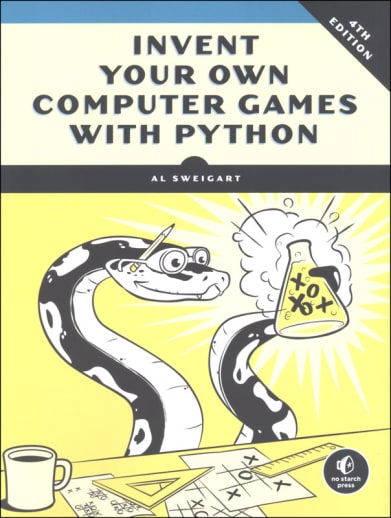
Invent your Own Computer Games with Python (4th Edition)

SKU
042884
ISBN
9781593277956
Grade 4-AD
Teaching Method
Traditional
Teacher-centered curriculum commonly used in classrooms that may include a text, teacher manual, tests, etc.
Charlotte Mason
A methodology based on the work of a 19th century educator who maintained that children learn best from literature (Living Books), not textbooks.
Classical
A methodology based on the Latin Trivium (three stages of learning), including the grammar stage (memorization and facts), logic stage (critical thinking), and rhetoric stage (developing/defending ideas).
Unit Study
A thematic or topical approach centered around one topic that integrates multiple subject areas.
Montessori (Discovery)
A methodology based on the work of a 20th century educator that emphasizes student and sensory-driven discovery learning and real-life applications.
Other
Other methodologies
Religious Content
Secular
Contains content contrary to common Christian beliefs (i.e. evolution).
Neutral
Avoids religious or theoretical topics or presents multiple viewpoints without preference.
Christian/Religious
Faith-based or including instructional religious content.
Learning Modality
Auditory
Learns through listening, talking out loud or reading out loud.
Visual
Learns through seeing, prefers written instructions and visual materials.
Kinesthetic/Tactile (Hands-On)
Learns through moving, doing and touching.
Multi-Sensory
Curriculum that employ a variety of activities/components.
Presentation
Sequential
Curriculum progresses through well-defined learning objectives. Emphasizes mastery before moving to the next topic.
Spiral
Topics and concepts are repeated from level to level, adding more depth at each pass and connecting with review.
Conceptual/Topical
Focus is on the “why,” often with a unifying concept as well as specific skills; coverage may be broader.
Teacher Involvement
Low Teacher Involvement
Student-led materials; parent acts as a facilitator.
Medium Teacher Involvement
A mix of teacher-led time and independent student work.
High Teacher Involvement
Teacher-led lessons; may utilize discussions, hands-on activities and working together.
Additional Materials Required
No other materials needed
Everything you need is included.
Other Materials Required
There are additional required resources that are a separate purchase.
Other Materials Optional
There are additional resources mentioned or recommended but are not absolutely necessary.
Consumable
Consumable
Designed to be written in; not reusable.
Non-Consumable
Not designed to be written in; reusable.
Our Price
$39.99 $39.99 $20.95
Rainbow Savings: $19.04

Description

No Starch Press continues to impress me with their straightforward, high-quality, content-packed coding books, and this one is no exception. Python isn’t a natural language for computer games, but it is a useful language, and computer games are fun. This book takes advantage of all three of those facts to serve as a natural entry point into the world of Python programming. Suitable for absolute beginners, basic programming concepts are covered in adequate detail before the book launches into simple guessing and choosing games. Projects slowly gain complexity until students are able to incorporate sounds and images to make a “true” video game.

As with almost every other No Starch Press coding book I have reviewed, I am delighted with the mix of thorough explanations, detailed documentation, and visual references. Each chapter begins with a full printout of the final source code, followed by a section-by-section explanation of every core concept. It is virtually impossible to get lost in the middle of a project, and if all else fails, students can simply review the source code and query the internet for an explanation.

Publisher's Description of Invent your Own Computer Games with Python (4th Edition)

Invent Your Own Computer Games with Python will teach you how to make computer games using the popular Python programming language—even if you've never programmed before!

Begin by building classic games like Hangman, Guess the Number, and Tic-Tac-Toe, and then work your way up to more advanced games, like a text-based treasure hunting game and an animated collision-dodging game with sound effects. Along the way, you'll learn key programming and math concepts that will help you take your game programming to the next level.

Learn how to:

  • Combine loops, variables, and flow control statements into real working programs
  • Choose the right data structures for the job, such as lists, dictionaries, and tuples
  • Add graphics and animation to your games with the pygame module
  • Handle keyboard and mouse input
  • Program simple artificial intelligence so you can play against the computer
  • Use cryptography to convert text messages into secret code
  • Debug your programs and find common errors
  • As you work through each game, you'll build a solid foundation in Python and an understanding of computer science fundamentals.

    What new game will you create with the power of Python?

    The projects in this book are compatible with Python 3.

    Details
    More Information
    Product Format:Paperback
    Grades:4-AD
    Brand:No Starch Press
    Author:Al Sweigart
    ISBN:9781593277956
    Length in Inches:9.25
    Width in Inches:7
    Height in Inches:0.875
    Weight in Pounds:1.6
    Videos
    This product doesn't have a video
    Reviews
    Product Q&A