No video access is included; this is the All-in-One Student Workbook/Teacher Guide only.
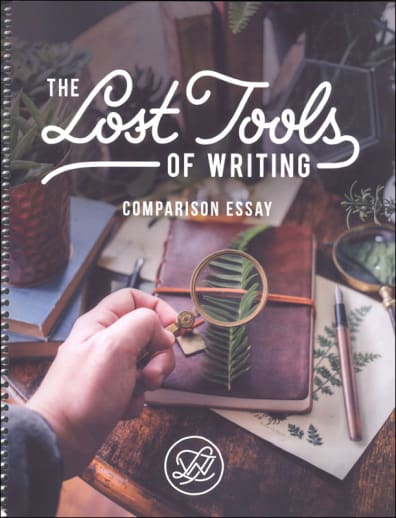
Lost Tools of Writing – Comparison Essay is a semester course that expands the foundational skills covered in Level One with a focus on the common topic of comparison. Designed to precede Level Two and Three; it provides an option for review and practice in writing a different type of essay. Comparison is part of the decision-making process or it is done to gain a deeper understanding of two topics. When looking for similarities and differences and evaluating the importance of each, we practice making wise decisions. Repetition allows us to internalize thinking skills. This type of writing is a natural follow-up to persuasive writing and requires the use of the same tools: invention, arrangement, and elocution. Essay assignments are based on three types of outlines building in complexity. The third outline is repeated to allow extra practice with the most difficult form. The book includes material for both student and teacher.Lost Tools of Writing - Comparison Essay (All-in-One Student Workbook/Teacher Guide)
SKU
029040
ISBN
9780999146699
Grade 9-12
Classical
Christian/Religious
High Teacher Involvement
Multi-Sensory
No other materials needed
These icons are designed to help you quickly understand and learn important information about our products.
Teaching Method
Traditional
Teacher-centered curriculum commonly used in classrooms that may include a text, teacher manual, tests, etc.
Charlotte Mason
A methodology based on the work of a 19th century educator who maintained that children learn best from literature (Living Books), not textbooks.
Classical
A methodology based on the Latin Trivium (three stages of learning), including the grammar stage (memorization and facts), logic stage (critical thinking), and rhetoric stage (developing/defending ideas).
Unit Study
A thematic or topical approach centered around one topic that integrates multiple subject areas.
Montessori (Discovery)
A methodology based on the work of a 20th century educator that emphasizes student and sensory-driven discovery learning and real-life applications.
Other
Other methodologies
Religious Content
Secular
Contains content contrary to common Christian beliefs (i.e. evolution).
Neutral
Avoids religious or theoretical topics or presents multiple viewpoints without preference.
Christian/Religious
Faith-based or including instructional religious content.
Learning Modality
Auditory
Learns through listening, talking out loud or reading out loud.
Visual
Learns through seeing, prefers written instructions and visual materials.
Kinesthetic/Tactile (Hands-On)
Learns through moving, doing and touching.
Multi-Sensory
Curriculum that employ a variety of activities/components.
Presentation
Sequential
Curriculum progresses through well-defined learning objectives. Emphasizes mastery before moving to the next topic.
Spiral
Topics and concepts are repeated from level to level, adding more depth at each pass and connecting with review.
Conceptual/Topical
Focus is on the “why,” often with a unifying concept as well as specific skills; coverage may be broader.
Teacher Involvement
Low Teacher Involvement
Student-led materials; parent acts as a facilitator.
Medium Teacher Involvement
A mix of teacher-led time and independent student work.
High Teacher Involvement
Teacher-led lessons; may utilize discussions, hands-on activities and working together.
Additional Materials Required
No other materials needed
Everything you need is included.
Other Materials Required
There are additional required resources that are a separate purchase.
Other Materials Optional
There are additional resources mentioned or recommended but are not absolutely necessary.
Consumable
Consumable
Designed to be written in; not reusable.
Non-Consumable
Not designed to be written in; reusable.
Our Price
$47.00 Description
Publisher's Description of Lost Tools of Writing - Comparison Essay (All-in-One Student Workbook/Teacher Guide)
Welcome to The Lost Tools of Writing: Comparison Essay. This semester-long program provides a way for students to gain more practice in foundational thinking skills plus practice in writing a different kind of essay. Through LTW: Comparison Essays, students will solidify the foundations laid in LTW I, develop deeper thinking skills, master an additional form of essay-writing, and delve more deeply into analogical thinking with different kinds of metaphor-writing. The skills students gain through LTW: Comparison Essay extend beyond academics to life in the world, cultivating more refined and careful thinking about people, things, ideas, and their own decisions.
LTW: Comparison Essays fulfills the purpose of understanding people, things, or ideas more deeply, or assessing whether one is better or in some way more desirable than another. The bigger purpose of these thinking and writing skills is to grow in wisdom and prudence by practicing making finer distinctions and better decisions. Students can learn and practice principles and habits of decision-making for their own lives.
Deeper Thinking
The goal of using the common topics is not to think about the topics, but to think with them. Just as repeated practice allows a player to throw a football without thinking about how to grip it or a musician to play a piece of music without thinking of where to put her fingers, repetition allows us to internalize thinking skills so that we can put our focus where it needs to be: on the people and things in our decisions. Internalizing the means of thinking frees us to think about about our decisions and the people, places, and things that are in them—to think with the tools and not about them.
A Different Kind of Writing
By writing comparison essays after persuasive essays, students will be able to compare the two kinds of writing to each other. They will find that all writing requires coming up with something to say (invention), organizing the material (arrangement), and expressing ideas in a fitting way (elocution). Further, they will see that the common topics and elocution tools they learned in Level I have prepared them to complete any kind of writing. As long as they are given an outline (those forms that come to us by tradition and make each kind of writing what it is) they can execute any kind of writing.
The Overall Picture of a Comparison Outline
When we compare two items we can do so for different reasons. Sometimes we want to assess which one is better than the others. But sometimes, as is often the case with studies in history and literature (and friendships), we simply desire to gain a deeper understanding of both people. Comparison essays can help us gain understanding.
Sometimes we compare because we do need to choose one thing over the other. We can only attend one college, play a limited time in a recital, and eat one meal for lunch. Comparing can help us find the similarities and differences we need to know in order to decide which choice is best. Also, deciding repeatedly about our writing hones our ability to make wise decisions when they matter in our lives. Comparison essays cultivate that skill.
Outlines
Three outlines are presented in this book of comparison essays. The first is simple; then complexity builds with each successive outline. The third outline is repeated in Essay Four to allow for more practice with the most difficult form. You will find the block outline used when comparing is for the purpose of further understanding. The point-by-point outline is used when we make an assessment about which item is better.
Elocution
Elocution begins with a review of Level I's metaphor lesson. Succeeding lessons build on that foundation, leading the students to create the more complex expanded metaphor, leading them into more and more analogical thinking.
All the skills that students learned in every canon of Level I can be applied in these comparison essays since Level I skills are universal thinking, organizing, and writing skills. Sometimes the review will be more obvious and sometimes less so. But in LTW: Comparison Essay you will be led through a way to expand on Level I skills through a different kind of writing with many lessons and benefits of its own.
Category Description for Lost Tools of Writing
Lost Tools of Writing provides a thorough breakdown of skills, tools, and basic principles to learn and use in the step-by-step process of developing the art of communication. Aiming at “creative discipline” as well as “disciplined creativity,” three canons (or principles) are explained: invention (ideas), arrangement (ordering of ideas), and elocution (expression of ideas). Once explained, these canons are then incorporated into lesson exercises and assignments. Lessons are covered over several weeks while the student constructs an essay/address. Teacher-Student interaction is essential. Teacher contributions include concept presentation and development as well as discussion. Thankfully, the support for the teacher is impressive. There are instructional videos for the teacher (lifetime access available free from the publisher’s website for the purchaser), thoroughly developed lesson plans, and extensive samples. Lost Tools of Writing is a robust, systematic course that prepares students to think and to communicate ideas well.
Required for each level are the Teacher Guide and Student Workbook. These are available separately or in a Set. Purchase of the Set also includes the link and password to instructional videos at the publisher website.
The Teacher Guide for each level is the teacher's companion and foundation. It provides a thorough explanation and introduction to classical writing and to the way it is developed in the Lost Tools. It also includes a proposed Plan of Action, a Year-at-a-Glance Chart, a Lesson Sequence, and the comprehensive Lesson Plans with samples and worksheets. An impressive set of Appendices are also included.
The Student Workbook provides worksheets for the lesson exercises, essay templates, and appendices (Self-Edit Checklists, Sample Essays, Glossary, and Lesson Summaries). The student uses this to complete the preparatory assignments leading up to the crafting of each lesson's essay assignment. One Student Workbook (not reproducible) needed per student. Available only in the Teacher/Student Set is a link and password to access helpful instructional videos from the publisher’s site. Instructional videos provide parents additional tips and insights for teaching through the Lost Tools of Writing Level.
Details
| Product Format: | Paperback |
|---|---|
| Grades: | 9-12 |
| Brand: | Circe Institute |
| ISBN: | 9780999146699 |
| Length in Inches: | 11.125 |
| Width in Inches: | 8.75 |
| Height in Inches: | 0.5 |
| Weight in Pounds: | 0.8 |
Videos
Reviews