These icons are designed to help you quickly understand and learn important information about our products.
Teaching Method
Traditional
Teacher-centered curriculum commonly used in classrooms that may include a text, teacher manual, tests, etc.
Charlotte Mason
A methodology based on the work of a 19th century educator who maintained that children learn best from literature (Living Books), not textbooks.
Classical
A methodology based on the Latin Trivium (three stages of learning), including the grammar stage (memorization and facts), logic stage (critical thinking), and rhetoric stage (developing/defending ideas).
Unit Study
A thematic or topical approach centered around one topic that integrates multiple subject areas.
Montessori (Discovery)
A methodology based on the work of a 20th century educator that emphasizes student and sensory-driven discovery learning and real-life applications.
Other
Other methodologies
Religious Content
Secular
Contains content contrary to common Christian beliefs (i.e. evolution).
Neutral
Avoids religious or theoretical topics or presents multiple viewpoints without preference.
Christian/Religious
Faith-based or including instructional religious content.
Learning Modality
Auditory
Learns through listening, talking out loud or reading out loud.
Visual
Learns through seeing, prefers written instructions and visual materials.
Kinesthetic/Tactile (Hands-On)
Learns through moving, doing and touching.
Multi-Sensory
Curriculum that employ a variety of activities/components.
Presentation
Sequential
Curriculum progresses through well-defined learning objectives. Emphasizes mastery before moving to the next topic.
Spiral
Topics and concepts are repeated from level to level, adding more depth at each pass and connecting with review.
Conceptual/Topical
Focus is on the “why,” often with a unifying concept as well as specific skills; coverage may be broader.
Teacher Involvement
Low Teacher Involvement
Student-led materials; parent acts as a facilitator.
Medium Teacher Involvement
A mix of teacher-led time and independent student work.
High Teacher Involvement
Teacher-led lessons; may utilize discussions, hands-on activities and working together.
Additional Materials Required
No other materials needed
Everything you need is included.
Other Materials Required
There are additional required resources that are a separate purchase.
Other Materials Optional
There are additional resources mentioned or recommended but are not absolutely necessary.
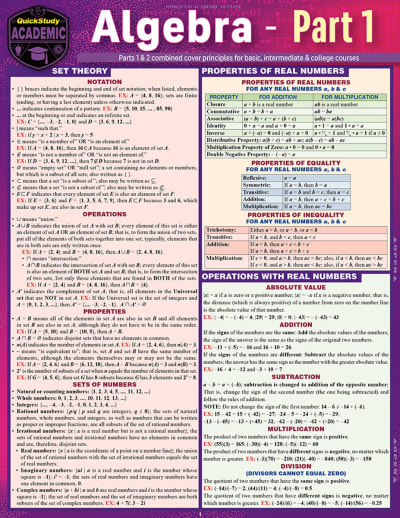
Over 1 million sold to college and high school students supporting better test scores, grades, and improved skills - a best-selling reference for over 25 years. As a college student or being college bound, the importance of algebra in a student’s academic career is so large it can determine your future path. Whether math is second nature or a challenge, this guide is your go-to for answers at your fingertips. Typically found throughout hundreds of pages in textbooks or websites this collection of need-to-know facts is in our famous QuickStudy 6-page laminated format packed with clear and concise rules, terminology, example equations and explanations for review, study, or to quickly look up that concept you just can’t remember. Author and math expert Sandy Kizlik and the developers at ExpoLog who write and edit for textbook publishing companies target content that is the backbone of support you need which we offer at a price lower than any college level study tool you will find anywhere, making it easy to add it to your college success toolbox. A good grade could be critical for a higher grade point average for some students or Algebra could be the gateway to a person’s career. This best-selling guide combined with QuickStudy’s Algebra Part 2 has helped many accomplish their goals for a fraction of the cost.
6 page laminated guide includes:
Set Theory
Notation
Operations
Properties
Properties of Real Numbers
Operations with Real Numbers
Algebraic Terms
Combining Like Terms
Multiplying
Dividing
Steps for Solving a First-Degree Equation with One Variable
Steps for Solving a First-Degree Inequality with One Variable