
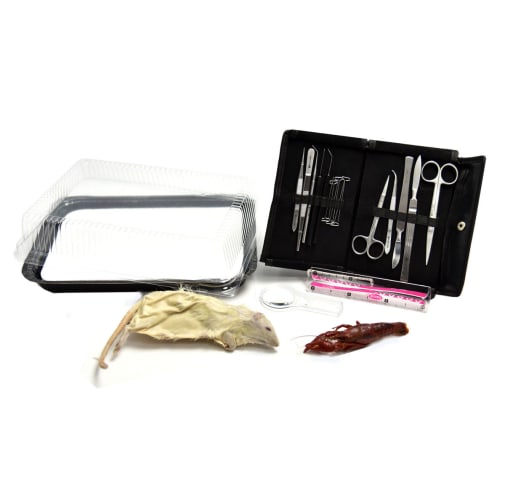
Assembled specifically for use with the Bob Jones Biology (4th Edition) course for grade 10, this kit includes the dissecting pan with flex pad, dissecting tools, magnifier, earthworm, crayfish, frog, perch, and rat.
BJU Dissecting Lab with Specimens (4th Edition)
SKU
006157
Grade 9-11
These icons are designed to help you quickly understand and learn important information about our products.
Teaching Method
Traditional
Teacher-centered curriculum commonly used in classrooms that may include a text, teacher manual, tests, etc.
Charlotte Mason
A methodology based on the work of a 19th century educator who maintained that children learn best from literature (Living Books), not textbooks.
Classical
A methodology based on the Latin Trivium (three stages of learning), including the grammar stage (memorization and facts), logic stage (critical thinking), and rhetoric stage (developing/defending ideas).
Unit Study
A thematic or topical approach centered around one topic that integrates multiple subject areas.
Montessori (Discovery)
A methodology based on the work of a 20th century educator that emphasizes student and sensory-driven discovery learning and real-life applications.
Other
Other methodologies
Religious Content
Secular
Contains content contrary to common Christian beliefs (i.e. evolution).
Neutral
Avoids religious or theoretical topics or presents multiple viewpoints without preference.
Christian/Religious
Faith-based or including instructional religious content.
Learning Modality
Auditory
Learns through listening, talking out loud or reading out loud.
Visual
Learns through seeing, prefers written instructions and visual materials.
Kinesthetic/Tactile (Hands-On)
Learns through moving, doing and touching.
Multi-Sensory
Curriculum that employ a variety of activities/components.
Presentation
Sequential
Curriculum progresses through well-defined learning objectives. Emphasizes mastery before moving to the next topic.
Spiral
Topics and concepts are repeated from level to level, adding more depth at each pass and connecting with review.
Conceptual/Topical
Focus is on the “why,” often with a unifying concept as well as specific skills; coverage may be broader.
Teacher Involvement
Low Teacher Involvement
Student-led materials; parent acts as a facilitator.
Medium Teacher Involvement
A mix of teacher-led time and independent student work.
High Teacher Involvement
Teacher-led lessons; may utilize discussions, hands-on activities and working together.
Additional Materials Required
No other materials needed
Everything you need is included.
Other Materials Required
There are additional required resources that are a separate purchase.
Other Materials Optional
There are additional resources mentioned or recommended but are not absolutely necessary.
Consumable
Consumable
Designed to be written in; not reusable.
Non-Consumable
Not designed to be written in; reusable.
Our Price
$108.00 $108.00 $70.86
Rainbow Savings: $37.14
Description
Publisher's Description of BJU Dissecting Lab with Specimens (4th Edition)
Complete the dissection activities in BJU Press, Biology Grade 10 curriculum hassle-free! This Nature's Workshop Plus! Kit contains the items you need to complete the dissection experiments. It contains a 9"x13" tray with a 7 1/2" x 11 1/4" x 5/8" thick EPS pad and a clear dome cover. The 3" high, clear plastic cover snaps firmly to the pan to prevent excessive moisture loss and is designed to allow specimens to remain in the tray between dissection periods. The thick pad allows for easy pinning of the specimens and the economical pan and pad combination is easy to wipe clean and durable enough to reuse several times.
The specimens are individually packed in a vacuum sealed bag, they are a Rat 7-9", and a Crayfish 4-6". The specimens are preserved with a Formalin fixed holding solution.
Dissecting tool kit contains the following: Double fold vinyl case with lining, 1-1/2" stainless steel scalpel, 1-1/2" stainless steel narrow blade scalpel, 5-1/2" stainless steel scissors, 4-1/2" stainless steel iris scissors, 4-1/2" SS straight fine-point forceps, 4-1/2" SS curved fine-point forceps, 5" SS straight blunt-point forceps, Straight dissecting needle, Bent dissecting needle, 6" probe and seeker, Six dissecting pins, and a 6" ruler. Also included is a dual power magnifying lens, 3x, 6x.
Category Description for BJU Press Biology
A comprehensive high-school biology laboratory course including cellular biology, genetics, biotechnology, the history of life, microbiology, botany, zoology, ecology, human anatomy and physiology, and the systems of the human body. The course takes a tacitly Christian position on current issues like AIDS, abortion, sexuality, drugs, euthanasia, hypnotism, homosexuality, ecology, physical disorders, genetic engineering, etc. Laboratory exercises are included in the Student Lab Manual (sold separately). The Dissection Labs DVD is a real help, often providing a better view of the target system than a real dissection provides. If you decide to do the actual dissections, you will need a kit that contains specimens (earthworm, crayfish, perch and frog), dissection tray, and tools. Bob Jones sells one that includes the Dissection Activity Book, or check out our item #8779 which includes specimens, tray and tools, but no book or magnifier. The Dissection Kit Student Activity and Teacher's Activity books sold separately provide detailed descriptions of the four specimens, as well as instructions and diagrams on the best way to dissect each creature and questions to answer along the way. The teacher's book contains the answers. A microscope and other equipment may also be necessary.
Details
| Product Format: | Other |
|---|---|
| Grades: | 9-11 |
| Brand: | Nature's Workshop |
| Length in Inches: | 13 |
| Width in Inches: | 10.25 |
| Height in Inches: | 4.875 |
| Weight in Pounds: | 4.1 |
Videos
Reviews