These icons are designed to help you quickly understand and learn important information about our products.
Teaching Method
Traditional
Teacher-centered curriculum commonly used in classrooms that may include a text, teacher manual, tests, etc.
Charlotte Mason
A methodology based on the work of a 19th century educator who maintained that children learn best from literature (Living Books), not textbooks.
Classical
A methodology based on the Latin Trivium (three stages of learning), including the grammar stage (memorization and facts), logic stage (critical thinking), and rhetoric stage (developing/defending ideas).
Unit Study
A thematic or topical approach centered around one topic that integrates multiple subject areas.
Montessori (Discovery)
A methodology based on the work of a 20th century educator that emphasizes student and sensory-driven discovery learning and real-life applications.
Other
Other methodologies
Religious Content
Secular
Contains content contrary to common Christian beliefs (i.e. evolution).
Neutral
Avoids religious or theoretical topics or presents multiple viewpoints without preference.
Christian/Religious
Faith-based or including instructional religious content.
Learning Modality
Auditory
Learns through listening, talking out loud or reading out loud.
Visual
Learns through seeing, prefers written instructions and visual materials.
Kinesthetic/Tactile (Hands-On)
Learns through moving, doing and touching.
Multi-Sensory
Curriculum that employ a variety of activities/components.
Presentation
Sequential
Curriculum progresses through well-defined learning objectives. Emphasizes mastery before moving to the next topic.
Spiral
Topics and concepts are repeated from level to level, adding more depth at each pass and connecting with review.
Conceptual/Topical
Focus is on the “why,” often with a unifying concept as well as specific skills; coverage may be broader.
Teacher Involvement
Low Teacher Involvement
Student-led materials; parent acts as a facilitator.
Medium Teacher Involvement
A mix of teacher-led time and independent student work.
High Teacher Involvement
Teacher-led lessons; may utilize discussions, hands-on activities and working together.
Additional Materials Required
No other materials needed
Everything you need is included.
Other Materials Required
There are additional required resources that are a separate purchase.
Other Materials Optional
There are additional resources mentioned or recommended but are not absolutely necessary.
This user-friendly worldview curriculum is part of the What
We Believe Series but can also be used on its own. It’s a hardcover
book filled with glossy, colorful pages, written directly to students in an engaging
and conversational tone. The 8 lessons are lengthy and meant to be divided over
several days. A sample schedule shows each lesson divided into 6 sessions
(twice a week, for 3 weeks), but it’s designed to be flexible and adaptable for
each unique family.
Each lesson includes the following components:
The Big Idea: introduction
and brief overview of lesson
What You Will Do: learning
objectives
Short Story: stories
featuring characters who must work through differences, ultimately showing us a
godly worldview
Think About It: thought-provoking
questions to dig deeper into stories
Words You Need to Know:
vocabulary defined; can be recorded in notebooks
Hide It in Your Heart:
Bible verses to record and memorize
Integrated Learning:
interdisciplinary topics related to the main texts, giving a broader
understanding
What Should I Do?: godly
character traits to demonstrate and apply
Prayer: acknowledging and
thanking God
Parables of Jesus: adapted
to help students explore what Jesus taught
Going Deeper: discussion
questions for parables
House of Truth: four
lessons end with a hands-on memory aid
The Regular
Notebooking Journal and Junior Notebooking Journal
(sold separately) are filled with beautiful illustrations, interactive
activities, projects, and more. They allow children a special place to record
thoughts and observations, while reinforcing the material and providing a
breakdown of daily assignments with what needs to be done each day. Lays a
solid foundation for life!
Publisher's Description of What on Earth Can I Do?
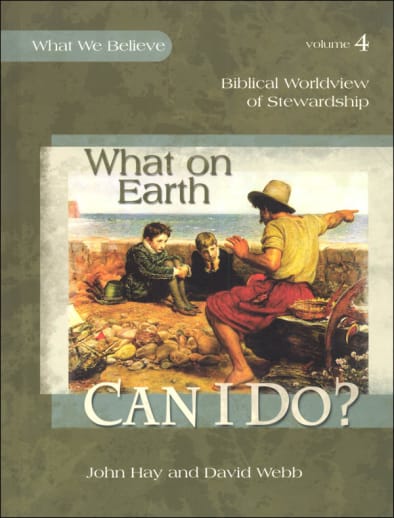
What On Earth Can I Do?, the fourth book in the award-winning What We Believe series, helps children understand what it means to be a "good and faithful servant" of God (Matthew 25:23) and to be stewards of all the blessings we have from God. It will help them choose to put God first in every area of their lives based on biblical truths taught in this study of stewardship.
The fourth book in the award-winning What We Believe series, What On Earth Can I Do? helps children understand what it means to be a "good and faithful servant" of God (Matthew 25:23).This study will help them choose to put God first in every area of their lives based on these biblical truths:
God owns all things because He created and sustains all things
He has entrusted me with certain gifts and wants me to use these gifts for His glory
I honor God by using my money and possessions wisely
I glorify Him by investing my time and talents wisely
My body is not my own but has been bought at a price
"What
On Earth Can I Do?" is the fourth and final volume in Apologia’s What We Believe
series. In this course, students will understand how to rightly relate to God
and follow Him with their whole heart. Across eight lessons, they will learn
what it means to love and follow Jesus, as well as how to be a “good and
faithful servant.” Additional topics cover how God owns all things because He
created and sustains all things; how He has entrusted them with specific gifts
and wants them to use the gifts for His glory; how to honor and glorify God with
money, time, talents, and their body; and caring for creation. Students will
also come to understand that God rewards faithfulness. The Textbook contains
student lessons, questions, and prayer points. Students will need a personal
journal or notebook; you may want to use the companion What On Earth Can I Do?
Notebooking Journal. Families doing the course together may find the What On Earth Can I Do?
Junior Notebooking Journal helpful for younger family members.