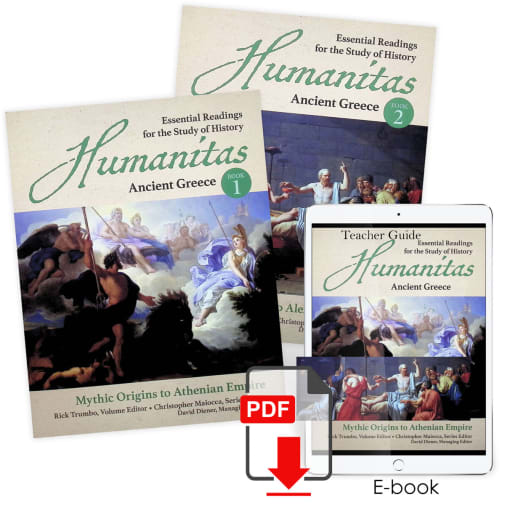

Everything needed for a 1-semester classical study of Ancient Greece in high school! This package includes 2 thick Student Texts (softcover) and the downloadable Teacher E-book. Beautifully organized pages showcase each primary source document alongside an introduction, timeline, maps, vocabulary, background information, afterwords, and Socratic questions to help students meaningfully engage with the text. Volume 1 (405 pgs) begins with Greek mythical origins and unfolds to the Athenian Empire. Volume 2 (444 pgs) begins with the Peloponnesian War and goes through Alexander the Great. For a full year of chronological ancient history, complete the Ancient Rome semester after this.
Humanitas Ancient Greece Program
SKU
HAGRPG
Grade 9-12
These icons are designed to help you quickly understand and learn important information about our products.
Teaching Method
Traditional
Teacher-centered curriculum commonly used in classrooms that may include a text, teacher manual, tests, etc.
Charlotte Mason
A methodology based on the work of a 19th century educator who maintained that children learn best from literature (Living Books), not textbooks.
Classical
A methodology based on the Latin Trivium (three stages of learning), including the grammar stage (memorization and facts), logic stage (critical thinking), and rhetoric stage (developing/defending ideas).
Unit Study
A thematic or topical approach centered around one topic that integrates multiple subject areas.
Montessori (Discovery)
A methodology based on the work of a 20th century educator that emphasizes student and sensory-driven discovery learning and real-life applications.
Other
Other methodologies
Religious Content
Secular
Contains content contrary to common Christian beliefs (i.e. evolution).
Neutral
Avoids religious or theoretical topics or presents multiple viewpoints without preference.
Christian/Religious
Faith-based or including instructional religious content.
Learning Modality
Auditory
Learns through listening, talking out loud or reading out loud.
Visual
Learns through seeing, prefers written instructions and visual materials.
Kinesthetic/Tactile (Hands-On)
Learns through moving, doing and touching.
Multi-Sensory
Curriculum that employ a variety of activities/components.
Presentation
Sequential
Curriculum progresses through well-defined learning objectives. Emphasizes mastery before moving to the next topic.
Spiral
Topics and concepts are repeated from level to level, adding more depth at each pass and connecting with review.
Conceptual/Topical
Focus is on the “why,” often with a unifying concept as well as specific skills; coverage may be broader.
Teacher Involvement
Low Teacher Involvement
Student-led materials; parent acts as a facilitator.
Medium Teacher Involvement
A mix of teacher-led time and independent student work.
High Teacher Involvement
Teacher-led lessons; may utilize discussions, hands-on activities and working together.
Additional Materials Required
No other materials needed
Everything you need is included.
Other Materials Required
There are additional required resources that are a separate purchase.
Other Materials Optional
There are additional resources mentioned or recommended but are not absolutely necessary.
Consumable
Consumable
Designed to be written in; not reusable.
Non-Consumable
Not designed to be written in; reusable.
Our Price
$79.90 $79.90 $69.95
Rainbow Savings: $9.95
Product Overview
- Colorful, engaging, comprehensive!
- One-semester classical study of Ancient History for high school
- Includes carefully curated primary source documents
- For a full year, add Humanitas Ancient Rome
Important
This package contains a non-returnable digital item.Description
Publisher's Description of Humanitas Ancient Greece Program
Beginning with the mythic past and moving into the concrete particulars of history, Humanitas Ancient Greece Book 1 will take the reader to the origins of the ancient Greeks. Homer and Hesiod help shape the Greek consciousness, offering later generations of Greeks distinct notions of what it means to be Greek. But the mythic vision of the cosmos is challenged in the Archaic Era as distinct political identities come into focus and the early natural philosophers deny the existence of the gods. Athens and Sparta emerge as early rivals, embodying disparate ways of life, but are unified by the threat of Persian conquest. The severely outnumbered Greeks unite in order to combat the invaders, but can they survive their own internecine conflict in the wake of the Greco-Persian Wars? Students will embark on their journey into Greece through visual art, epic, lyric poetry, tragedy, natural philosophy, and historical and political documents to discover how a small group of peoples would come to shape the world.
In Humanitas Ancient Greece Book 2, students will discover that philosophy and culture advance as the city-states of Greece fight themselves in the Peloponnesian War. Heraclitus and Parmenides offer conflicting views of reality that will play out in the contest between the sophists and the philosophers, eventually making its way into the agora and daily life. Will truth and classical education triumph or will political expediency and moral relativism dominate? Students will watch Athens overreach with her empire, alienating her erstwhile allies, as the battle for Greece begins. Socrates chastises his native Athens amid the war, as does his fellow citizen Aristophanes. Occupied by their petty rivalries, the Greeks fail to heed warnings about or prevent the advances of Philip of Macedon until it is too late. Alexander the Great conquers the known world with remarkable alacrity, and his death just as quickly throws the order he established into chaos. Students will prepare to journey out of Greece and into Rome by encountering Archimedes in the defense of Syracuse against Rome.
Humanitas: Ancient Greece Teacher's Guide PDFThe Humanitas: Ancient Greece Teacher's Guide PDF supplies teachers with lesson objectives, contextual information about the source documents, and relevant points of discussion. It includes “Look Ahead” and “Look Back” notes that explain how various source documents relate to each other, as well as the discussion and writing prompts that appear in the student edition.
Category Description for Humanitas Upper-School Humanities Curriculum
Why read about famous people from history when you can read and learn directly from them? Humanitas is a 4-year high school history curriculum based on primary source documents. It is comprehensive and powerful, exposing students first-hand to the greatest minds, ideas, and events of the past. And if you’re thinking that primary source documents are too intimidating, you’ll be pleasantly surprised with these courses! Classical Academic Press has done an amazing job sourcing key documents, extracting core material, and updating archaic language just a bit so students can hear ancient voices like that of Dionysius on the founding of Rome, or Martin Luther on the limitation of government. Just the right amount of secondary information has been added to the primary (original) sources to allow students to digest and engage with the material in a meaningful way.
The Student Textbooks are beautifully illustrated, with helpful chapter introductions for each document and marginal annotations throughout the document to aid in understanding. Difficult terms are explained, critical background info given, and historical context and timelines are provided to see how each document fits into the larger picture in history. Each chapter ends with Socratic questions for discussion and writing.
Each of the 8 titles is designed as a one semester history course (containing 2 books) for .5 credit, but similar titles are paired together for a continuous, full year of history… worth 1 credit. Doing all 8 courses provides 4 years of chronological history (though they can be done in any order), earning 4 credits. These include Level 1 courses – Ancient Greece and Ancient Rome, Level 2 courses – Early Medieval and Late Medieval, Level 3 courses – American Origins and American Republic, and Level 4 courses – Early Modern and Late Modern. Currently only Level 1 (Ancient), Level 3 (American), and the first semester of Level 2 (Medieval) courses have been released, with others coming soon.
The Teacher’s Guide PDF E-books provide everything needed to teach the courses… lesson plans, additional help in understanding each document, and suggestions for facilitating a robust discussion. Because of the emphasis on Socratic discussion, these are perfect for a classroom or homeschool co-op, but a homeschool family can adapt them for discussion around the table with family/friends.
Details
| Product Format: | Product Bundle |
|---|---|
| Grades: | 9-12 |
| Brand: | Rainbow Resource Center |
Videos
Reviews