
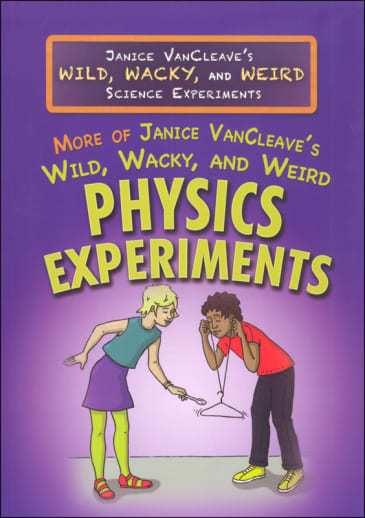
Colorfully illustrated, Janice VanCleave’s Wild, Wacky, and Weird Physics Experiments includes easy to follow experiments to teach the foundations of physics. This little book contains 24 easy to follow experiments that begin with a brief purpose, materials list, and step-by-step instructions. After the procedural instruction, a brief summary and explanation is included. The required supplies for the experiments are easy to find. An overview of the scientific method and glossary are included. Excellent introduction to basic physics for children of all ages.
Janice Vancleave's Wild, Wacky, and Weird Science Experiments More Physics Experiments
SKU
080410
ISBN
9781499465532
Grade 2-5
These icons are designed to help you quickly understand and learn important information about our products.
Teaching Method
Traditional
Teacher-centered curriculum commonly used in classrooms that may include a text, teacher manual, tests, etc.
Charlotte Mason
A methodology based on the work of a 19th century educator who maintained that children learn best from literature (Living Books), not textbooks.
Classical
A methodology based on the Latin Trivium (three stages of learning), including the grammar stage (memorization and facts), logic stage (critical thinking), and rhetoric stage (developing/defending ideas).
Unit Study
A thematic or topical approach centered around one topic that integrates multiple subject areas.
Montessori (Discovery)
A methodology based on the work of a 20th century educator that emphasizes student and sensory-driven discovery learning and real-life applications.
Other
Other methodologies
Religious Content
Secular
Contains content contrary to common Christian beliefs (i.e. evolution).
Neutral
Avoids religious or theoretical topics or presents multiple viewpoints without preference.
Christian/Religious
Faith-based or including instructional religious content.
Learning Modality
Auditory
Learns through listening, talking out loud or reading out loud.
Visual
Learns through seeing, prefers written instructions and visual materials.
Kinesthetic/Tactile (Hands-On)
Learns through moving, doing and touching.
Multi-Sensory
Curriculum that employ a variety of activities/components.
Presentation
Sequential
Curriculum progresses through well-defined learning objectives. Emphasizes mastery before moving to the next topic.
Spiral
Topics and concepts are repeated from level to level, adding more depth at each pass and connecting with review.
Conceptual/Topical
Focus is on the “why,” often with a unifying concept as well as specific skills; coverage may be broader.
Teacher Involvement
Low Teacher Involvement
Student-led materials; parent acts as a facilitator.
Medium Teacher Involvement
A mix of teacher-led time and independent student work.
High Teacher Involvement
Teacher-led lessons; may utilize discussions, hands-on activities and working together.
Additional Materials Required
No other materials needed
Everything you need is included.
Other Materials Required
There are additional required resources that are a separate purchase.
Other Materials Optional
There are additional resources mentioned or recommended but are not absolutely necessary.
Consumable
Consumable
Designed to be written in; not reusable.
Non-Consumable
Not designed to be written in; reusable.
Our Price
$14.53 $14.53 $7.11
Rainbow Savings: $7.42
Product Overview
- Easy to follow, step-by-step instructions to complete 24 physics experiments at home
- Excellent companion to your science textbook or use to sprinkle in some fun learning activities throughout the year
Description
Publisher's Description of Janice Vancleave's Wild, Wacky, and Weird Science Experiments More Physics Experiments
In a series of fun and involving hands-on physics experiments, kids charge an object with static electricity, demonstrate how static charges produce sound, use magnetic force to suspend a paper airplane, determine that objects in water have a different weight than they do in air, and learn how a substances buoyancy can be changed. They will also determine if shape determines the strength of an object, learn the effect that an objects center of gravity has on motion, demonstrate how the length of a pendulum affects the time of each swing, and discover how the center of gravity is also the balancing point of an object. Featuring color illustrations and safe, simple step-by-step instructions, Janice VanCleave again shows just how much fun science can be.
Details
| Product Format: | Paperback |
|---|---|
| Grades: | 2-5 |
| Brand: | Rosen School Supply |
| ISBN: | 9781499465532 |
| Length in Inches: | 9.125 |
| Width in Inches: | 6.4375 |
| Height in Inches: | 0.1875 |
| Weight in Pounds: | 0.3 |
Videos
Reviews