
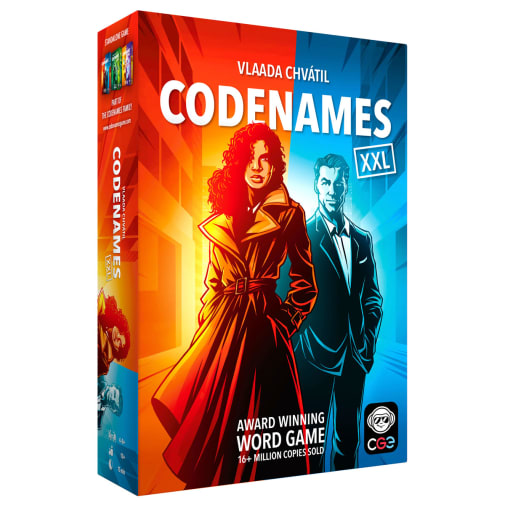
Double the size for double the fun! With larger cards and larger font, the original game can now be enjoyed with larger groups - and everyone will be able to see!
Codenames XXL Game
SKU
073115
Grade 9-AD
These icons are designed to help you quickly understand and learn important information about our products.
Teaching Method
Traditional
Teacher-centered curriculum commonly used in classrooms that may include a text, teacher manual, tests, etc.
Charlotte Mason
A methodology based on the work of a 19th century educator who maintained that children learn best from literature (Living Books), not textbooks.
Classical
A methodology based on the Latin Trivium (three stages of learning), including the grammar stage (memorization and facts), logic stage (critical thinking), and rhetoric stage (developing/defending ideas).
Unit Study
A thematic or topical approach centered around one topic that integrates multiple subject areas.
Montessori (Discovery)
A methodology based on the work of a 20th century educator that emphasizes student and sensory-driven discovery learning and real-life applications.
Other
Other methodologies
Religious Content
Secular
Contains content contrary to common Christian beliefs (i.e. evolution).
Neutral
Avoids religious or theoretical topics or presents multiple viewpoints without preference.
Christian/Religious
Faith-based or including instructional religious content.
Learning Modality
Auditory
Learns through listening, talking out loud or reading out loud.
Visual
Learns through seeing, prefers written instructions and visual materials.
Kinesthetic/Tactile (Hands-On)
Learns through moving, doing and touching.
Multi-Sensory
Curriculum that employ a variety of activities/components.
Presentation
Sequential
Curriculum progresses through well-defined learning objectives. Emphasizes mastery before moving to the next topic.
Spiral
Topics and concepts are repeated from level to level, adding more depth at each pass and connecting with review.
Conceptual/Topical
Focus is on the “why,” often with a unifying concept as well as specific skills; coverage may be broader.
Teacher Involvement
Low Teacher Involvement
Student-led materials; parent acts as a facilitator.
Medium Teacher Involvement
A mix of teacher-led time and independent student work.
High Teacher Involvement
Teacher-led lessons; may utilize discussions, hands-on activities and working together.
Additional Materials Required
No other materials needed
Everything you need is included.
Other Materials Required
There are additional required resources that are a separate purchase.
Other Materials Optional
There are additional resources mentioned or recommended but are not absolutely necessary.
Consumable
Consumable
Designed to be written in; not reusable.
Non-Consumable
Not designed to be written in; reusable.
Our Price
$34.99 $34.99 $30.95
Rainbow Savings: $4.04
Description
Publisher's Description of Codenames XXL Game
The new edition of Codenames XXL refreshes the classic experience players know and love. From a revised word list for improved gameplay, beautiful art, a brand-new insert that keeps your game neatly organized, to a streamlined rulebook that makes the game easier to teach and learn, this updated version is designed to delight longtime fans of the game and welcome new ones. This version is ideal for players with visual impairments as well as large groups. The updated edition comes in a more compact box for easier storage and transport but the font used for the words is even larger than before!
In Codenames XXL, two rival spymasters know the secret identities of 25 agents. Their teammates, however, only know these agents by their codenames - single, seemingly random words, like "sunflower," or even "carrot." (Yes, there's an agent out there codenamed "carrot.") The goal is simple: each spymaster wants their team to identify all of their agents first, without accidentally revealing the assassin.
To play, lay out 25 cards, each featuring a single word. The spymasters share a key card that shows which words correspond to agents from each team, innocent bystanders, and the assassin. They then take turns giving one-word clues followed by a number. The clue should relate to multiple cards that their team should guess, and the number tells teammates how many cards are linked to that clue.
Teammates guess one card at a time. If they guess correctly, they can keep going. But if they pick a card belonging to the opposing team or an innocent bystander, their turn ends. And if they choose the assassin? Game over.
Play continues with each spymaster offering new clues until one team successfully identifies all of their agents — or someone tragically uncovers the assassin.Get ready for clever clues, bold guesses, and the ultimate race to uncover your team’s secret agents — Codenames XXL makes every game night unforgettable!
In Codenames XXL, two rival spymasters know the secret identities of 25 agents. Their teammates, however, only know these agents by their codenames - single, seemingly random words, like "sunflower," or even "carrot." (Yes, there's an agent out there codenamed "carrot.") The goal is simple: each spymaster wants their team to identify all of their agents first, without accidentally revealing the assassin.
To play, lay out 25 cards, each featuring a single word. The spymasters share a key card that shows which words correspond to agents from each team, innocent bystanders, and the assassin. They then take turns giving one-word clues followed by a number. The clue should relate to multiple cards that their team should guess, and the number tells teammates how many cards are linked to that clue.
Teammates guess one card at a time. If they guess correctly, they can keep going. But if they pick a card belonging to the opposing team or an innocent bystander, their turn ends. And if they choose the assassin? Game over.
Play continues with each spymaster offering new clues until one team successfully identifies all of their agents — or someone tragically uncovers the assassin.Get ready for clever clues, bold guesses, and the ultimate race to uncover your team’s secret agents — Codenames XXL makes every game night unforgettable!
Category Description for Codenames
Codenames pits two teams against each other in a race to uncover their secret spies. Each team votes one player to be the "spymaster." Twenty-five code name cards, each with one word, are laid out. Each word belongs to one of the teams, or is an innocent bystander. One card is the assassin. The two spymasters are the only ones who know which is which. The trick is for the spymasters to think of a one-word clue which relates to as many of their words as possible. The rest of your team works together to decide which card or cards you are trying to have them guess. Whichever team finds all of their secret agents first wins. 200 double-sided code name cards and 40 different key cards mean this game can be played over and over again. Younger players can participate even if they aren't ideal "spymasters", and it works with varying group sizes.
Details
| Product Format: | Other |
|---|---|
| Grades: | 9-AD |
| Brand: | Czech Games Edition |
| EAN/UPC: | 8594156310462 |
| Length in Inches: | 12.6875 |
| Width in Inches: | 9.125 |
| Height in Inches: | 2.875 |
| Weight in Pounds: | 3.25 |
Videos
Reviews