
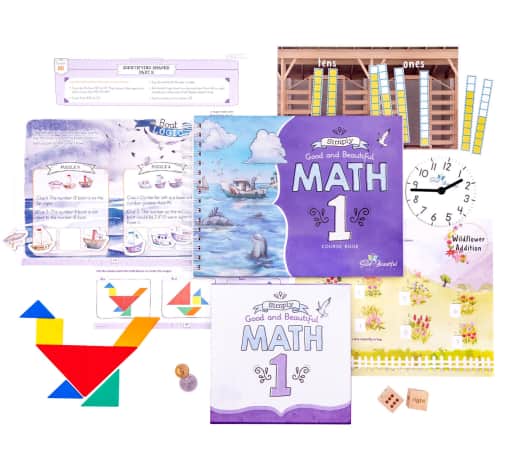
Simply Good and Beautiful Math 1

SKU
070344
Grade 1
Teaching Method
Traditional
Teacher-centered curriculum commonly used in classrooms that may include a text, teacher manual, tests, etc.
Charlotte Mason
A methodology based on the work of a 19th century educator who maintained that children learn best from literature (Living Books), not textbooks.
Classical
A methodology based on the Latin Trivium (three stages of learning), including the grammar stage (memorization and facts), logic stage (critical thinking), and rhetoric stage (developing/defending ideas).
Unit Study
A thematic or topical approach centered around one topic that integrates multiple subject areas.
Montessori (Discovery)
A methodology based on the work of a 20th century educator that emphasizes student and sensory-driven discovery learning and real-life applications.
Other
Other methodologies
Religious Content
Secular
Contains content contrary to common Christian beliefs (i.e. evolution).
Neutral
Avoids religious or theoretical topics or presents multiple viewpoints without preference.
Christian/Religious
Faith-based or including instructional religious content.
Learning Modality
Auditory
Learns through listening, talking out loud or reading out loud.
Visual
Learns through seeing, prefers written instructions and visual materials.
Kinesthetic/Tactile (Hands-On)
Learns through moving, doing and touching.
Multi-Sensory
Curriculum that employ a variety of activities/components.
Presentation
Sequential
Curriculum progresses through well-defined learning objectives. Emphasizes mastery before moving to the next topic.
Spiral
Topics and concepts are repeated from level to level, adding more depth at each pass and connecting with review.
Conceptual/Topical
Focus is on the “why,” often with a unifying concept as well as specific skills; coverage may be broader.
Teacher Involvement
Low Teacher Involvement
Student-led materials; parent acts as a facilitator.
Medium Teacher Involvement
A mix of teacher-led time and independent student work.
High Teacher Involvement
Teacher-led lessons; may utilize discussions, hands-on activities and working together.
Additional Materials Required
No other materials needed
Everything you need is included.
Other Materials Required
There are additional required resources that are a separate purchase.
Other Materials Optional
There are additional resources mentioned or recommended but are not absolutely necessary.
Consumable
Consumable
Designed to be written in; not reusable.
Non-Consumable
Not designed to be written in; reusable.
Our Price
$58.98

Description

Each Simply Good and Beautiful homeschool math course develops a basic foundation for math in young students. It provides a perfect balance of enjoyable learning and fun with a variety of unique games and engaging stories.

Lessons are parent-led and will take 15-20 minutes to complete. Full color, the Course Book is divided into units with a total of 120 lessons, allowing for additional review or reteaching if needed. Lesson text uses two colors: blue for parent notes and black to read to the child. Lessons follow a similar format: beginning review, introduce the new concept through a short story, and guided activities. Units conclude with an assessment test to ensure children have concept mastery before moving forward.

This full-year kit includes both the Math 1 Course Book and the Math 1 Box. The Math Box has been updated and is now a heavy-duty cardboard box with a gloss finish and a magnetic lid. Contents include plastic coins, 2 wooden dice, double-sided clock pieces, 7 boat pieces, and tangram shapes. The coins have changed from plastic to chipboard. The new box has a cardboard clock separate from the top of the box. Tangrams are made of silicone instead of being magnetic.

This level covers writing numbers 0-100; number line up to 100; number bonds; addition up to 3 numbers; counting by 2’s, 4’s, 25’s, 100’s; calendar skills; subitizing; interpreting data; plotting data on bar graphs; place value through the hundreds place; estimation; greater than, less than, and equal to; rounding to nearest ten; fact families; simple number patterns (twos, fives, and tens); volume and weight comparisons; one half, one-fourth; symmetry; parallel lines; two and three-dimensional shapes; U.S currency: nickel, quarter, one dollar; reading time to the nearest five minutes; measuring centimeter, meter, inches, feet; drawing line segments.

Find free learning songs, the Math 1 Answer Key, and other helpful Math 1 resources on the FAQs, Helps, and Extras page at goodandbeautiful.com.

Publisher's Description of Simply Good and Beautiful Math 1

All items in our Math 1 Box are heavily used in lessons, activities, and games throughout the course. 


This beautiful and durable math box (5.31”x5.31”x1.5”) is designed with an easy-to-open folding lid with magnetic closures and 4 compartments for easy storage of all manipulatives. The Math 1 Box contains:

  • Clock with movable arms (3.75” in diameter)

  • Coin replicas including 5 quarters, 5 dimes, 5 nickels, and 5 pennies

  • 2 wooden dice that are approximately 1” square including:

    • 1 die with words left and right

    • 1 standard die numbered 1–6

  • 6 double-sided clock pieces (approximately 1.75”x2”)

  • 7 boat manipulatives including 2 sailboats, 1 submarine, 3 tugboats, 1 rowboat (approximately 1.5”x1.5”)

  • 26 silicone tangram shapes and pattern block pieces

Category Description for Simply Good and Beautiful Math

Efficient, parent and child friendly, thorough, and affordable -- this program has it all! Focusing on conceptual understanding and mathematical reasoning, Simply Good and Beautiful Math teaches to all learning styles with games, activities, and stories. It is a strong math curriculum that was developed by math specialists to meet high academic standards. It is not aligned to the CCS but will meet or exceed most state standards.

Grades K-3 are teacher interactive, with the lessons presented in 2 colors: blue for parent notes and black to read to the child. A simi­lar format is used throughout: short review, introduce new concept through a short story, and guided activities. The time for each les­son has been carefully planned to meet the attention span of younger learners. At the Kindergarten level lessons take 10 minutes per day, with lesson time gradually increas­ing each year. Full-color Course Books are divided into units with a total of 120 lessons, allowing for additional review or reteaching if needed. Units conclude with an Assessment Test to ensure children have concept mastery before moving forward. Each test, however, does not cover all concepts taught, as many will be retaught later. Answer Keys for Grades 1-3 and more teaching resources are free at the publisher’s website. Depending on the level, this may include teaching videos, audio downloads, printable flashcards, extra practice pages, or a certificate of completion. Sets include the All-in-One Course book and manipulatives. You provide a few household items.

Beginning in Grade 4, lessons are indepen­dent with parental teaching support as need­ed. Lesson time varies - 4th graders may spend 35-45 minutes per lesson, while Grade 8 learners will spend 50-60 minutes per lesson. Grades 4-5 Sets include the full-color Course Book(s), Mental Math Map Mysteries book, Answer Key, and access to instructional vid­eos. The 120 lessons follow a similar format: video instruction, mini lesson with practice, and review. Unit Assessments are included. Engaging videos provide full instruction and interactive practice problems. Students who have mastered concepts can choose to read the mini lesson summary instead of watching the video. Mental Math Mysteries correlates with the Course Book to provide a fun review. Answer Key provides answers to problems, math mysteries activities, and assessments. Additional free teaching resources available online include additional practice pages and flashcards. Grade 6-8 Sets include the Course Books, Answer Key or the Answer Key and Solutions (Gr. 7-8), and the Instructional videos. Videos at this level provide most of the instruction or students may read the overview and complete the lessons. Grade 7 is intended for students who need an extra year to solidify basic math concepts before taking Pre-Algebra. Students who have com­pleted grade 6 and are ready, may move into Grade 8 Pre-Algebra. A scientific calculator is required for Grades 7-8 . 

Details
More Information
Product Format:Other
Grade:1
Brand:The Good and the Beautiful
Videos
Reviews
Product Q&A