
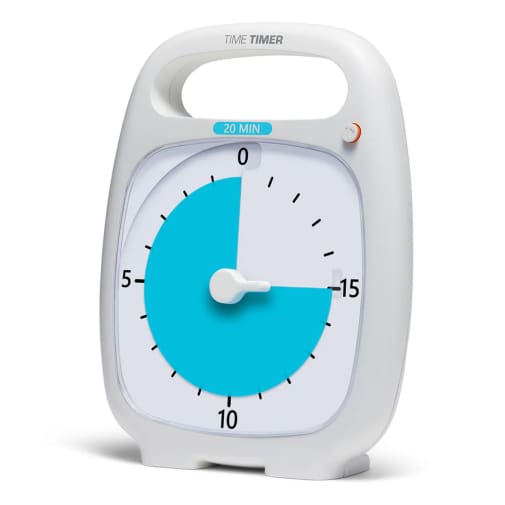
This timer is perfect for test taking, games, activities, and even chores! Now with a pause button, timed increments can be paused if needed. The time increments of 0, 5, 10, and 15 are listed to show a countdown from 20. The numbers in between can be determined by lines, much like a regular clock. Volume can be adjusted with a knob on the back. Requires 2 AA batteries, not included.
Time Timer Plus 20 Minutes
SKU
068027
Grade K-AD
These icons are designed to help you quickly understand and learn important information about our products.
Teaching Method
Traditional
Teacher-centered curriculum commonly used in classrooms that may include a text, teacher manual, tests, etc.
Charlotte Mason
A methodology based on the work of a 19th century educator who maintained that children learn best from literature (Living Books), not textbooks.
Classical
A methodology based on the Latin Trivium (three stages of learning), including the grammar stage (memorization and facts), logic stage (critical thinking), and rhetoric stage (developing/defending ideas).
Unit Study
A thematic or topical approach centered around one topic that integrates multiple subject areas.
Montessori (Discovery)
A methodology based on the work of a 20th century educator that emphasizes student and sensory-driven discovery learning and real-life applications.
Other
Other methodologies
Religious Content
Secular
Contains content contrary to common Christian beliefs (i.e. evolution).
Neutral
Avoids religious or theoretical topics or presents multiple viewpoints without preference.
Christian/Religious
Faith-based or including instructional religious content.
Learning Modality
Auditory
Learns through listening, talking out loud or reading out loud.
Visual
Learns through seeing, prefers written instructions and visual materials.
Kinesthetic/Tactile (Hands-On)
Learns through moving, doing and touching.
Multi-Sensory
Curriculum that employ a variety of activities/components.
Presentation
Sequential
Curriculum progresses through well-defined learning objectives. Emphasizes mastery before moving to the next topic.
Spiral
Topics and concepts are repeated from level to level, adding more depth at each pass and connecting with review.
Conceptual/Topical
Focus is on the “why,” often with a unifying concept as well as specific skills; coverage may be broader.
Teacher Involvement
Low Teacher Involvement
Student-led materials; parent acts as a facilitator.
Medium Teacher Involvement
A mix of teacher-led time and independent student work.
High Teacher Involvement
Teacher-led lessons; may utilize discussions, hands-on activities and working together.
Additional Materials Required
No other materials needed
Everything you need is included.
Other Materials Required
There are additional required resources that are a separate purchase.
Other Materials Optional
There are additional resources mentioned or recommended but are not absolutely necessary.
Consumable
Consumable
Designed to be written in; not reusable.
Non-Consumable
Not designed to be written in; reusable.
Our Price
$40.95 $40.95 $34.95
Rainbow Savings: $6.00
Description
Publisher's Description of Time Timer Plus 20 Minutes
The Time Timer PLUS 20 Minute timer offers a greater visual impact for shorter duration needs such as completing homework blocks, therapy sessions, silent reading, instrument or sports practice, and 15 to 20 minute activities for kids at home. The Time Timer PLUS 20 Minute is a workplace essential for meetings with 15 and 20 minute agenda items to keep each item on track. The PLUS 20 Minute works perfectly when starting an organizing project at home. The PLUS family is also the only analog visual timer line that offers a pause feature... because life is full of interruptions.
The Time Timer PLUS 20 Minute packs all the features that have made our visual timers the first choice of teachers, students, parents, and professionals into a 20-minute timer.
Benefits
- Teachchildren the concept of elapsed time
- Make homework and practice time more productive
- Keepmeetings on time and moving forward
- Reduce conflict in family and household routines
- Manage the stress of transitions by showing "how much longer"
- Empowerteachers to teach instead of constantly monitoring behavior
- Increase performance on tests and in the workplace
- Transcends language and culture barriers
Category Description for Time Timer
These timers will have many uses in your classroom. Each timer has a round analog clock face, with black numbers against a white background. Set the timer at any point from 0 to 60 minutes or more (depending on the timer), then watch the time elapse clockwise. A red disk shows the remaining time, gradually diminishing until no red is visible. The clock face has numbers for every five-minute interval (i.e. 55 min, 50 min, etc.), and tick marks designate minutes. The timer is silent (no distracting ticking). It has an on/off switch for an optional "beep beep" sound when the time is up. Of course, these timers are handy for timing tests and homework sessions, but these versatile tools can be used to teach time concepts to students and promote time management as well. ~ Lisa
Details
| Product Format: | Other |
|---|---|
| Grades: | K-AD |
| Brand: | Time Timer |
| EAN/UPC: | 051497392063 |
| Length in Inches: | 8.875 |
| Width in Inches: | 7 |
| Height in Inches: | 3.25 |
| Weight in Pounds: | 0.9 |
Videos
Reviews