These icons are designed to help you quickly understand and learn important information about our products.
Teaching Method
Traditional
Teacher-centered curriculum commonly used in classrooms that may include a text, teacher manual, tests, etc.
Charlotte Mason
A methodology based on the work of a 19th century educator who maintained that children learn best from literature (Living Books), not textbooks.
Classical
A methodology based on the Latin Trivium (three stages of learning), including the grammar stage (memorization and facts), logic stage (critical thinking), and rhetoric stage (developing/defending ideas).
Unit Study
A thematic or topical approach centered around one topic that integrates multiple subject areas.
Montessori (Discovery)
A methodology based on the work of a 20th century educator that emphasizes student and sensory-driven discovery learning and real-life applications.
Other
Other methodologies
Religious Content
Secular
Contains content contrary to common Christian beliefs (i.e. evolution).
Neutral
Avoids religious or theoretical topics or presents multiple viewpoints without preference.
Christian/Religious
Faith-based or including instructional religious content.
Learning Modality
Auditory
Learns through listening, talking out loud or reading out loud.
Visual
Learns through seeing, prefers written instructions and visual materials.
Kinesthetic/Tactile (Hands-On)
Learns through moving, doing and touching.
Multi-Sensory
Curriculum that employ a variety of activities/components.
Presentation
Sequential
Curriculum progresses through well-defined learning objectives. Emphasizes mastery before moving to the next topic.
Spiral
Topics and concepts are repeated from level to level, adding more depth at each pass and connecting with review.
Conceptual/Topical
Focus is on the “why,” often with a unifying concept as well as specific skills; coverage may be broader.
Teacher Involvement
Low Teacher Involvement
Student-led materials; parent acts as a facilitator.
Medium Teacher Involvement
A mix of teacher-led time and independent student work.
High Teacher Involvement
Teacher-led lessons; may utilize discussions, hands-on activities and working together.
Additional Materials Required
No other materials needed
Everything you need is included.
Other Materials Required
There are additional required resources that are a separate purchase.
Other Materials Optional
There are additional resources mentioned or recommended but are not absolutely necessary.
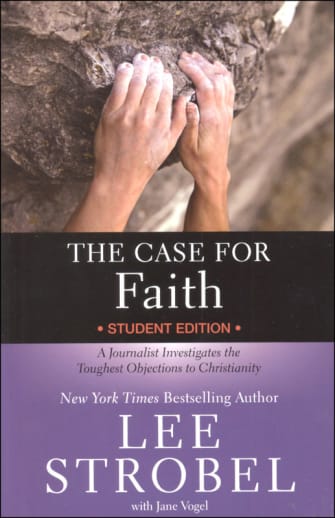
Publisher's Description of Case for Faith Student Edition
Why is there suffering? Doesn't science disprove miracles? What about hell—and the millions who've never heard of Jesus? Is heaven for real? Is God unjust? Lee Strobel decided to use his award-winning journalistic skills to investigate the idea of faith, and prove that placing our trust in things we cannot see is a solid bet. This updated The Case for Faith Student Edition adapts Strobel's bestselling The Case for Faith to present hard-hitting findings as well as interviews with believers and skeptics alike in an easy-to-follow manner so you can make a decision about Christian faith for yourself.
The Case for Faith Student Edition:
Is written for readers ages twelve and older
Presents the arguments for and against having faith that teens and young adults often ask and encounter so they can see the real evidence and facts
Uses logic and solid information to examine why Christians believe what they do
Can also be used in the classroom, in group studies, or as part of a religious studies or comparisons class
Contains infographics and charts to make the facts clearPairs well with The Case for Christ Student Edition, The Case for a Creator Student Edition, The Case for the Real Jesus Student Edition, and The Case for Miracles Student Edition
Lee Strobel's research provides:
Scientific data, expert testimonies, and interviews
Cross-religious comparisons
Historical and archeological proofs he discovered during his investigation
Prepare yourself for an eye-opening, no-punches-pulled investigation into eight of the toughest objections to Christianity. The answers will prove whether or not Jesus is who he says he is and if heaven is for real, leading you to a life-changing decision in your current case for or against Christianity. Even if you're an atheist or just aren't sure about Jesus, these stories will turn your whole world upside down. If you're already a Christian, you'll gain powerful insights that will reshape your understanding of the Bible and affect your life of faith like never before.
Lee Strobel was a skeptic — until he investigated the claims of Christianity. His scientifically and philosophically based, readable books highlight Christianity's truth, equipping believers to answer questions about their faith, and presenting non-Christians with valid reasons for believing. Each of these versions are written specifically to address children's needs, while analyzing evidence and building compelling cases using historical facts, up-to-date scientific research, and true stories. Newly added, the Young Readers edition presents the evidence of Jesus to kids ages 8-12 (sturdy hardcover edition). Approx. 90 pgs.